Friday, April 26, 2013

Jose Ramon Lerma at ArtZone 461. A 60-year retrospective


Lerma's paintings and collages, now on view at ArtZone 461, contain all the various threads of 60 years of art making in the Bay Area, including Abstract Expressionism, Funk Pop, and Conceptualism. The show is a slice of art history but it is also a tribute to the son of migrant workers who managed to live the life of an artist without compromising his integrity.

 Born in Hollister in 1930, Lerma was a long time Californian, a Chicano and the first in his family to attend college.

His 4th grade teacher was the first to recognize his talent and from then on, he painted constantly, copying Renaissance art from 10-cent books. Later, in 1949, another teacher helped him to get a scholarship to the California School of Fine Arts  (now SFAI).


The Korean War interrupted his schooling but when he returned to San Francisco, he continued his studies, studying under such Bay Area notables as Hassel Smith, Edward Corbett and James Budd Dixon.

The artist commented on his early years at the school as having, “…the most impact on my life and art.  The art world of the fifties was free of the market and its temptations.  There was a certain purity about it.”

He showed at the small galleries that came and went in the San Francisco of the 50’s – Sparas, the “Six” and even Ubu. He was part of a scene that included Alan Ginsberg's 1955's public reading of "Howl.' Lerma was part of the culture which valued making art over making a career as an artist.

“We were rebelling against some of the things that were going on in the city, “Lerma explains. “We wanted to be ourselves, to express things that were unique about the West Coast. We were not interested in following what was happening back East…It was a very spirited thing without much money... We were all outsider’s and we knew it, but we still wanted to show everybody what we were doing.”

Lerma lived the life of a Bohemian artist, painting as much as he could and not that interested in a career. At various times, he worked as a live-in baby sitter and later worked at Macy’s.  There he collected what would have been swept out the door – paper, fabric, and iconic images.

In the 70’s, he developed an allergy to oil paints and began making collages, constructions and the occasional installation. Some of the more interesting pieces in the show are his construction/collages, made from bits of yardstick and other building material from long lost SF landmark businesses such as Goodman Lumber.

Lerma experimented fearlessly across genres and avoided categorization.  The retrospective shows a representative example of his work but the show is confusing because the works are not all hung chronologically. The strongest visual piece in the show is a figure drawing in black and white while his collages and assemblages reveal a quirky, questioning look at American icons such as Mickey Mouse and art goddess Frieda Kahlo. The abstract pieces are less successful, showing but not integrating influences as widely diverse as Jackson Pollock’s drip pieces and the stylized Zen landscapes of Mt. Tam. According to gallery owner, Steve Lopez, their matt surface is due to the use of inexpensive oil paint, a frugal choice made necessary by Lerma's finances.


Lerma’s fierce independence and refusal to play the art game have impacted his visibility. He lived his life as a seeker after his own truth, not looking for financial security or career success. He lived without compromising his principles and has never regretted it. For that reason alone, his art is worth recognizing and respecting. If Diaogenes were alive today and looking for an honest man, he would recognize a kindred spirit in José Ramón Lerma. (all images courtesy of the gallery).

http://artzone461.com/gallery_/home.html

http://www.examiner.com/list/jos-ram-n-lerma-at-artzone-461-a-60-year-retrospective

Tuesday, April 16, 2013

Isabelle de Borchgrave at Serge Sorokko, Suhas Bhujbal at Dolby Chadwick:

Belgian artist Isabelle de Borchgrave, whose "Pulp Fashion" exhibition of historical gowns made of paper was the Fine Arts Museums most-attended show in 2011 is back in San Francisco with a smaller show of Fortuny pleated dresses, textile-like paintings and new bronze clothing sculptures at the Serge Sorokko Gallery.

Isabelle de Borchgrave began her studies at the age of 14 at the Centre des Arts Décoratifs in Brussels.  She went on to establish her own studio designing dresses, jewelry, and accessories, and later specialized in designing fabrics. Following a 1994 visit to the Metropolitan Museum of Art, in New York, she dreamed up the idea of paper costumes, for which she has become world renowned. 

Isabelle de Borchgrave: "New Paintings and Sculptures" is a departure from the work shown at the Legion. Instead of the monochromatic palate of the earlier show, the works at Sorokko feature pieces in vibrant colors, tribal patterns, and ethnic textiles

Borchgrave. Petite Chapeau
Works on paper are meticulously hand painted with bold patterns and then folded into an origami-like, accordion-style canvas. Elaborately painted life-size kimonos pose across from de Borchgrave's paper pleated Grecian dresses modeled after Fortuny's famous pleated silk Delphos gowns. And across from those fragile forms are dense corsets of worn patinas. Small scale sculptures of jewelry-like neckpieces are juxtaposed with larger-scale bronze works.

In de Borchgrave's art, the starting point is almost always the same: sheets of paper one meter by one and a half meters (3.3 feet by 4.9 feet), which she sets to work on with her brushes and paints on an enormous linen-covered table in her studio in Brussels. "Her colors, reports The New York Times, "are very much inspired by her travels: reds from the roses of Turkey, earth hues from Egypt, blues from Greece...Borchgrave produces astonishing effects of scintillating color, weight, transparency and texture. Her renderings of diaphanous gauzes are especially astonishing."

The exhibit is an expertly curated display of the artist's range and unique ability to transform a common medium into the otherworldly. Givenchy puts it beautifully, "Isabelle is one of a kind. She plays with paper as a virtuoso plays an instrument."

Best of all for those with a bit of spare change -you can now buy the dresses at a mere $45,000 per item.

Exhibit on view through Sat. April 20 at Serge Sorokko Gallery, 55 Geary St., sorokko.com

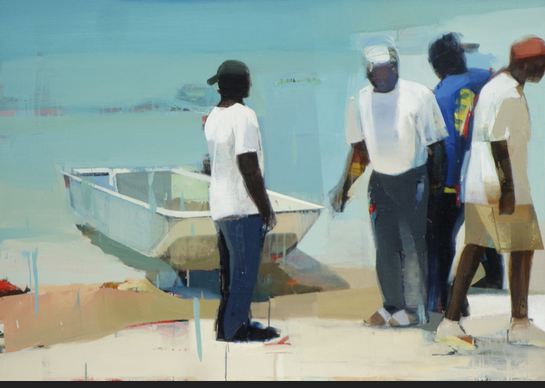
Suhas Bhujbal at Dolby Chadwick: The Indian born artist, more known for his geometric compositions, has new work which fuses his previous fascination with urban landscape with luminous figurative works.

 Bhujbal. Getting Ready for the Day

During a 2011 trip to Cat Island in the central Bahamas, artist Suhas Bhujbal found something he craved: peace and quiet. The island's lifestyle -- one in which people gather on the beach and enjoy each other's company -- reminded him of his childhood in India. "I appreciate the simplicity in life," he comments. "I paint what I see, experience, and feel. It is really about falling in love in that moment and bringing that on the canvas in a visual form."

Bhujbal. Hanging Out.

 Suhas Bhujbal: "Dialogues" from 
April 4 -- 27, 2013
. Dolby Chadwick Gallery. 
10 Post Street
San Francisco. http://www.dolbychadwickgallery.com

http://www.examiner.com/list/isabelle-de-borchgrave-at-serge-sorokko-suhas-bhujbal-at-dolby-chadwick

Friday, April 5, 2013

Museum of Craft & Design reopens, Misrach's 'Cancer Alley' at the Cantor

After losing their space in 2010, the Museum of Craft and Design has finally found a new home in the old American Can Company factory on the edge of Dogpatch, San Francisco's latest trendy district. The public opening kicks off tomorrow, Saturday April 6, 2013, with a community celebration of the new museum and inaugural exhibits.
The new location is at 2569 Third Street in San Francisco. For more information, go to sfmcd.org.

At the Cantor: Revisiting the South: Richard Misrach’s "Cancer Alley"

Like the Western landscapes for which Misrach is best known, these photographs challenge viewers with environmental, political and social concerns while engaging them with evocative and lyrically beautiful large-scale prints. In focusing on the delicate state of the Mississippi River, Misrach signals not just the environmental challenges facing the South but also the larger costs of our modern world at the dawn of the 21st century. His photographs are a stark commentary on the concentration of petrochemical complexes located along this 100-mile stretch of the Mississippi River.

For the 85 miles between Baton Rouge and New Orleans, the haunting swamplands of the Mississippi River corridor—called America’s wetland for its biological value to the nation—bump up against the sprawling refineries and paraphernalia of the petrochemical industry. Industry leaders call this stretch of the Mississippi, sandwiched between 150-plus oil and gas plants on both sides of its devastated banks, Chemical Corridor. But locals—who blame the millions of pounds of toxic chemicals pouring out of industry smokestacks every year for high rates of miscarriages, cancer, respiratory ailments and other serious diseases—have another name for it. They call it Cancer Alley.

Looking through Misrach’s lens, the viewer comes to realize that Cancer Alley’s industrial corridor—which produces almost one-third of America’s gasoline, plastics and other chemicals—is generating a lethal combination of pollutants that is quietly deteriorating local communities and watersheds, leaving behind only cryptic relics of what was once a richly diversified past.

Hazardous Waste Containment Site, Dow Chemical Corporation, Mississippi River, Plaquemine, Louisiana, negative 1998, print 2012

But his images do more than hint at pollution and death: The petrochemical industry reveals itself as an omnipresent and brazen specter through the photographs’ rusted pipelines, mammoth tankers and tangles of steel, concrete and smokestacks belching noxious fumes and toxins into the air and water.

The exhibition “Revisiting the South: Richard Misrach’s Cancer Alley” highlights the severe environmental degradation of the Mississippi River corridor from Baton Rouge to New Orleans. The show, which includes 19 large-scale color photographs and 14 contact sheets, is on view from March 27 to June 16, 2013 at the Cantor Arts Center, Stanford.

http://www.examiner.com/article/museum-of-craft-and-design-reopens-misrach-s-cancer-alley-at-the-cantor?CID=examiner_alerts_article

Sunday, March 24, 2013

The week ahead: Modernism, Walt Disney, RayKo Photography Center Show


Kraemer's work, now up at Modernism, is stunning. The range of work in the current exhibition dates from 1993 to 2013, with the older work just as fresh as the current batch. The exhibition announcement features “This Much,” a large (74” x 95 ½”) breakthrough work in pastel, acrylic and charcoal on paper from 1993.


The "Snow White and the Seven Dwarfs" show at the Disney Museum was more interesting that I thought it would be. I think that "Peter Pan" was the first cartoon that I remember seeing, which lead to some interesting experiments in thinking that I could fly. Hey, I was only 7. But the show was a revelation to see how skillful and detailed the early cartoons were.

http://www.examiner.com/article/the-week-ahead-modernism-walt-disney-rayko-photo-centerhttp://www.examiner.com/article/the-week-ahead-modernism-

Thursday, March 21, 2013

Drop In Jazz

Sometimes you just want to sit down and listen to live jazz. Starting at 6:30PM many nights, you can drop in and listen to student jazz concerts at The Jazz School in Berkeley.
The basement concert room of the school is adjacent to the Jazz Cafe, about a half block from the Addison/Shattuck exit of the Berkeley BART station, right near Berkeley Rep.
The night I was there, I enjoyed hearing a piano player accompanying a procession of young jazz singers. I left during the set break, after which a jazz ensemble was to perform.
Most nights are free, including a special event this Sunday, Jazz Search West 2013 talent search.

Posted by Phil Gravitt

Wednesday, March 20, 2013

The FBI has new leads on the 1990 robbery at the Isabella Stewart Gardner Museum


Govaert Flinck’s Landscape with an Obelisk (1638)

On Monday, March 18, the art world was galvanized by the information that the FBI has  identified the perpetrators in the $500 million art heist at the Isabella Stewart Gardner Museum in 1990. Investigators have long been baffled for decades over the theft.

In the early morning hours of March 18, 1990 the robbers entered the museum and tied up two night watchmen. Once in, they roamed the galleries with impunity, picking off the cream of the fabulous collection. The robbery was not discovered until the next morning. 
 Rembrandt’s Storm on the Sea of Galilee (1633)

The stolen works include: Rembrandt’s Storm on the Sea of Galilee (1633), A Lady and Gentleman in Black (1633) and a Self Portrait (1634), an etching on paper; Vermeer’s The Concert (1658–1660); and Govaert Flinck’s Landscape with an Obelisk (1638); and a Chinese vase or Ku, all taken from the Dutch Room on the second floor. Also stolen from the second floor were five works on paper by the Impressionist artist Edgar Degas and a finial from the top of a pole support for a Napoleonic silk flag, both from the Short Gallery. Edouard Manet’s Chez Tortoni (1878–1880) was taken from the Blue Room on the first floor.

A decade ago, an attempt was made to sell some of the 13 artworks, including three Rembrandts, a Vermeer, a portrait by Edouard Manet, and sketches by Renoir. But the location of the stolen masterworks is still unknown.

 Vermeer’s The Concert (1658–1660)

Richard DesDesLauriers, special agent in charge of the Boston office of the FBI, said that "the probe “accelerated” in 2010 and “crucial pieces of evidence” were developed identifying the robbers and their associates.

“The FBI believes with a high degree of confidence in the years after the theft the art was transported to Connecticut and the Philadelphia region and some of the art was taken to Philadelphia where it was offered for sale by those responsible for the theft. With that confidence, we have identified the thieves, who are members of a criminal organization with a base in the mid-Atlantic states and New England,” stated DesLauriers,

DesLauriers added that because the investigation is continuing it would be “imprudent” to disclose their names or the name of the criminal organization. He said the probe was in its “final chapter.”

Officials are seeking help from the public and will be launching a massive public awareness campaign that will stretch beyond New England. Among the exposure tactics will be a dedicated FBI website, video postings on FBI social media sites, digital billboards, and a podcast. To view and listen to these items, visit the FBI’s new webpage about the theft: www.FBI.gov/gardner.


 There is a $5 million reward for information on the whereabouts of the missing art. The statute of limitations has run out on the robbers, and they might be granted immunity for other charges, such as possessing the stolen paintings.
 
Arts journalist Lee Rosenbaum, who writes the art blog "Culture Grrl" added further details about Boston Globe reporter Milton Valencia‘s Twitter feed from the news conference. His tweets suggests that the hunt may be moving to Philadelphia.

Special Agent Geoffrey Kelly, who is the lead investigator in the case nd a member of the Art Crime Team. “In the past, people who realize they are in possession of stolen art have returned the art in a variety of ways, including through third parties, attorneys, and anonymously leaving items in churches or at police stations.”

If you have a tip, call : 1-800-CALL-FBI (1-800-225-5324). Or you can go to this website: https://tips.fbi.gov. In addition, the press release gives you permission to “contact…the museum directly or through a third party.” Isabella Stewart Gardner Museum.

http://www.examiner.com/list/the-fbi-provides-new-information-on-the-1990-isabella-stewart-gardner-art-heist

Friday, March 15, 2013

Weekend Picks for March 15 - 17


Yemen "apartment house." @ Naftali Hilger

Jewish Community Center of San Francisco: Jews of Yemen; photographs by Naftali Hilger. Israeli photojournalist Naftali Hilger’s photos of the Jews of Yemen takes us into a world of ancient traditions. One of the few outsiders allowed within the community, he returned six times between 1986 and 2008. Hilger, who will host a gallery tour and talk on March 19th, presents this ancient world in all its elegance and spare grace.

 @ Naftali Hilger

Women cook over wood stoves in rooms with white washed walls, a boy studies the Torah with an elder-images of a world lost in time and threated by contemporary Islamic politics. Most of the images are domestic but one stands out – a photo of a man standing by a rock in the desert close to Saudi Arabia. According to the caption, Jews who left the area in the past 130 years wrote their names on the rock before leaving their country.

Where: Katz Snyder Gallery, Jewish Community Center, 3200 California St., S.F.
When: 8 a.m. to 10 p.m. Mondays-Thursdays, 8 a.m. to 6 p.m. Fridays-Sundays; closes April  30 Admission: Free. Contact: www.jccsf.org
Note: Hilger will lead a gallery tour and lecture at 7 p.m. March 19.

Ampersand by Max Rippon. 

White Walls: “Cut from the Chase” Barcelona-based artist Max “Ripe” Rippon continues to explore typography, calligraphy and hand painting in his new exhibition, “Cut From The Chase.” The works contain ink, spray paint, watercolor and one-shot enamel on paper.  While street signage, calligraphy and graffiti are influences, Rippon offers a new look on lettering. White Walls. 868 Geary St, SF. http://www.whitewallssf.com/
 

What do indoor clouds, Google Street View and Dutch masterworks have in common? Find out at a unique evening event hosted by the SFAC Galleries in conjunction with its current exhibition Conversation 6. The SFAC Galleries brings together the de Young Museum’s special exhibition Girl with a Pearl Earring: Dutch Paintings from the Mauritshuis assistant curator Melissa Buron of the Fine Arts Museums of San Francisco, and renowned photographer Doug Rickard to expand the dialogue around the exhibited works of Dutch installation artists Bernadnaut Smilde, who will be visiting from Amsterdam.

Moderated by Galleries Director and exhibition curator Meg Shiffler, the panel will draw conversational threads that will enliven a broad discussion around major themes such as documentation, site, ephemerality vs. permanence, and “truth” in image making. This program is made possible through the generous support of the Graue Family Foundation.

When: Wednesday, March 20th, 6-7:30 p.m. . Where: Koret Auditorium, SF Library, Main Branch, 100 Larkin Street, lower level. S.F. Arts Commission Gallery. 401 Van Ness Ave. http://www.sfartscommission.org/

http://www.examiner.com/list/weekend-picks-for-march-15-17

Monday, March 11, 2013

Gary Winogrand at SFMOMA


 When Gary Winogrand died at age 56 of gall bladder cancer, he was considered one of the greatest documentary photographers of his era. A native New Yorker, he walked the length and breadth of America's streets, taking what seemed to be casual snapshots of people going about their daily business.

Garry Winogrand (14 January 1928, New York City – 19 March 1984, Tijuana, Mexico) was a street photographer known for his portrayal of America in the mid-20th century. John Szarkowski called him the central photographer of his generation.

But the bulk of his work was unknown. That is not to say he was unknown or unappreciated. By the time of his death in 1984, he had a Guggenheim fellowship, was featured in Edward Steichen's classic "Family of Man" exhibition at the Museum of Modern Art, and later figured prominently in two major photography shows, also at MoMA, curated by Steichen's successor John Szarkowski, one of Winogrand's early champions.

New York. 1962
In 1964, with the support of the first of three Guggenheim fellowships, he traveled for four months to fourteen states and recorded an America in transition. By photographing people indirectly through car windshields, he caught an American in uneasy transition between eras.

At the time, Winogrand tapped into the tumultuous zeitgeist of the 1960's, an era soon to come to a roiling boil. He applied for his grant in the early 60s, at the height of the Cuban missile crisis, when nuclear war suddenly had become a terrifying possibility.

In his grant application Winogrand complained that the mass media "all deal in illusions and fantasies. I can only conclude that we have lost ourselves and that the bomb may finish the job permanently, and it just doesn't matter, we have not loved life.  I look at the pictures I have done up to now," he wrote in 1963, "and they make me feel that who we are and what we feel and what is to become of us just doesn't matter. I cannot accept my conclusions, and so I must continue this photographic investigation further and further."

Coney Island, 1952
But the bulk of his output, his enormous output, was unknown. At his death, Winogrand left behind 2500 undeveloped rolls of 36-exposure 35mm film (mostly Tri-X), 6,500 rolls of film that had been developed but not contact-printed–not to mention 300 apparently untouched, unedited 35mm contact sheets.

Guest curator Leo Rubinfien, an old friend and student, along with Erin O'Toole, a curator at San Francisco's Museum of Modern Art, and Sarah Greenough, senior curator of photographs at the National Gallery of Art, have mined this treasure trove to produce the first major Winogrand retrospective in almost three decades. The show took the three curators three years to put together, because those 6,500 undeveloped rolls were bolstered by 4,100 rolls that Winogrand had processed but not transferred to contact sheets, for a total of nearly 400,000 unknown images.

LA, Venice Beach. 1980-84
The touring exhibit which opened at the San Francisco Museum of Modern Art this week, and accompanying catalog, consist of more than 400 images derived largely from Winogrand's later days roaming the streets of Los Angeles with his Leicas. While he may be best known for his New York City scenes, these photos prove that Winogrand had an astute eye for images that illuminated America's increasingly troubled society.

Winogrand gives us no answers. But he wasn't looking for answers. "The fact that photographs — they’re mute, they don’t have any narrative ability at all. You know what something looks like, but you don’t know what’s happening, you don’t know whether the hat’s being held or is it being put on her head or taken off her head. From the photograph, you don’t know that. A piece of time and space is well described. But not what is happening." (interview with Bill Moyers, WNET, 1982)

One thing is clear - the era of "Mad Men" was much more perplexing and unhappy than the world deified on TV by Don Draper and his chauvinist, cigarette puffing cohorts.

The massive exhibit is overwhelming, which is fitting given how prolific Winogrand was. The show is organized in a loosely linear fashion: "Down From the Bronx" (earlier work shot primarily while he was living in New York), "A Student of America" (his work from the mid-'60s through the '70s, from all over America), and finally "Boom and Bust" (mostly shot in Southern California, and much of which has never been viewed).

Hanging on the walls, intermingled with his photos, are Winogrand's original contact sheets, pieces of this three Guggenheim Fellowship applications, letters to his daughters, and other personal artifacts.

The final summation, if one can make a final summary of such a prolific photographer, was encapsulated by John Szarkowski, in his book on Winogrand, “Fragments from the Real World.” (MoMA, 1984).

New York. Opera. 1952
 "When we consider the heedless daring of his successes and his failures we become impatient with tidy answers to easy questions, and with the neat competence of much of what now passes for ambitious photography. Winogrand has given us a body of work that provides a new clue to what photography might become, a body of work that remains dense, troubling, unfinished, and profoundly challenging. The significance of that work will be thought by some to reside in matters of style or technique or philosophical posture. There is no original harm in this misunderstanding, and useful work may come of it, but it will have little to do with the work of Garry Winogrand, whose ambition was not to make good pictures, but through photography to know life."

http://www.examiner.com/list/gary-winogrand-at-sfmoma

All images courtesy of SFMOMA: Barry Winogrand Archive, Center for Creative Photography, University of Arizona; © The Estate of Garry Winogrand, courtesy Fraenkel Gallery, San Francisco

Source: http://www.sfmoma.org/exhib_events/exhibitions/452#ixzz2NHIHUBRd San Francisco Museum of Modern Art
http://www.sfmoma.org/

Thursday, March 7, 2013

Weekend Picks for March 8th - 10th

Hooch, Harlots, & History: Vice in San Francisco at The Old Mint: The San Francisco Historical Society hosts an historical presentation of the wilder side of the Baghdad on the Bay, featuring Duggan McDonnell, "Broke Ass" Stuart Schuffman, Woody LaBounty, and Laureano Faedi.

 From: http://lenacorazon.com/2011/07/31/row80-lady-criminals-of-19th-century-san-francisco/

Before San Francisco was the jewel of the West, it was a hard-drinking, hard-fighting dirty town. This historical recreation will feature rare archival footage of the vice side of San francisco, live music, food and one complimentary drink included with admission. Additional drinks available with $5 donation to the San Francisco Museum & Historical Society.

The Old Mint. 88 5th St, San Francisco, CA 94103

Chaotic fragments of color and texture define their own internal rhythm in the mixed-media images of Southern California artist Allison Renshaw. Her first Bay Area solo show, "Better Than Candy," features her recent work on a theme of convergence. As in our day-to-day reality, genres, cultures and styles collide, and new stories emerge. Through April 6. Mirus Gallery, 540 Howard St., S.F. (415) 543-3440. www.mirusgallery.com.

At the de Young Museum: Eye Level in Iraq: Photographs by Kael Alford and Thorne Anderson

Thorne Anderson, Thawra, Baghdad, Iraq, April 18, 2003. Digital inkjet print. High Museum of Art, Atlanta. © Thorne Anderson
This exhibition presents the photographs of Kael Alford (American, b. 1971) and Thorne Anderson (American, b. 1966), two American-trained photo journalists who documented the impact and aftermath of the US-led allied invasion of Iraq in 2003. They made these photographs during a two-year span that began in the months leading up to the allied invasion in spring 2003 and covers the emergence of the armed militias that challenged the allied forces and later the new central Iraqi government.

The photographs were made outside the confines of the U.S. military’s embedded journalist program, in an attempt to get closer to the daily realities of Iraqi citizens. The photographers wanted to show Iraq from an important and often neglected point of view. This shift in physical perspective placed them in great danger, but they sought to learn how the war, and the seismic political and cultural shifts that accompanied it, were affecting ordinary people.

Baghdad fell to the allied forces on April 9, 2003. A decade later, reflecting on why this work was made, Kael Alford has stated “I consider these photographs invitations to the viewer to learn more, to explore the relationships between public policy objectives and their real world execution and to consider the legacies of human grief, anger, mistrust and dismay that surely follow violent conflict. I hope that these images will also open a window on the grace of Iraq and perhaps help to give a few of these memories a place to rest.”

http://deyoung.famsf.org/

Friday, February 1, 2013

Busy, Busy, Busy


Carel Fabritius. The Goldfinch. 1634. Oil on panel. Mauritshuis, the Hague, Netherlands

Art saves lives and it certainly continues to enrich mine. The Double Dutch show at the de Young is the most spectacular exhibit now in the Bay Area. Don't get me wrong. I don't mean that the works are bold, loud or gaudy.

No, this kind of work is work that you need to be able to stop and look at, take in, think about. A couple of friends of mine have gone and so far, the crowds haven't been impossible. I hope they remain so for the opportunity to see so many old masters in our city won't come again. If you have money to travel to Holland and see them in the museum once their restorations are finished, good for you. But most of us don't have that kind of money so this is a once in a life time event.

http://www.examiner.com/article/girl-with-a-pearl-earring-paintings-from-the-mauritshuis-at-the-de-young


René Magritte. The Listening Room (La Chambre d'Écoute, 1952

Weekend Recommendations: I haven't been able to get over to Berkeley to see the show on 'Silence" but it's high on my list of "must do things." All of the shows at the BAM have been intellectually challenging. I may not always like them but I appreciate what the museum does with limited resources but unlimited creative imagination.


Dorothea Tanning has long been a favorite of mine and even more so since she was both a painter and a poet, something that I aspire to.

http://www.examiner.com/article/late-nights-at-the-bam-pfa-silence-studio-glass-and-dorothea-tanning
Pieces from Matisse's "Jazz" come to Monterey. Now here is an artist that I find continually inspiring. At the age of 71, he recovers from cancer surgery and proceeds to invent a new art form.

http://www.examiner.com/article/henri-matisse-improvisation-at-the-monterey-museum-of-art

Saturday, January 26, 2013

Thursday, November 29, 2012

The Richmond Arts Center Holdiay Festival

The Richmond Arts Center has everthing for your special holiday shopping - from art to textiles to custom made chocolate - and be sure to check out the silent auction. They have a custom made Vampire box for sale. Get that winning bid in!

Alexander James. Custom made vampire box. Wooden stake crosses - everything you need to deal with any inopportune fangers.

http://www.examiner.com/article/the-richmond-art-center-s-holiday-arts-festival

Monday, November 19, 2012

3 Fish by the Beach

Eric Rewitzer of 3 Fish Studios

3 Fish Studios recently moved from Dogpatch to my 'hood, the Outer Sunset - 4541 Irving Street (at 47th Ave). They took over an old grocery store space and have really made it work for them - it's so perfect as an art studio/gallery that you can't imagine it as anything else. After walking by several times and not finding them open, I lucked out today. Both Eric (the primary printmaker) and Annie (the primary painter) were there. They welcomed me and my nephew, Dylan, showed us around the place and made me an espresso. My first thought was "what a gorgeous, inspiring place for a couple of artists to work."

My next thought, was, "are these (Eric's prints) woodcuts or linocuts?" They have some characteristics of both, and they reminded me of Tom Killion's woodcut images of local landscapes. Eric talked about his admiration for Killion's work and his experimentation with color throughout the run, as well as second editions with recut color blocks.

Eric's imagery is pure, concentrated San Francisco: the bridges, the industrial waterfront, the skyline, the icons. Even the landscapes have an edgier feel. That's Eric at top, with a bridge print on the press and a couple of Godzilla in SF prints on the back wall. Annie's paintings cover the same territory, but with a painterly esthetic. Their prices are really affordable, for paintings, prints and classes.

They teach classes in the evening and have a flexible schedule in the studio. Drop by if you're in the neighborhood, or call for an appointment if you're coming just to see them.


3 Fish Studios
4541 Irving Street (at 47th Ave)
San Francisco, CA 94122
415-242-3474
http://www.3fishstudios.com/
hello@3fishstudios.com

Friday, November 2, 2012

Making Synchronicity out of Random Noise

Yesterday afternoon I visited the members' preview of the new 4th floor shows at SFMOMA: Jasper Johns, Jay DeFeo, and Rafael Lozano-Hemmer. In that order. The Jasper Johns show was nice. Colorful, tactile, fun - the etchings were great - I definitely want to get back to see those again. Body silhouettes with lots of numbers, letters, & patterns. The perfect visual appetizer. On my way through the "tunnel" to the DeFeo exhibit, I noticed a wild "sculpture" on the western deck - it looked like an antennae. (I forgot about it, but it came back to me later.)

The DeFeo show unfolds like Beethoven's Symphony No. 9. The first room is discordant, unfocused. Then structure appears, in her monumental canvas & paint period, and you know this is a unique, true force. In the third "movement" she stretches out, exploring photography, collage, form, and line; building on distant themes. Then emotion is unleashed in the fourth and final section. Some of them reminded me of Betty Theodore's work. "Spark of the Gods" shines from the final, small-in-size, paintings; completed right before she died. (The image here is her portrait of a wounded, dying pigeon, that she cared for in her own final days.) I reentered the world, still stunned, on the fourth floor landing.

The entrance to Rafael Lozano-Hemmer's installation, "Frequency and Volume" was in front of me, so I wandered in, to see a glass cubicle full of what appeared to be sound editing equipment and 18 transistor radios. OK, moving on . . . the next room was dark (black) except for a single white (projected light) wall. On moving into the room, I saw my own silhouette on the white wall. Thinking of Kara Walker, I started posing and creating shifting tableaux with the other occupants of the room. The seemingly random noises and words/numbers on our silhouettes suddenly snapped into alignment and I realized that I was a dial on a radio receiver - moving side to side changed the frequency and moving forward & back changed the volume. Each person occupied a different frequency band. Then I remembered the antenna I'd seen earlier. I kept going back to the "Space to Earth" frequency, rocking back and forth in an audible volume and thinking about the connections between these three shows.

Wednesday, October 24, 2012

Celestial Bodies: Serenity Series
UCSF Women's Health Center

Wednesday October 24, 2012
5:30PM to 7:30PM
Meet the featured artists:
Gala Sadurni, Janet Seifert, Jennifer Ewing, Jessica Anne Schwartz, Johnny Botts, Rosalie Z. Fanshel
Not Afraid - Jennifer Ewing

Sponsored by the UCSF National Center of Excellence in Women’s Health, each part in the series invites Bay Area artists to present a body of work that interprets the idea of ‘serenity’ in order to inspire relaxation, well-being and calm. This installment of the series features artists whose work investigates CELESTIAL BODIES as object, inspiration and environment. The exhibit includes work that focuses on planets, the sun, the moon, stars and galaxies, and includes astronomical associations and metaphors for extraterrestrial journeys. This is the final installment in a series of 4 exhibits that explore our environment as a metaphor for 'serenity'.
Since 2007, the 'Serenity' series is the San Francisco Bay Area's largest continuous exhibit focused on positive, healing and uplifting artwork.
Curator: Matt McKinley
Venue: UCSF Center of Excellence in Women's Health
Showing through Jan 15, 2013
Floors 3, 4, 5, 6 and 7
2356 Sutter St (x. Divisadero) SF, CA

Posted by Phil Gravitt