Showing posts with label Asian Art Museum. Show all posts

Saturday, October 8, 2016

Quick Saturday Museum Round-Up: Legion, De Young, Asian Art Museum, Kearny St. Workshop & Market St.


Legion of Honor ‏@legionofhonor Now open! Meet the Le Nains, a 17th century artistic trio of brothers who lived together, played together and painted together. http://leg.hn/yGXGF

Berkeley Art Museum and Pacific Film Archive ‏@BAMPFA
Happy Saturday! FamilyFare today consists of exploring the Berkeley Eye Exhibit & creating some fun art. http://ow.ly/rouG304HKoT

De Young Museum ‏@deyoungmuseum
Encourage exploration and creativity with one of our free family art-making sessions! http://dey.ng/DLge2

Ed Ruscha exhibit closes tomorrow https://deyoung.famsf.org/

Asian Art Museum ‏@asianartmuseum Get in on @AsiaWeekSF action with a trip to our "Mother-of-Pearl Lacquerware from Korea" show—now on view.

This afternoon: Kearny Street Workshop, the Bay Area’s hub for Asian Pacific American arts, presents APAture’s Performing Arts Showcase Featuring Sammay Dizon and a lineup of some of today's most exciting emerging artists from the San Francisco Bay Area. http://www.asianart.org/events/1046?starttime=1475884800

"While lollygagging up Market Street, stop and take a peek at the cool doohickeys and rad new structures along the way. The third annual Market Street Prototyping Festival is underway, happening on Market from the Embarcadero to Van Ness. "
http://sf.curbed.com/2016/10/7/13206230/market-street-prototyping-festival-2016

Saturday, March 5, 2016

Spring shows at the Asian Art Museum

"Pearls on a string" at the Asian Art Museum, San Francisco
"Pearls on a String: Artists, Patrons and Poets at the Great Islamic Courts." In May 2013, the National Endowment for the Humanities made a gift to the Walters Art Museum in Baltimore that underwrote an exhibition drawn in part from its collection of Islamic art and manuscripts. That exhibit has now traveled to San Francisco. In a journey spanning the 16th through 18th centuries, "Pearls on a String" takes viewers to through three Islamic capitals to answer the question "Who's behind the art?"

http://www.examiner.com/article/spring-shows-at-the-asian-art-museum

Friday, November 6, 2015

'Looking East: How Japan Inspired Monet, Van Gogh, and Other Western Artists' at the Asian Art Museum

Japanese portrayal of Commodore Matthew Perry’s gunship in Edo Harbor, 1853, block print, artist unknown
In 1853, Commander Perry famously forced Japan to end two centuries of self-imposed isolation and sign treaties opening its ports to trade with the Western powers. As Japanese prints, albums, and objects began to arrive in Europe and North America in unprecedented quantities, a craze for all things Japanese set in among collectors, artists, and designers.

Full review here: http://www.examiner.com/article/how-looking-east-inspired-western-artists?CID=examiner_alerts_article

A page from Random Sketches by Hokusai (Hokusai manga)
Whether it was used to pad a crate of porcelain is unproven, but it is certain that one of the fifteen volumes of "Random Sketches" by Hokusai (Hokusai manga) was in the possession of the well-known Paris-based printer Auguste Delâtre, who had it at his workshop by 1856. That year he showed it to the artist Félix Bracquemond, who was impressed enough to try to buy the book. Delâtre refused to sell and continued to show it to other artists for whom he printed.

 A year later Bracquemond purchased another copy for himself and, in addition to immediately incorporating some of Hokusai’s motifs in his own work, shared the images in the book with many of the artists in his circle, including Édouard Manet, Edgar Degas, and Whistler.

(left) Mary Cassatt, Woman Bathing, 1890–1891, color aquatint and drypoint; (right) Utagawa Hiroshige, Kinryuzan Temple in Asakusa, from the series, One Hundred Views of Famous Places in Edo (1856), color woodcut with ‘lacquer’ and embossing.
 Not long after, Japanese books and prints were much more easily found and obtained in Paris. Shortly after that, by the late 1850’smore , Western artists were discovering Japanese art and incorporating it into their work. The first discoveries led to admiration, then imitation, then innovation, then a true synthesis.

Known by the French term japonisme, the phenomenon created a radical shift in Western taste toward Japanese aesthetic principles. Japonisme played a prominent role in the major movements of Western art in the late nineteenth and early twentieth centuries, among them Impressionism, Post-Impressionism, and Art Nouveau, and influenced everything from architecture and furniture to book illustration and painting.

San Francisco’s Asian Art Museum surveys this sweeping development in the traveling exhibition "Looking East: How Japan Inspired Monet, Van Gogh, and Other Western Artists.”  This in-depth and richly rewarding traveling show is a loan from the Boston’s Museum of Fine Arts, which drew on its incredible collection of Asian art.

Comprised of more than 170 art works, the exhibit is organized into four themes: women, city life, nature and landscape. Within each theme, artworks from Japan are paired with American or European works to represent the West’s assimilation of new thematic and formal approaches. The Asian has also thoughtfully provided a complete time line of the transmission of art from East to West for those seeking a deeper understanding of this complex topic.

Carp banners in Kyoto, 1888, by Louis Dumoulin
The first works in the show make it very clear that while Western artists may have admired Japanese prints, they didn’t have a clue as to how to go about assimilating the work into existing styles. The elegance of simplicity, open space, irregular forms, the use of natural materials - in fact, the real essence of Japanese art went right over the heads by a number of the Western artists represented in the opening section of the exhibit. Louis Dumoulin’s “Carp banners in Kyoto (1888) is a heavy, heavily painted work not lightened up by the carp banners floating in the typical western 3-dimensional treatment of space.


Or, for instance, this inkwell by French artist Legrand which is described as, "Silver, partially gilded, decorated in champlevé, basse-taille, and cloisonné enamels, with cut out base supported on four cast turtles, enameled with geometric patterns, naturalistic scenes, and facsimile prints surrounding a sea with carp. Fitted with a drawer etched and parcel-gilt in three colors. Base supports four shaped letter racks in geometric patterns flanked by two rolling blotters topped with "shi-shi" dogs holding brocade balls. Removable central section has a vase-shaped pen holder decorated with female figures, plants, and field mice in kimonos, flanked by nesting boxes enameled in landscape and geometric motifs. Removable lids topped by a beetle and a wasp in gold and basse-taille enamel." Did they leave anything out?


Most of the decorative objects in the show have this same kind of over the top use of Japanese patterned design with the Victorian love of “more is better and even more is better yet.”


 Not all of the pairings work in terms of art-to-art direct inspiration - Mary Cassatt’s lovely painting of a mother and child owes as much to centuries of depictions of the Virgin Mary and Jesus as it does to Japanese prints of mothers and children. Van Gogh is known to have copied Japanese prints and even used their images in his work but his portrait of "Postman Joseph Roulin" is not an homage to Japanese art but pure, unadulterated Van Gogh. The section on women has more than its share of courtesans, both east and west. Both Japan's licensed pleasure quarters and 19th century European brothels and streetwalkers presented a lot of inspiration for those interested.

Where Western artists begin to integrate Japanese art into their own work is first apparent in the section on prints - Toulouse Lautrec’s “Little Casino” with it’s dancing figure separated by a diagonal block of black against white and Degas’ romping horses show the direct but integrated influence of Japanese prints.


In the print "Mary Cassatt at the Louvre: The Etruscan Gallery," Degas made use of several features that are unmistakably borrowed from Japanese prints by Harunobu, Utamaro, and Hokusai. Compositions with two figures, one standing and one sitting or kneeling, are common in Japanese prints. So is the geometric division of the background that, in Degas’ print, is created by a series of vertical and diagonal lines that render the room abstract. Perhaps the most obvious borrowing is the standing figure who leans on an umbrella; Degas took this directly from a sketch of a woman with a rearing horse in a volume of "Random Sketches by Hokusai," a book he would have studied for its depiction of the spontaneous, natural positions of figures, particularly women.


Where Western artists come into their own with an utterly unique synthesis of a multitude of influences is in the last gallery. The two Monet’s in the show are the best the city has seen in quite some time. Monet’s “Water Lily Pond”  with Its humpback footbridge arching over light-reflecting water is similar to the one seen in Hiroshige’s "Bamboo Yards, Kyôbashi Bridge." “Haystack” may owe their off center design to Japanese art but the impasto color and sheer beauty are again neither East nor West but solely Monet's own. Gauguin’s “Landscape with Two Breton Women”  uses  a Japanese influenced flat perspective but the bold, symbolic colors and symbolism are his unique hallmark, prefiguring his work in Tahiti. “I have never seen anything as beautiful as a tree” would be the theme song in the last gallery, where everyone from Munch to Gauguin to Behrens seem to be inspired by the vertical tree-trunk rhythms in one of Hokusai’s “Thirty-Six Views of Mount Fuji.”

It’s really immaterial if all the Western artists in the show were directly influenced by Japanese art. Enough were to create an innovative synthesis between east and west. Plan to spend a delightful day to take it all in. While the big names in Western artist such as Van Gogh and Monet are what most of us know, the lesser known artists and the wealth of Japanese art offers a wider, deeper and equally insightful perspective.

"Looking East" will be on view from Oct. 30, 2015–Feb. 7, 2016 with the exhibition's final weeks marking the start of the museum's 50th anniversary year in 2016.

Saturday, October 31, 2015

'Looking East' at the Asian Art Museum

From the subtle to the exuberantly gaudy.. so much wonderful work that you will need several visits to take it all in. A real review to come...


From the MFA Collections Catalog:
"Silver, partially gilded, decorated in champlevé, basse-taille, and cloisonné enamels, with cut out base supported on four cast turtles, enameled with geometric patterns, naturalistic scenes, and facsimile prints surrounding a sea with carp. Fitted with a drawer etched and parcel-gilt in three colors. Base supports four shaped letter racks in geometric patterns flanked by two rolling blotters topped with "shi-shi" dogs holding brocade balls. Removable central section has a vase-shaped pen holder decorated with female figures, plants, and field mice in kimonos, flanked by nesting boxes enameled in landscape and geometric motifs. Removable lids topped by a beetle and a wasp in gold and basse-taille enamel." Did they leave anything out? I don't think so, but I admire the Parisian exuberance here!

Sunday, October 4, 2015

A second look at "First Look" at the Asian

In August 2015, the Asian Art Museum launched its second summer exhibition of works from its recent contemporary art collection. The exhibition featured highlights and recent acquisitions in the Museum’s expanding contemporary art collection. Running until 11 October, the show marks the second time in 2015 that the Asian Art Museum is mounting a major display of contemporary art from its collection. The museum boasts a 180,000 strong collection, 1,100 of which are Asian contemporary artworks acquired in the past 15 years.

Allison Harding was the Guest Curator at the Asian Art Museum and the one who organized “First Look”. As she explained to the press:

"To truly understand the contemporary, you must understand the tradition from which it emerged. “First Look” embodies how tradition can inspire new works in the present and continue to impact contemporary life.”

The Asian Art Museum is not new to contemporary art exhibitions. The Museum has already held “28 Chinese” this summer, presenting 48 works by 28 Chinese artists organized by Miami’s Rubell Collection. Over the past 15 years, the Asian Art Museum has made a concentrated effort to include contemporary art in its exhibitions and acquisitions. They have organized two major contemporary art exhibitions – “Phantoms of Asia” (2012) and “Gorgeous” (2014) and number of exhibitions and installations including “Proximities” (2014), “Tetsuya Ishida: Saving the World with a Brushstroke” (2014-2015) and “Sanaz Mazinani: Threshold” (2015).

Many of the pieces, as skillful as they are, could be done by anybody, anywhere. For me, Asian art has such a magnificent past; I don't want to see that past thrown away for a generic modern "future." The best artists - well, those whose work I liked - combined cultural traditions with work that will prove timeless.


The Night of Perpetual Day, 2013
By Yang Yongliang (Chinese, b. 1980)
Four-channel HD video with sound, 8:32 min.
Acquisition made possible by Gorretti and Lawrence Lui, with additional funding from Richard Beleson, 2014.14

"The Night of Perpetual Day" combines Chinese painting traditions with new media techniques to construct an animated landscape exploring China’s rapid urban development. The artist’s process begins in the city, where he photographs the development of contemporary China that surrounds him. His images document the tensions of urbanization: progress and destruction, the grayness of the metropolis and the beauty of nature. He then digitally collages different photographs together and animates them to construct a landscape simultaneously futuristic and historic,
Interview with the artist at the Guardian


Vase, 1985
By Kim Yik-yung (Korean, b. 1935)
Porcelain with clear glaze
Gift of Dr. Phyllis A. Kempner and Dr. David D. Stein, 2015.22

Kim Yik-yung’s ceramics emphasize the whiteness of porcelain clay and the aesthetics of modern forms, overlapping the traditional and the contemporary. While studying in New York in the early 1960s, Kim went to a lecture by the influential British ceramic artist and teacher Bernard Leach and heard him say one should learn everything about ceramic art by studying Korea’s Joseon dynasty (1392–1910) whiteware ceramics. Since then, her goal has been to create unembellished porcelain forms with innovative surface treatments that convey the sense of serenity characteristic of traditional Korean ceramics.
My UFO by Yako Hoda

 At age sixteen Yako Hodo began six years of apprenticeship with three different bamboo masters before becoming an independent artist. Making only one or two exhibition pieces each year, he won numerous awards for his bamboo work, which transforms the strength and resiliency of bamboo into energetic, sculptural compositions. While "Wave Crest" and "Forest" suggest the beauty and movement of natural forms, "My UFO" offers the artist’s view of more alien terrain. 

Ended Season by Zheng Chongbin. Ink and acrylic on Xuan paper.


Tuesday, February 24, 2015

'Seduction: Japan's Floating World,' now open at the Asian Art Museum


“Seduction: Japan’s Floating World,” works from the John C. Webber collection, now open at theAsian, brings you all the glitz, glamour, drama, eroticism and entertainment of Edo Japan. Fifty works from ukiyo to kimonos to scrolls to objects d’ art allow us to enter this world of sex for sale - delightful, deceptive, decorative and for most of the women involved in the sex trade, exploitative and ultimately tragic. 

http://www.examiner.com/article/seduction-japan-s-floating-world-now-open-at-the-asian

Friday, January 2, 2015

Bay Area top ten art picks for 2014


 Vuillard from the "Intimate Impressions" show at the Legion


I am going over my articles for the year - I wrote a lot more than I thought I did and it's not all bad either. Some of the works, like the "Hagaddah" by Arthur Szyk, touched me deeply and others - like the "Masters of Fire" at the Legion - intrigued me. I was saddened by the lost of so many galleries and gladdened to find out that some -like Meridian and Roots - managed to survive eviction, find new spaces and continue on their mission. It's hard to limit the list to ten; the Cantor Arts Center at Stanford deserves a separate list for their shows on Robert Frank and Charleton Watkins as well as the new art spaces curated by DeWitt Cheng.

http://www.examiner.com/article/bay-area-top-ten-art-picks-for-2014


@Large: Ai Weiwei on Alcatraz. http://www.examiner.com/article/ai-weiwei-s-songs-of-freedom-on-alcatraz


Jackson Pollock

Joan Mitchell, Sunflowers

First on everybody's list is the new museum in Stanford:. http://www.examiner.com/article/the-anderson-collection-at-stanford-opens-to-the-public


My next choice for one of the most beautiful, spiritual, and ethical shows of the year was the Arthyr Szyk exhibit at the Contemporary Jewish Museum: http://www.examiner.com/article/arthur-szyk-and-the-art-of-the-haggadah


"Intimate Impressionism from the National Gallery of Art" at the Legion of Honor. http://www.examiner.com/article/weekend-picks-for-march-28-30


Tetsuya Ishida: Saving the World with a Brushstroke" at the Asian Art Museum.  http://www.examiner.com/article/bay-area-art-picks-for-november-14-20th


“Roads of Arabia” at the Asian Art Museum. On everybody’s top ten list, although it is equal parts archaeology and art history (censored to exclude the ancient Jewish and Christian communities in the Arabian peninsula before the rise of Islam). http://www.examiner.com/article/roads-of-arabia-explores-the-arabian-peninsula-s-ancient-past


"Masters of Fire" at the Legion of Honor. This was another show that is equal parts art and archaeology: http://www.examiner.com/article/masters-of-fire-at-the-legion-of-honor

 Zheng Chongbin

 Li Huayi

A real eye opener for me - Contemporary Chinese calligraphy married to modern art. The Chinese painters in this show - Li Huayi, Wang Tiande, Zheng Chongbin and Lu Chuntao come from such a long tradition of using ink and manipulating the brush to create art that that is such an integral part of Chinese culture that it is imprinted in their DNA. http://www.examiner.com/article/li-huayi-wang-tiande-zheng-chongbin-and-lu-chuntao-at-nanhai

Ursula O'Farrell

Women artists in the Bay Area: From the sidewalk, Mythos Gallery looks like just another nondescript storefront off busy Shadduck Avenue in Berkeley. But if the viewer takes a second look, he (or she) will see one of the most powerful – if smallest – exhibitions of women artists from the 1950’s through today. The exhibition at Mythos Gallery is the first of two to showcase women painters who arose out of the Abstract Expressionist and Figurative artistic movements of the 1950's. http://www.examiner.com/article/beauty-fierce-as-stars-groundbreaking-women-painters-at-mythos-gallery


Romare Bearden at Jenkins Johnson: http://www.examiner.com/article/storyteller-works-by-romare-bearden-at-jenkins-johnson

Tuesday, November 4, 2014

'Roads of Arabia' explores the Arabian peninsula's ancient past


A new exhibit "Roads of Arabia," now showing at the Asian Art Museum displays a treasure trove of the Arabian peninsula's largely unknown pre-Islamic past, some of which dates back to the beginnings of human history.The objects on display may radically transform our understanding of the history of that now barren wasteland, still largely closed to Westerners. Although the exhibit is not lacking in beauty, “Roads of Arabia” is an archaeological and historical exhibition, rather than an art show.

In 2009, Australian scholar David Kennedy used Google Earth to identify almost 2,000 unexplored archaeological sites. He was able to focus attention on the battle between the powerful Saudi Arabian clergy for the destruction of that heritage and the determination of the  Saudi Arabian monarchy to protect that inheritance.

more at: http://www.examiner.com/article/roads-of-arabia-explores-the-arabian-peninsula-s-ancient-past

Saturday, August 23, 2014

'From Two Arises Three," Korea Day and more at the Asian Art Museum


 The Tao gives birth to one
one gives birth to two
two gives birth to three
three gives birth to ten thousand things
—Laozi, Daode jing

 Sunday is KoreaDay at the Asian Art Museum and it's F R E E. Daylong extravaganza for all ages.

The 2nd floor galleries have two exhibits worth going out of the way to see. "From Two Arises Three" focuses on the work of two American contemporary artists working in uniquely Chinese styles: painter Arnold Chang and photographer Michael Cherney.

http://www.examiner.com/article/from-two-arises-three-korea-day-and-more-at-the-asian-art-museum

Wednesday, July 2, 2014

'Gorgeous' at the Asian Art Museum


 Summer gatherings in mountain villas, 1738, by Hua Yan (Chinese, 1682–1756). Set of twelve hanging scrolls; ink on gold-surfaced paper. 


SFMOMA is closed for renovation but continues to be present in the Bay Area's art world. Last week, they, in collaboration with the Asian Art Museum opened "Gorgeous," the museum equivalent of a summer movie. "Gorgeous" works like an arranged marriage, which is to say, sort of, kind of and not at all. More at:

http://www.examiner.com/article/gorgeous-at-the-asian-art-museum

Friday, March 28, 2014

Weekend Picks for March 28 - 30


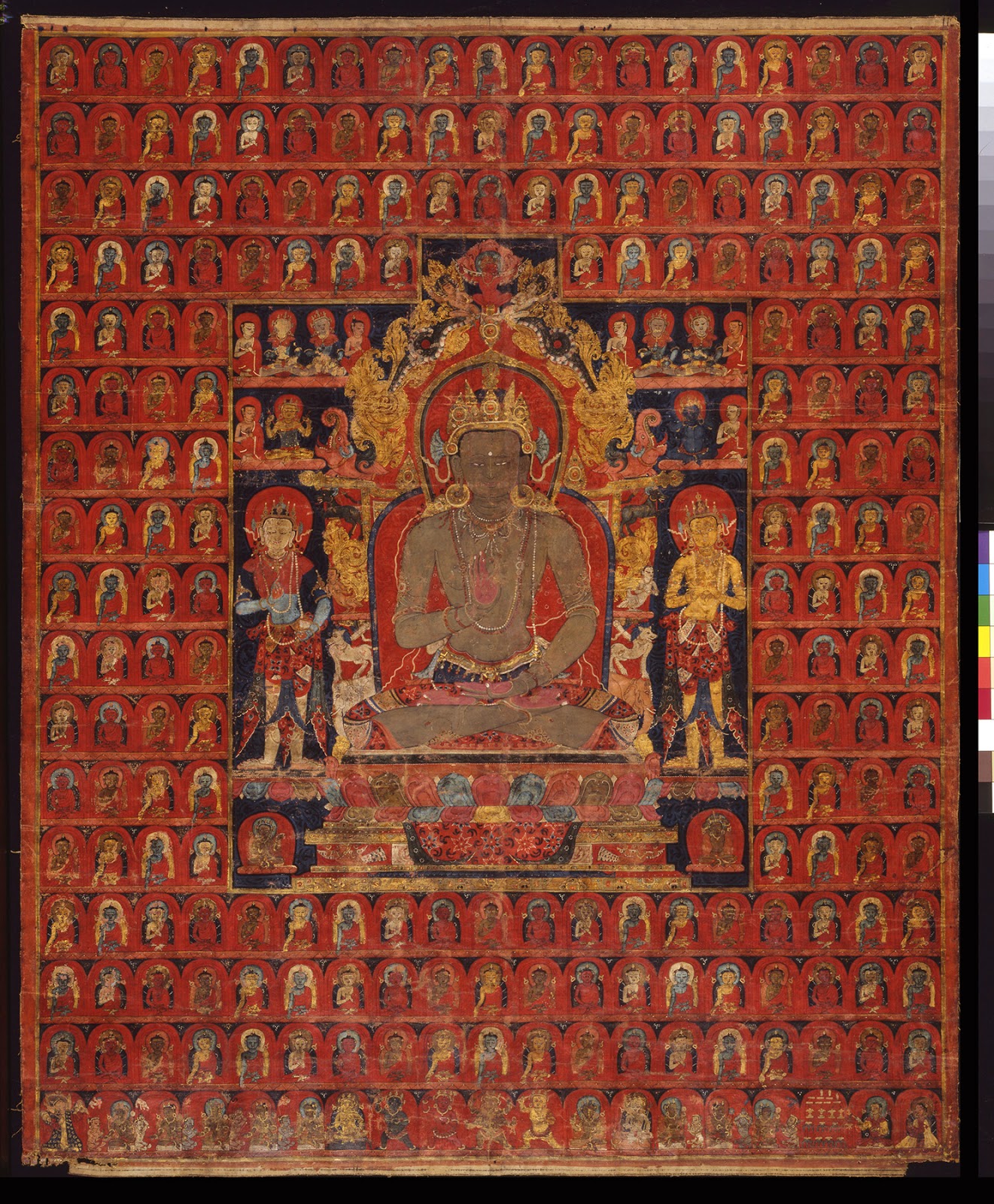
The cosmic Buddha Ratnasambhva, approx 1275 - 1350

Asian Art Museum: "Enter the Mandala" - a small but powerful exhibit of 14th-century Buddhist paintings which are aligned in a 2nd floor gallery with the cardinal directions.

 The cosmic Buddha Vairochana, Tibet, Approx 1100- 1250

The space is transformed into an architectural mandala. Those who walk the patterned floor have a chance to experience the images in three dimensions and to dwell in the midst of the cosmic symbols and be transported to another world.


 Impressionists and more at: http://www.examiner.com/article/weekend-picks-for-march-28-30

Thursday, March 13, 2014

Rudolf Bauer at Weinstein Gallery and more


I see that the works of Rudolf Bauer will be opening at Weinstein on March 15 - looks like a fascinating exhibit.
http://en.wikipedia.org/wiki/Rudolf_Bauer_%28artist%29

Realm of the Spirit runs March 15 to April 20 at Weinstein Gallery (383 Geary Street). Bauer runs March 18 to April 19 at the San Francisco Playhouse (450 Post Street).
Read more at http://www.7x7.com/arts-culture/hunt-slonem-s-iconic-rabbit-paintings-and-more-intriguing-art-openings#OF0fV4J23HUyZLMM.99

Bunnies at Sorokko Gallery, nightlife at the museums and Pi day:

http://www.examiner.com/article/the-rediscovery-of-rudolph-bauer-nightlife-at-the-museums-and-pi-day
Realm of the Spirit runs March 15 to April 20 at Weinstein Gallery (383 Geary Street). Bauer runs March 18 to April 19 at the San Francisco Playhouse (450 Post Street).
Read more at http://www.7x7.com/arts-culture/hunt-slonem-s-iconic-rabbit-paintings-and-more-intriguing-art-openings#OF0fV4J23HUyZLMM.99

Wednesday, February 26, 2014

'Yoga. The Art of Transformation' at the Asian

For most of us, the word “yoga” conjures up images of impossible body contortions, limited to the young, the limber and those fascinated by a certain image of India. Others, of a more spiritual bent, know yoga through the writings of Yogendra.

The current show, “Yoga and the Art of Transformation” shows how little we knew.

Gathered from 25 museums and private collections across the globe, the 135 artworks date from the 2nd to the 20th centuries. The exhibit debuted in October in Washington, D.C., at the Smithsonian Institution's Arthur M. Sackler Gallery.  But it had to come to California  - possibly the first place where yoga was taken seriously in the West.

http://www.examiner.com/article/yoga-the-art-of-transformation-at-the-asian-art-museum

Saturday, January 11, 2014

The week ahead. Asian Art Museum, Creativity Explored, Fouladi Projects, Mark Wolfe Gallery, ArtHaus


At the Asian: "In Grand Style" closes this Sunday (Jan 12). n 1795, King Jeongjo journeyed to his father's mausoleum in an elaborate mile-long procession of thousands of people. The king ordered court officials to meticulously document the occasion, resulting in the royal protocol––several volumes of books containing every detail. This is just one of the fascinating stories in the first major U.S. exhibition exploring the colorful celebrations of Korea's Joseon dynasty. The illustrious era is brought to life by 110 exquisite artworks from Korea, many of which are in the U.S. for the first time.

Through the art, “In Grand Style” explores four key themes: what it meant to be a king during the Joseon dynasty; royal processions and banquets; women at the royal court; and the lives and celebrations of the Joseon dynasty’s subjects.

The Joseon period has left a substantial legacy to modern Korea; much of modern Korean etiquette, cultural norms, societal attitudes towards current issues, and the modern Korean language and its dialects derive from the culture and traditions of Joseon. The exhibit is full of exquisite objects and gives the viewer a comprehensive look at the life lived by the elite

http://www.examiner.com/list/the-asian-art-museum-presents-grand-style-masterpieces-from-korea


Camille Holvoet at Creativity Explored: Camille Holvoet has worked at CE for 12 years making brightly-colored, desirous cakes, and cross-eyed smiling figures in oil pastels and other media. This past year, she created a series of astounding and provocative self-portraits. The background of these drawings include scrawled narrative text and blunt statements of the artist’s desires. While cheerful at first glance, these commanding graphic works also reveal Holvoet's experiences of living in mental institutions, frustrated sexuality, and vivid memories of childhood.

More at:  http://www.examiner.com/article/the-week-ahead-asian-art-museum-fouladi-mark-wolfe-gallery-arthaus