Friday, July 26, 2013

Friday Links


Donald Kinney's show comes down this weekend and I highly recommend that you get over to see it while you can. This is one of the best best photography shows that I have seen in a long time in one of the most beautiful libraries in the Bay Area. Donald poetic eye and feeling for the Northern California landscape needs to be seen to be fully appreciated.  Mill Valley Library, 375 Throckmorton, Lower Level
http://www.examiner.com/article/donald-kinney-exhibits-his-photographs-of-marin-county

Land artist Walter De Maria dies of stroke, aged 77

The “uncompromising” creator of The Lightning Field and The New York Earth Room shied away from the spotlight. He studied history and art at the University of California, Berkeley from 1953 to 1959. Trained as a painter, De Maria soon turned to sculpture and began using other media. De Maria and his friend, the avant-garde composer La Monte Young, participated in "Happenings." and theatrical productions in the San Francisco area. One of his Boxes for Meaningless Work (1961) is inscribed with the instructions, “Transfer things from one box to the next box back and forth, back and forth, etc. Be aware that what you are doing is meaningless.”

http://en.wikipedia.org/wiki/Walter_De_Maria

http://www.theartnewspaper.com/articles/Land-artist-Walter-De-Maria-dies-of-stroke-aged-/30150

The artist Andy Goldsworthy is creating a new work for the Presidio of San Francisco, the national park that was formerly a military base. The artist will hang a felled tree covered in cracked clay from the ceiling of a building within the park that was once used by the Army to store explosives.

According to the Presidio Trust’s website, Tree Fall will be “a fully reversible” work installed in the Powder Magazine building, “a small (25 feet by 30 feet) and currently inaccessible masonry structure”. “The gunpowder room would’ve been a fairly dangerous place to be, so [the work] will have that sense of caution to it,” Goldsworthy says. Due to be completed by the end of August, Tree Fall will be the artist’s third project in the park, following Spire, 2008, and Wood Line, 2011.

“What I find so fascinating about the Presidio is that, in the heart of this military machine, there was a huge planting programme,” Goldsworthy says, referring to the fact that the park’s 300-acre forest was planted by the US military between 1886 and 1900. “They had quite a sophisticated sense of landscape,” he says. “They read the landscape in the way that sculptors do—or at least the way I do.”

http://www.theartnewspaper.com/articles/Andy-Goldsworthy-to-make-third-work-for-San-Francisco-Presidio/30137

Amazon gets into the act and launches a virtual art gallery. http://www.theartnewspaper.com/articles/-Amazon-to-launch-virtual-art-gallery/29989

Another theft of art from a museum. Did somebody declare July "Art Theft Month" and not tell the rest of us? Thieves stole ten paintings from the Van Buuren Museum on the outskirts of Brussels on 16 July, including Kees van Dongen’s The Thinker, 1907, valued at more than €1m. What makes the loss particularly poignant is that the paintings came from a family collection, lovingly assembled by the Van Buurens.             
http://www.theartnewspaper.com/articles/Ten-paintings-stolen-from-Brussels-museum/30123 

The saga of the theft from the Dutch museum gets sadder and crazier - apparently it only took them 3 minutes to break in. And then, mommy dearest burned the art to protect her son. I guess that priceless art isn't so priceless when you don't have a buyer.
http://artdaily.com/news/63996/Three-minutes--pliers-all-spectacular-Dutch-art-heist-suspects-needed--prosecutors-#.UfKqrlOYUXw

Monday, July 22, 2013

Japanese Prints: Hokusai at the Los Angeles County Museum


 Thirty-six Views of Mount Fuji is an ukiyo-e series of large, color woodblock prints by the Japanese artist Katsushika Hokusai (1760–1849). The series depicts Mount Fuji in differing seasons and weather conditions from a variety of different places and distances. It actually consists of 46 prints created between 1826 and 1833. The first 36 were included in the original publication and, due to their popularity, ten more were added after the original publication.


While Hokusai's Thirty-six Views of Mount Fuji is the most famous ukiyo-e series to focus on Mount Fuji, there are several other series with the same subject, including Hiroshige's Thirty-six Views of Mount Fuji and Hokusai's own later series One Hundred Views of Mount Fuji.


Mount Fuji is a popular subject for Japanese art due to its cultural and religious significance. This belief can be traced to The Tale of the Bamboo Cutter, where a goddess deposits the elixir of life on the peak. As Henry Smith explains, "Thus from an early time, Mt. Fuji was seen as the source of the secret of immortality, a tradition that was at the heart of Hokusai's own obsession with the mountain."


And this is what he wrote about himself in his autobiography. It is the quintessence of his art philosophy:

"From the age of five I have had a mania for sketching the forms of things. From about the age of fifty I produced a number of designs, yet of all I drew prior to the age of seventy there is truly nothing of great note. At the age of seventy-two I finally apprehended something of the true quality of birds, animals, insects, fish and of the vital nature of grasses and trees. Therefore, at eighty I shall have made some progress, at ninety I shall have penetrated even further the deeper meaning of things, at one hundred I shall have become truly marvelous, and at one hundred and ten, each dot, each line shall surely possess a life of its own. I only beg that gentlemen of sufficiently long life take care to note the truth of my words."


Constantly seeking to produce better work, he apparently exclaimed on his deathbed, "If only Heaven will give me just another ten years... Just another five more years, then I could become a real painter." He died on May 10, 1849 and was buried in Tokyo. (images from Wikipedia as the LACMA site only had one image up).

http://www.examiner.com/article/japanese-prints-hokusai-at-the-los-angeles-museum-of-art

Friday, July 19, 2013

Weekend art picks for the frugal


http://www.examiner.com/article/bay-area-weekend-arts-on-the-cheap-july-19-21

Wednesday, July 10, 2013

Marcia Stein Textiles at SFBuLo

With SFMOMA closed until just before the new Bay Bridge section opens in three years, there isn't much else to do but visit SFBuLo, aka SF Building Lobbies.
The lobby at 201 California Street, at Front Street in the Financial District, has an intricate quilt exhibit by artist Marcia Stein, courtesy of William Torphy Fine Arts.
In her thin, simple looking quilts, Stein captures fine detail of the settings,depth, somehow even the mood and the weather.


Posted by Phil Gravitt

Sunday, July 7, 2013

Donald Kinney at the Mill Valley Public Library


 One of the best photographers in the Bay Area, if not California (!) will be showing a selection of his work at the Mill Valley Public Library. The reception is Tuesday and everybody who can attend, should attend.


Donald writes the photo blog "A Photo A Day" which is a daily hymn to the beauties of Northern California. His work is lyrical and insightful but with typical modest, he downplays just how beautiful it all is. He is able to capture the elusive ripples of water at his beloved Lagunitas Creek, the blanket of fog as it flows over the Northern California hills. His writing is as beautiful as his images.


When he was 16, Donald was able to meet the late, great Ansel Adams. He saw the photographer working in the Carmel area, followed him to where he was having breakfast but Donald was too shy to approach the man. However, he left a message on his windshield and Adams replied some days later. "A few days later
a postcard arrived in the mail--it read;  “Can’t decipher your signature, but sure, I’d love to see your photos--just give me a call when you want to come over”.


Let him tell you in his own words. "Somehow I got enough courage to call him, and about  an hour later I was sitting in his front room with him giving me pointers on how I could improve each image. Of course, my photography at that point was pathetic,  but it inspired me to read his books...A few months later I felt I had to show him my new attempts, so I re-invited myself to his home and after he
had looked through my new work he complimented me on how much I had improved.  The moment was probably the finest in all of my short sixteen years."


Like many of us, Donald was not independently wealthy and so, being able to follow his heart took many years. But he retired about ten years ago and ever since then, is up at 4 a.m., following the light, the sun, the fog, the panorama of nature that surrounds us in the Bay Area.


I think I began following his blog though his images of Lagunitas Creek. His ability to capture the color, the shape of ripples on water, the patterns, the subtle changes of light and weather were mesmerizing.


I believe that Donald subconsciously picks up the Japanese reverence for nature but another friend of mine, painter Dale Erickson sees the influence of 19th century landscape painters Kensett and Heade.


The show is packed into a small narrow hallway and in order to maximize this opportunity, Donald has framed the pieces into diptychs and triptychs. This does not work for me as I prefer fewer larger images. But it's understandable that he wants to give those who attend the exhibit a chance to see as many images as possible.


This piece won a prize a prize at the Marin County Fair, complete with a  $100 gift certificate given by "Digital Rain/Digital Image Magic" a local business here in San Rafael. Donald told me that some might think that the image was Photoshopped but it wasn't. He was in the right place at the right time - made possible by his dedication to getting out there and photographing every day

Donald: "I realize that many of you live at great distances, unable to attend the opening on Tuesday, so if you can't be here in the flesh I'll invite you to be here in Spirit. A bunch of friends; some whacky dudes and gals, and even some relatives I haven't seen for 10 years have said they will be stopping by. I still have people I need to invite, but consider yourself invited. RSVP not required. I'm going to bring wine for all of you alcoholics. "

http://aphotoaday.blogspot.com

http://www.photographingmarincounty.com/exhibit/index.html

all images @ Donald Kinney. Used with permission.

Saturday, July 6, 2013

Fiestas Frida


Creativity Explored artist Nita Hicks, known for her portraits of iconic women, painted an image of Frida Kahlo for display in the Somos Frida Community Day event on July 7, 2013.

See Nita's work along with several other artists' portrayal of the infamous Frida Kahlo during this one-day exhibition. The Somos Frida Community Day event also includes live performers and dancers, local artisans and vendors, face painting for youth, and a costume contest for the Best Frida, Fridita, Fridrag, Diego and Dieguito.

This one-day event and exhibition is part of Fiestas Frida, a yearly event celebrating the life of Frida Kahlo.
Somos Frida Community DaySunday, July 7, 2013
2:00 pm to 9:00 pm

The Women's Building
3543 18th Street, #8
San Francisco, CA 94110

http://www.examiner.com/article/somos-frida-community-day

Monday, July 1, 2013

'Folding Paper: The Infinite Possibilities of Origami' at the Crocker Art Museum


 "Folding Paper: The Infinite Possibilities of Origami" at the Crocker Art Museum is the first major exhibition to explore the rich tradition of paper folding, both in Japan and Europe.

“Folding Paper” is organized into four sections, beginning with The History of Origami. Paper was introduced to Japan via China around the 6th century AD and Japanese paper folding is assumed to have begun shortly afterward. Rooted in the ceremonial world, most notably in the native Shinto tradition, priests performed purification rituals using zigzag strips of folded white papers known as shide. Paper folding as a pastime arose under the Imperial Court of the Heian period (794-1185).

A little known European tradition of paper folding also existed, and after Japan adopted the German kindergarten system in the late 19th century, both Eastern and Western paper-folding techniques were incorporated into the Japanese curriculum as a method of developing children’s mathematical, artistic and manual skills. The two folding traditions combined to become known for the first time as “origami”—which translates to “folded paper.”

Michael LaFosse, Alexander Swallowtail. Butterfly

The second section, "Animals and Angels: Representations of Real and Imagined Realms, "illustrates the work of origami artists who create realistic and stylized representations of the natural and supernatural worlds. Many contemporary origami artists have transcended the traditional flat, angular representations of animals and humans and use specially made paper to enhance textural richness. Artist Eric Joisel and Michael LaFosse, in particular, have adopted the wet-folding technique—which enables the smoothing and rounding of points and angles—so skillfully that their figures appear chiseled rather than folded.
 Miyuki Kawamura

"Angles and Abstractions: Geometric Forms and Conceptual Constructions" highlights origami’s mathematical roots through modular objects and tessellations. Typically, modulars are geometric structures like the works of mathematician Tom Hull and artist Miyuki Kawamura, whose works are made up of many pieces of paper held together with friction and tension, but they can be as diverse as the twisted floral forms of Krystyna and Wojtek Burczyk and Heinz Strobl’s paper strip spheres.

The final section, "Inspirational Origami: Its Impact on Science, Industry, Fashion and Beyond," explores the transformative power of modern-day origami. Origami is not only used to explain and teach arithmetic and geometry, but computational origami employs algorithms and theory to solve complex problems. For example, Dr. Robert J. Lang is a scientist and mathematician who used computational origami to determine how to fold the lens for Lawrence Livermore National Laboratory’s Eyeglass Telescope so that it could be launched compactly and then re-opened in space. The resulting design used an origami structure he called the “Umbrella” after its resemblance in the furled state to a collapsible umbrella.

216 O Street. Sacramento, CA 95814. 916.808.7000. cam@crockerartmuseum.org

https://www.crockerartmuseum.org/  Through September 29.

At the Examiner.com: http://www.examiner.com/article/folding-paper-the-infinite-possibilities-of-origami-at-the-crocker-art-museum

Friday, June 28, 2013

'Beyond Belief' opens at the Contemporary Jewish Museum

Agnes Martin, Falling Blue, 1963; oil and graphite on canvas; 71 7/8 in. x 72 in. (182.56 cm x 182.88 cm).

Co-organized by the Contemporary Jewish Museum (CJM) and the San Francisco Museum of Modern Art (SFMOMA), Beyond Belief: 100 Years of the Spiritual in Modern Art is an expansive exhibition conceived as a journey into the connections between spirituality and modern and contemporary art. Spanning the years from 1911 to 2011, the exhibition features more than sixty works on loan from SFMOMA.

The exhibit benefits from the more intimate space; smaller works like those by Klee and Kandinsky have been lost in SFMOMA's larger galleries. But three pieces in particular - Philip Guston's"Red Sea; The Swell; Blue LIght," .Rothko's 'No 14" and  Teresite Fernandez, 'Fire" needed more space. Each piece needs a room by itself as each is so powerful. But, again, it may be the more intimate spaces at the CJM that make the viewer aware of the power of this art.

Teresita Fernández. Fire, 2005

"Beyond Belief" is divided into ten sections, organized under headings that examine widely held spiritual ideas, many of which closely parallel or are rooted in Jewish religious thought—such as the Bible’s original creation story and the bias against literal depictions of God.

The exhibition begins, aptly, with Genesis and wends its way through different sections that reveal how artists have addressed diverse spiritual ideas, such as the invisible presence of God, death, redemption, mystical writing, and the understanding of God as a divine architect.

In Tallus Mater (Madre Tallo/Stem Mother), Mendieta evokes the power of prehistoric fertility goddesses, especially those associated with Mayan and Native American spiritual systems. The ficus, or fig tree, roots with which Mendieta created this sculpture might allude to the Garden of Eden, a primary creation myth in Western monotheism.

Many rich religious stories are translated into complex and provocative works of art, some on display for the first time in years.

Helen Lundeberg’s mysterious painting Oracle—a Greek word meaning either a prophet or the physical shrine where a divine voice emanates—evokes a host of natural forms.

The show requires an open mind to other dimensions of spirituality. There is a lot of wall text and some have found the organization confusing, but a thoughtful and contemplative approach will allow the deeper meanings to emerge.

While perhaps the museum overreaches in their attempt to bring together the aesthetic and the spiritual, the presentation of artists who affirmed the transcendental in art yields much in the way of both enjoyment and enlightenment. In a decade which has seen art reduced to cow parts in formaldehyde, any attempt to break away from the crass commercialism and expensive emptiness is commendable.

The museum has created an interactive website to help visitors explore the exhibit in more depth: http://beyondbelief.thecjm.org

Contemporary Jewish Museum: 736 Mission Street (btwn. 3rd and 4th Streets), San Francisco, CA 94103 | Hours: Daily 11am–5pm, Thursdays 1–8pm, Closed Wednesdays | 415.655.7800 | info@thecjm.org

http://www.examiner.com/list/beyond-belief-opens-at-the-contemporary-jewish-museum

Sunday, June 23, 2013

The de Young's tribute to 'Richard Diebenkorn. The Berkeley Years...'

 Berkeley #22. 1954

"Richard Diebenkorn: The Berkeley Years: 1953-1966," which opened Saturday at the de Young Museum, is the first show to focus on the thirteen years that he spent in Berkeley between 1953 to 1966. The core of the show is the breakthrough work of this period, where Diebenkorn developed his working methods, important artistic themes and gained national recognition.

More than 130 paintings and drawings, beginning with the artist's earlier abstract works and moving through his subsequent figurative phase, display how he moved all his life between abstraction and representation.
http://www.examiner.com/list/de-young-s-tribute-to-richard-diebenkorn-the-berkeley-years-1953-1966

Thursday, June 20, 2013

'Introductions' at Creativity Explored, 'West of Center' at Mills College Art Center

 Marcus McClure, Watermarks. 
"Introductions" at Creativity Explored presents recent work by four young studio artists who represent a range of artistic styles, perspectives and subject matter in its new summer exhibition.

Kate Thompson, 24, expresses her vision in exquisitely detailed scenes using pen and ink on paper, one of which is licensed to the contemporary home furnishings store CB2 for an upcoming pillow design.

Marcus McClure, 29, creates exuberant layered abstracts in mixed media using predominantly circular and other geometric forms; CB2 also selected two of McClure’s works as the basis for past rug designs. 


Steven Liu. Cyclists.

With black marker on canvas, Steven Liu, 24, fluidly renders intricate scenes with people– all elaborately detailed and in a state of motion, reflecting his own active physical nature.

Keenan Dietiker, 23, specializes in abstract landscapes using mixed media on paper.

The four artists have all attended Creativity Explored for at least one year, and are still evolving in their practice.  “Each of these young artists incorporates a unique vision, approach and technique,” says Gallery Manager Amy Auerbach, co-curator of the exhibit. “We felt their combined pieces offer an intriguing spectrum of work, from very abstract to intricately rendered,” adds Gallery Assistant and co-curator, Janessa Post.

Since its inception 30 years ago, Creativity Explored’s innovative and respected programs, structure, and culture have served as an organizational model worldwide in the field of art and disability. Creativity Explored provides artists with developmental disabilities the means to create, exhibit, and sell their art in their studios and gallery, and around the world.

Through August 7.  3245 Sixteenth Street (at Guerrero), San Francisco, CA 94103, http://www.creativityexplored.org/

In the late 1960s and early 1970s, artists living in the American West produced an incredible amount of beautiful, innovative, and far-out artwork. Now, Oakland’s Mills College Art Museum is hosting a retrospective of art from that place and era. Dubbed "West of Center: Art and the Counterculture Experiment in America, 1965-1977, " the exhibition features drawings, videos, and photographs from that time period’s counter cultural movement, with artists like the Ant Farm Collective, Anna Halprin, and Single Wing Turquoise Bird.

"West of Center" illuminates the unique works of these individuals through videos, photographs, drawings, ephemera, and other original and re-created objects and environments.

through September 1, 5000 MacArthur Boulevard. http://mcam.mills.edu/

http://www.examiner.com/list/introductions-at-creativity-explored-west-of-center-at-mills

Saturday, June 15, 2013

'Impressionists on Water' at the Legion

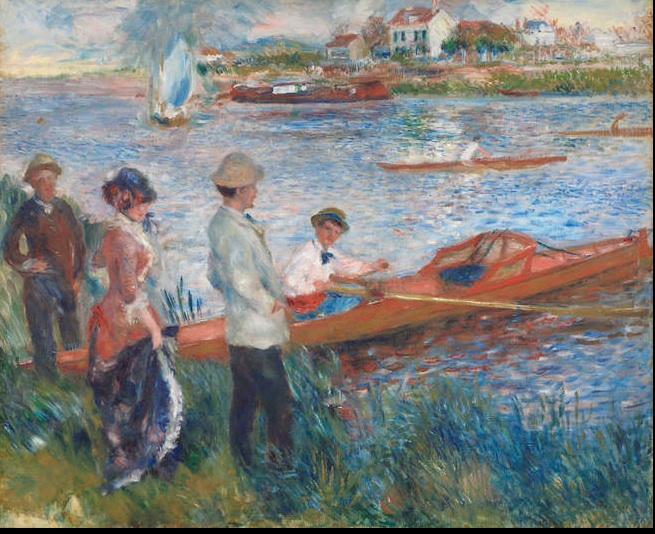
 Pierre-Auguste Renoir (French, 1841–1919) Oarsmen at Chatou,1879

 The "Impressionists on Water" show at the Legion has received, at best, tepid reviews from our local art critics. I suppose that they prefer work that is considered more challenging, like the current show of work by Nicole Eisenman at the Berkeley Art Museum and Pacific Film Archive. 

Impressionism is so familiar to us by now that we have forgotten what a radical movement it was, a new way of experiencing the world through quick sensations, expressed in paint. Even their preferred mode of painting - en plain air - was considered revolutionary. They experienced nature directly, instead of through the medium of staged sets within a studio setting. Their art making depended on the radical changes in art supplies which included portable easels and manufactured paint in tubes. The impressionists created a work without mythology or kings or monsters; one which still speaks to the sensual and sensitive within us.


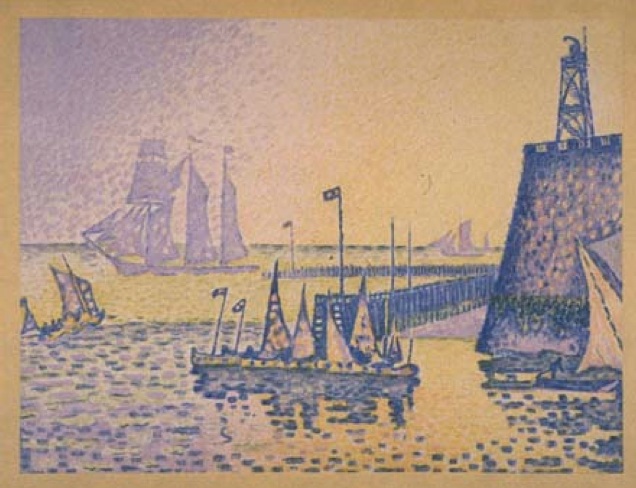
Paul Signac (French, 1863–1935). À Flessingue (At Flushing, Netherlands),1896

But in these perilous times, where it looks like we might be throwing more money at yet another Middle Eastern country in the middle of a confusing civil war, what would be better for the spirit than experiencing beautiful art? 

Why art that is beautiful became suspect and then, denigrated and even despised is an essay for another time. But for now, imagine yourself floating down the Seine on a summer day in 1898. The Franco-Prussian war is over and the horrors of WW I not even on the horizon. Enjoy a brief moment of tranquility before the 20th century arrived, beginning with optimism and ending with the destruction of so much that was promised but seldom delivered.


Paul Signac (French, 1863–1935). Le Soir (Abend-La Jetée de Flessingue) (Evening), published in Pan,1898


http://www.examiner.com/list/impressionists-on-water-opening-at-the-legion-of-honor

Friday, June 14, 2013

Weekend picks for June 13 - 16

Photographs from the Iraqi invasion at the de Young, a Sunday lecture at the Museum of the African Diaspora, Leibovitz at the San Jose Museum of Art and a call for artists from the San Francisco Center for the Book:

http://www.examiner.com/article/bay-area-weekend-picks-for-june-15-16

Thursday, June 13, 2013

Joss Whedon's witty homage to Shakespeare, 'Much Ado About Nothing'


"Much Ado About Nothing" is as charming and as well acted as any viewer could hope for. Filmed in 12 days in black and white, it's a breezy, somewhat truncated version of the original and will delight viewers with it's modern take and fast clip.

In the summer of 2011, the writer-director Joss Whedon, having completed principal photography on Marvel's Avengers Assemble, was contractually obliged to take a week off before he began editing.

Instead of taking the time off, Whedon, a Shakespearean geek from a long ways back, and at the urging of his wife, decided to film a play.

Those familiar with Shakespeare's version won't find anything startling about this: Claudio (Fran Kranz) falls in love with Heor (Jullian Morgese). At the same time. Benedict (Alexis Denisoff) and Beatrice (Amy Archer) trade barbs. Their encounters are made all the more bitter by Benedict's betrayal of Beatrice's love.

The Duke (Reed Diamond) and his entourage have decided to play a little trick on the two antagonists. When the two enemies are in view, but ostensibly hidden, the rest of the  gossip what the two are really madly in love with each other.

Soon enough, both Beatrice and Benedict are being fools for love; Denisoff shows a real talent for physical comedy which will come as no surprise to those who saw him as Wesley in both "Buffy" and "Angel."

The snake in the grass is the Duke's bastard brother, slickly and sexily played by Sean Maher, another Whedon regular, who sets up the lovers for a nasty bit of misunderstanding. Villainy, comedic turn by Nathan Fillion as the weary fool, head of a security firm, a fake death are resolved for a happy ending for all.

Don't worry about spoilers. Playgoers since Shakespeare's day know how the play will end. Lacking the artificial suspense of an unknown ending, viewers can relax and enjoy the Southern California setting and lines spoken clearly with an American accent. Whedon's stripped down version works better in the comedic scenes than in the one's which need Shakespearean narrative. But for lovers of good, old-fashioned romantic comedy, it's this summer's sparkling hit.

Directed by Joss Whedon; written by Mr. Whedon, based on the play by Shakespeare; director of photography, Jay Hunter; edited by Daniel S. Kaminsky and Mr. Whedon; music by Mr. Whedon; production design by Cindy Chao and Michele Yu; costumes by Shawna Trpcic; produced by Mr. Whedon and Kai Cole; released by Lionsgate and Roadside Attractions. Running time: 1 hour 47 minutes.

WITH: Amy Acker (Beatrice), Alexis Denisof (Benedick), Nathan Fillion (Dogberry), Fran Kranz (Claudio), Jillian Morgese (Hero), Sean Maher (Don John), Reed Diamond (Don Pedro), Clark Gregg (Leonato) and Tom Lenk (Verges). 

http://www.examiner.com/article/joss-whedon-s-witty-homage-to-shakespeare-much-ado-about-nothing

Saturday, June 8, 2013

Free Sunday at the CJM, Ferlinghetti at Krevsky, Sandi Yagi at Bash & a new gallery opens at the Oakland Museum of California

The Contemporary Jewish Museum (CJM) welcomes its new Executive Director Lori Starr and celebrates the first five years in its Daniel Libeskind-designed home in downtown San Francisco. Free admission, dance and music performances, art-making and crafts for families, and more on Sunday, June 9, 2013.

The festivities will include a reading by San Francisco Poet Laureate Alejandro Murguía and remarks by California State Senator Mark Leno on Jessie Square in front of the Museum, plus  indoor and outdoor performances by AXIS Dance Company, a cappella Leonard Cohen choir, The Conspiracy of Beards, Bulgarian woman’s choir True Life Trio, and Porto Franco Klezmer All-Stars.
Sunday, Jun 9. Free admission all day. http://www.thecjm.org/

Bash Contemporary: Grand Opening tonight with an exhibit of works by Sandi Yagi , mistress of 21st century Gothic. This will be Yagi's first solo show at a location that is becoming full of interesting, quirky art spaces, not afraid to show "risky" art. The Tenderloin is becoming the center of SF”s cutting edge art spaces, as noted in a recent article in "Beyond the Chron":
http://www.beyondchron.org/news/index.php?itemid=11458
http://bashcontemporary.com

 Lawrence Ferlinghetti. Future Woman. Through June 2013

George Krevsky: "Future Woman." SF poet laureate Lawrence Ferlinghetti is having his 7th solo show at George Krevsky. The 94-year old shows commendable vitality, if little finesse, in his current paintings of brash nudes.

“In 20th century art, the image of woman was constantly under attack, from Picasso’s two-faced women to De Kooning’s merciless portraits, to the latest tagger’s decimation.” Ferlinghetti wrote recently, “Women’s liberation movements freed women from conventional restraints, but also dethroned her from the pedestal where she had always been seen as the embodiment of pure beauty and mystery.” Pure beauty and mystery? Obviously he hasn't been looking at much for the last 50 years. Ferlinghetti's work is crude enough to qualify as a sexist attack and as far as women's lib freeing women - maybe Mr. Ferlinghetti should read the daily news. http://www.georgekrevskygallery.com/

But he is still the poet laureate of SF and can do no wrong as evinced by this laudatory interview at SF Weekly: http://www.sfweekly.com/2013-06-05/culture/lawrence-ferlinghetti-beat-generation-city-lights-howl-and-other-poems/

 Oakland Museum of California: After more than 3 years of construction, the Gallery of California Natural Sciences is open to the public. Visitors can experience seven real places throughout California that depict the stat's diverse habitats. A new exhibit is on display "Inspiration Points: Masterpieces of California Landscape," presenting more than 60 iconic paintings, photography and works on paper.

Xavier Timoteo Orozco Martinez

The artworks included in Inspiration Points have been carefully selected from the Museum's extensive and pre-eminent holdings of California art from the Gold Rush era to the present to tell the stories of how people have interacted with the natural world. Artists featured will include Ansel Adams, Albert Bierstadt, Thomas Hill, David Hockney, William Keith, Arthur Mathews, Richard Misrach, Thomas Moran, and more. The exhibition will be divided into several areas of focus that reflect artists' depiction of the landscape from a celebration of California's sublime natural world, to the documentation of exploitation of natural resources, to the investigation of the intersection of the urban and "wild."

 Arthur Mathews. Spring Dance.

Drew Johnson, Curator of Photography and Visual Culture,  says, "From majestic scenes of unspoiled wilderness to exploited lands and dystopian visions, Inspiration Points illuminates how artists have interpreted the landscape at particular moments in time. Highlighting important recent acquisitions while also shedding new light on timeless favorites, the exhibition examines the changing attitudes toward the environment over time and provides a surprising investigation of California's natural world." http://www.museumca.org/

http://www.examiner.com/list/cjm-sandi-yagi-at-brash-ferlinghetti-at-krevtsky-oakland-museum

Tuesday, June 4, 2013

SFMOMA on the go

After a 4-day extravaganza to end all museum extravaganzas, SFMOMA closed on Sunday for a 2 1/2 year expansion plan to make room for the Fisher Collection and other anticipated purchases.

People took photos of themselves in front of favorite artworks on every floor, and stood in line for hours to see the 24-hour film "The Clock." The free Family Day had a variety of activities for the kids, including making a model of a trebuchet and flinging non-lethal boulders. No castle walls were destroyed but there was a lot of laughter.

49,467 attended the museum, partied throughout the night and ended the celebrations at 5:30 p.m. on Sunday with a free-form dance through the atrium and out onto the street. As closings go, it was a joyous event.

But the museum is not going away. If anything, it's going to be even more present. "We're not going to let you forget about us," SFMOMA Director Neal Benezra told the crowd. "The lights may go off here at 6 o'clock this evening, but we'll be turning on the lights all over the city for the next 2 1/2 years until we see you all back here in 2016."

Bay Area's own Mark di Suvero's sculptures are on display at Crissy Field.  The eight sculptures scattered across the 26.5-acre field is the largest display of di Suvero's work on the West Coast. It is also the largest public single-site, single-artist exhibition mounted by SFMOMA and the pilot for an Art in the Park program by the Golden Gate National Recreation Area, which manages the field. The exhibition is free and will be up for a year.

The mammoth sculptures are also large enough to withstand the hurricane force of the wind coming through the Golden Gate Bridge. In fact, they are so study that it seems a shame that di Suvero wasn't put in charge of building the Bay Bridge. The bridge might have been built faster and with a greater respect for the steel bolts and girders.

"Lure: Bay Area Artists Explore the Sea" at SFMOMA's Artists Gallery at Ft. Mason. The America's Cup is the news of the day and several museums are taking advantage of the fact. This exhibit will bring together works by Bay Area artists whose art is inspired by the sea. Opening Saturday, June 15, 2013. 1:00 p.m. - 3:00 p.m.Building A, Fort Mason Center San Francisco, CA 94123. Free to the public.

 Teresita Fernández, Fire, 2005. Silk yarn, steel armature, and epoxy, 96 x 144 in. Collection SFMOMA, Accessions Committee Fund purchase; copyright © Teresita Fernández.

"Beyond Belief. 100 Years of the Spiritual In Art." Jointly organized by the Contemporary Jewish Museum and the San Francisco Museum of Modern Art, this expansive exhibition — spanning the years 1911 to 2011 — journeys into the far-reaching connections between spirituality and modern and contemporary art. Featuring diverse works by artists ranging from early 20th-century visionaries such as Paul Klee and Piet Mondrian to leading postwar and contemporary artists including Jay DeFeo, Kiki Smith, and Zarina, Beyond Belief offers a fresh new vision of familiar and lesser-known works from SFMOMA’s collection. On view June 28 through October 27, 2013. Admission is free for SFMOMA members. 

http://www.examiner.com/article/sfmoma-on-the-go

Wednesday, May 29, 2013

SFMOMA kicks off upcoming renovations with a 4-day party

Today, or Wednesday, May 28, 2013 at 11:02 a.m. to be exact, various San Francisco dignitaries were joined by the pupils of Bessie Carmichael School to officially kick off SFMOMA's upcoming two and-a-half years of renovations. They counted down, pushed the lever and flooded the temporary media space with glittering confetti. The glitter certainly reflects the upcoming 4-day long party, which began today with free admission until the museum closes on June 2.

SFMOMA has planned something for everyone. Visitors will have the opportunity to party on the rooftop with cocktails and live music; stay up all night in the galleries and catch performances by 48 artists in a 24-hour variety show marathon. Or they can explore SFMOMA’s landmark photography exhibition Garry Winogrand and line up to catch Christian Marclay’s 24-hour video movie "The Clock."...more at:
http://www.examiner.com/list/sfmoma-kicks-off-its-two-years-of-renovations-with-a-4-day-long-party

Sunday, May 26, 2013

At the Legion. 'Impressionists on Water'

The marketing people at the Legion have linked the upcoming Amerca's Cup with the Impressionists' exhibit of works about water.

Caillebotte, Regatta at Rrgenteuil. 1893.

The upcoming show at the Legion does not need this dubious honor. Unlike the multiple fails of the cup, including a death, these works never fail to delight. While Impressionist paintings now sell for millions of dollars, the artists were not rich or famous when these works were painted. These are the visions of men who rebelled against the establishment of the time. The fact that their painting still delights us, 100 plus years later is a testament to the enchantment of their art. 

 Monet. Boats Moored at Le Petit-Gennevillers. 1874.

The play of light, sense of atmosphere and physical experience of floating in a groundless world were irresistible for artists like Monet, Renoir, Sisley, Signac and Caillebotte (an accomplished sailor in his own right) -- key Impressionists who spent many hours at sea, on river boats, leisure craft and floating studios. Opens June 1

http://www.examiner.com/list/impressionists-on-water-opening-at-the-legion-of-honor

Thursday, May 23, 2013

The Contemporary Jewish Museum presents 'Beat Memories. The Photographs of Allen Ginsberg'


On March 25, in 1957, Allen Ginsberg helped make literary history. when 520 copies of his poem "Howl" were seized by U.S. Customs agents on charges of obscenity. Ginsberg and his publisher, City Lights, would fight those charges -- and win.

The current exhibit of his personal photographs at the Contemporary Jewish Museum won't make artistic history but they will help illuminate the private life of Ginsberg and his band of famous friends. The focus is on the personal lives, a disappointment to those who are looking for more documentation of the history that Ginsberg lived through as a poet and an activist.


http://www.examiner.com/list/the-cjm-presents-beat-memories-the-photographs-of-allen-ginsberg

Wednesday, May 15, 2013

artMRKT & ArtPadSF opening this week.

Hung Liu, The Sewer, 2013, oil on canvas, 72 x 72 inches. Nancy Hoffman Gallery

This is certainly proof of the old adage that when it rains, it pours. Two huge art fairs, opening in the same town, in the same week. 7x7SF has a game plan for those who are already overwhelmed: http://ht.ly/l48ZQ

artMRKT San Francisco, the Bay Area’s premier contemporary and modern art fair, opens today, May 15, at the Festival Pavilion at Fort Mason. The show will feature 70 galleries from around the globe, bringing some of the world’s most intriguing artists and galleries


Walter Robinson, Capitol Hill Billy, 2012; Plywood, steel, polyurethane plastic, rubber, digital print on tyvek; 32.5 x 32 x 21 inches. Catherine Clark

Regular hours: Friday, May 17, 2013 - 11:00 a.m. to 7:00 p.m.. Saturday, May 18, 2013 - 11:00 a.m. to 7:00 p.m. Sunday, May 19, 2013 - Noon to 6:00 p.m.

http://www.art-mrkt.com/sf

Daniel Green. Smell Sumo Feet Wrestlers. 2002. Creativity Explored

ArtPadSF, a smaller but edgier art fair opens tomorrow. Located in San Francisco Tenderloin district, the area is a bit rough around the edges but full of hidden treasure for the adventurous art seeker. The Phoenix Hotel closes to the public and turns 44 rooms for the creative and traveling into an art benefit for SF MOMA.

Over the course of the weekend, art patrons will be given the run of the hotel including the tropical courtyard. That's just for starters. The 4-day weekend promises more of the same, with screenings, panels, performances, access to a wide range of galleries and opportunities to talk to the artists.
http://artpadsf.com/

http://www.examiner.com/article/art-pad-and-artmrkt-opening-this-week-san-francisco

Friday, April 26, 2013

Jose Ramon Lerma at ArtZone 461. A 60-year retrospective


Lerma's paintings and collages, now on view at ArtZone 461, contain all the various threads of 60 years of art making in the Bay Area, including Abstract Expressionism, Funk Pop, and Conceptualism. The show is a slice of art history but it is also a tribute to the son of migrant workers who managed to live the life of an artist without compromising his integrity.

 Born in Hollister in 1930, Lerma was a long time Californian, a Chicano and the first in his family to attend college.

His 4th grade teacher was the first to recognize his talent and from then on, he painted constantly, copying Renaissance art from 10-cent books. Later, in 1949, another teacher helped him to get a scholarship to the California School of Fine Arts  (now SFAI).


The Korean War interrupted his schooling but when he returned to San Francisco, he continued his studies, studying under such Bay Area notables as Hassel Smith, Edward Corbett and James Budd Dixon.

The artist commented on his early years at the school as having, “…the most impact on my life and art.  The art world of the fifties was free of the market and its temptations.  There was a certain purity about it.”

He showed at the small galleries that came and went in the San Francisco of the 50’s – Sparas, the “Six” and even Ubu. He was part of a scene that included Alan Ginsberg's 1955's public reading of "Howl.' Lerma was part of the culture which valued making art over making a career as an artist.

“We were rebelling against some of the things that were going on in the city, “Lerma explains. “We wanted to be ourselves, to express things that were unique about the West Coast. We were not interested in following what was happening back East…It was a very spirited thing without much money... We were all outsider’s and we knew it, but we still wanted to show everybody what we were doing.”

Lerma lived the life of a Bohemian artist, painting as much as he could and not that interested in a career. At various times, he worked as a live-in baby sitter and later worked at Macy’s.  There he collected what would have been swept out the door – paper, fabric, and iconic images.

In the 70’s, he developed an allergy to oil paints and began making collages, constructions and the occasional installation. Some of the more interesting pieces in the show are his construction/collages, made from bits of yardstick and other building material from long lost SF landmark businesses such as Goodman Lumber.

Lerma experimented fearlessly across genres and avoided categorization.  The retrospective shows a representative example of his work but the show is confusing because the works are not all hung chronologically. The strongest visual piece in the show is a figure drawing in black and white while his collages and assemblages reveal a quirky, questioning look at American icons such as Mickey Mouse and art goddess Frieda Kahlo. The abstract pieces are less successful, showing but not integrating influences as widely diverse as Jackson Pollock’s drip pieces and the stylized Zen landscapes of Mt. Tam. According to gallery owner, Steve Lopez, their matt surface is due to the use of inexpensive oil paint, a frugal choice made necessary by Lerma's finances.


Lerma’s fierce independence and refusal to play the art game have impacted his visibility. He lived his life as a seeker after his own truth, not looking for financial security or career success. He lived without compromising his principles and has never regretted it. For that reason alone, his art is worth recognizing and respecting. If Diaogenes were alive today and looking for an honest man, he would recognize a kindred spirit in José Ramón Lerma. (all images courtesy of the gallery).

http://artzone461.com/gallery_/home.html

http://www.examiner.com/list/jos-ram-n-lerma-at-artzone-461-a-60-year-retrospective