Showing posts with label Legion of Honor. Show all posts

Friday, December 18, 2015

Raphael's 'Lady with a Unicorn' comes to SF's Legion of Honor in January


In his "Lives of the Artists," Renaissance writer Vasari declared that Heaven had bestowed upon Raphael the “infinite riches of her treasure.. of modesty, grace and talent.” His work personified the Renaissance ideals of clarity, order and balance.

Viewers will have a chance to decide for themselves when “Lady with a Unicorn." a one-painting exhibit opens at theLegion of Honor in January 2016. The work comes to us via the Cincinnati Art Museum and marks the very first timeRaphael’s “Portrait of a Lady with a Unicorn” has visited the United States, itself a reason for celebration.

http://www.examiner.com/article/raphael-s-lady-with-a-unicorn-opens-at-sf-s-legion-of-honor-january

Friday, January 2, 2015

Bay Area top ten art picks for 2014


 Vuillard from the "Intimate Impressions" show at the Legion


I am going over my articles for the year - I wrote a lot more than I thought I did and it's not all bad either. Some of the works, like the "Hagaddah" by Arthur Szyk, touched me deeply and others - like the "Masters of Fire" at the Legion - intrigued me. I was saddened by the lost of so many galleries and gladdened to find out that some -like Meridian and Roots - managed to survive eviction, find new spaces and continue on their mission. It's hard to limit the list to ten; the Cantor Arts Center at Stanford deserves a separate list for their shows on Robert Frank and Charleton Watkins as well as the new art spaces curated by DeWitt Cheng.

http://www.examiner.com/article/bay-area-top-ten-art-picks-for-2014


@Large: Ai Weiwei on Alcatraz. http://www.examiner.com/article/ai-weiwei-s-songs-of-freedom-on-alcatraz


Jackson Pollock

Joan Mitchell, Sunflowers

First on everybody's list is the new museum in Stanford:. http://www.examiner.com/article/the-anderson-collection-at-stanford-opens-to-the-public


My next choice for one of the most beautiful, spiritual, and ethical shows of the year was the Arthyr Szyk exhibit at the Contemporary Jewish Museum: http://www.examiner.com/article/arthur-szyk-and-the-art-of-the-haggadah


"Intimate Impressionism from the National Gallery of Art" at the Legion of Honor. http://www.examiner.com/article/weekend-picks-for-march-28-30


Tetsuya Ishida: Saving the World with a Brushstroke" at the Asian Art Museum.  http://www.examiner.com/article/bay-area-art-picks-for-november-14-20th


“Roads of Arabia” at the Asian Art Museum. On everybody’s top ten list, although it is equal parts archaeology and art history (censored to exclude the ancient Jewish and Christian communities in the Arabian peninsula before the rise of Islam). http://www.examiner.com/article/roads-of-arabia-explores-the-arabian-peninsula-s-ancient-past


"Masters of Fire" at the Legion of Honor. This was another show that is equal parts art and archaeology: http://www.examiner.com/article/masters-of-fire-at-the-legion-of-honor

 Zheng Chongbin

 Li Huayi

A real eye opener for me - Contemporary Chinese calligraphy married to modern art. The Chinese painters in this show - Li Huayi, Wang Tiande, Zheng Chongbin and Lu Chuntao come from such a long tradition of using ink and manipulating the brush to create art that that is such an integral part of Chinese culture that it is imprinted in their DNA. http://www.examiner.com/article/li-huayi-wang-tiande-zheng-chongbin-and-lu-chuntao-at-nanhai

Ursula O'Farrell

Women artists in the Bay Area: From the sidewalk, Mythos Gallery looks like just another nondescript storefront off busy Shadduck Avenue in Berkeley. But if the viewer takes a second look, he (or she) will see one of the most powerful – if smallest – exhibitions of women artists from the 1950’s through today. The exhibition at Mythos Gallery is the first of two to showcase women painters who arose out of the Abstract Expressionist and Figurative artistic movements of the 1950's. http://www.examiner.com/article/beauty-fierce-as-stars-groundbreaking-women-painters-at-mythos-gallery


Romare Bearden at Jenkins Johnson: http://www.examiner.com/article/storyteller-works-by-romare-bearden-at-jenkins-johnson

Saturday, October 18, 2014

'Houghton Hall; Portrait of an English Country House' at the Legion of Honor


Have you ever dreamed of living in a sumptuous English country estate, being served tea by a liveried footman, going to grand balls and sleeping in 4-poster beds, covered with rare Chinese silk? The current exhibit at the Legion of Honor, "Houghton Hall; Portrait of an English Country House" should satisfy even the most avid lover of Downtown Abbey and of a particular kind of very upper class, very elite English life style.


Houghton Hall brings to San Francisco a wonderful array of objects from one of Britain’s great country houses, and reflects the history of this magnificent estate across nearly 300 years, from the 18th century to the present day. The show features more than 100 pieces from the estate, including old-master paintings from their once-lost collection, Sèvres porcelain, and pieces from the eighteenth-century interiors and furniture designed by William Kent.

More at: http://www.examiner.com/article/houghton-hall-portrait-of-an-english-country-house-opens-at-the-legion

Saturday, September 13, 2014

The Poetry of Parmigianino's 'Schiava Turca' at the Legion


"Schiava Turca” (“Turkish Slave”) arrived at the Legion of Honor, cloaked in mystery. A small painting, set within an elaborate gold frame, the lady is winsome and coy, from her stripped turban, heavily rouged cheeks and delicately arched eyebrows to the tips of her graceful fingertips. On loan from the Galleria Nazionale di Parma, it was painted between 1531 and 1534 in Parma.

More at: http://www.examiner.com/article/the-poetry-of-parmigianino-s-schiava-turca-at-the-legion

Sunday, March 30, 2014

Matisse's illustrated books on view at the Legion of Honor


Henri Matisse was 60 years old when he began to create original illustrations for livres d’artiste (artists’ books). By the time of his death, 25 years later, he had produced designs for 14 fully illustrated books, several of which are considered 20th-century masterpieces of the genre. View seven of these rare books, including Poésies (1932) and Pasiphaé (1944), in conjunction with the special exhibition "Matisse from SFMOMA" at the Legion of Honor.

More at:  http://www.examiner.com/article/matisse-s-illustrated-books-at-the-legion-and-happy-birthday-to-van-gogh

Saturday, June 15, 2013

'Impressionists on Water' at the Legion

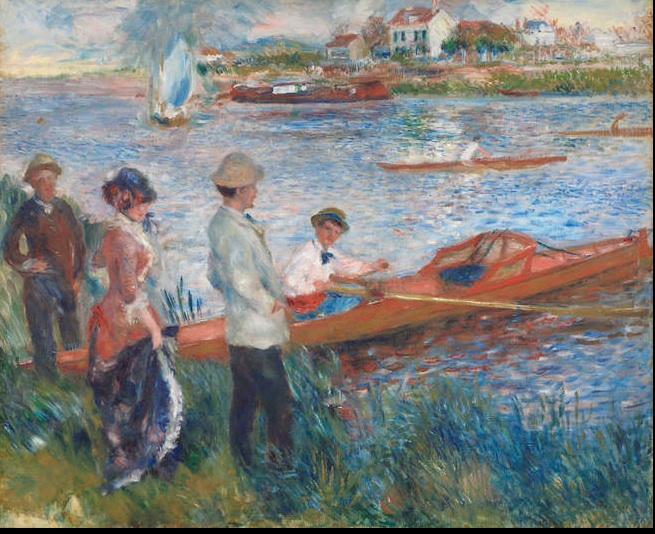
 Pierre-Auguste Renoir (French, 1841–1919) Oarsmen at Chatou,1879

 The "Impressionists on Water" show at the Legion has received, at best, tepid reviews from our local art critics. I suppose that they prefer work that is considered more challenging, like the current show of work by Nicole Eisenman at the Berkeley Art Museum and Pacific Film Archive. 

Impressionism is so familiar to us by now that we have forgotten what a radical movement it was, a new way of experiencing the world through quick sensations, expressed in paint. Even their preferred mode of painting - en plain air - was considered revolutionary. They experienced nature directly, instead of through the medium of staged sets within a studio setting. Their art making depended on the radical changes in art supplies which included portable easels and manufactured paint in tubes. The impressionists created a work without mythology or kings or monsters; one which still speaks to the sensual and sensitive within us.


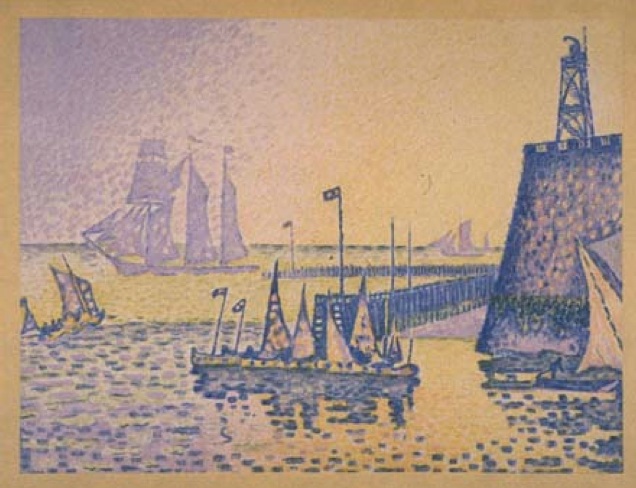
Paul Signac (French, 1863–1935). À Flessingue (At Flushing, Netherlands),1896

But in these perilous times, where it looks like we might be throwing more money at yet another Middle Eastern country in the middle of a confusing civil war, what would be better for the spirit than experiencing beautiful art? 

Why art that is beautiful became suspect and then, denigrated and even despised is an essay for another time. But for now, imagine yourself floating down the Seine on a summer day in 1898. The Franco-Prussian war is over and the horrors of WW I not even on the horizon. Enjoy a brief moment of tranquility before the 20th century arrived, beginning with optimism and ending with the destruction of so much that was promised but seldom delivered.


Paul Signac (French, 1863–1935). Le Soir (Abend-La Jetée de Flessingue) (Evening), published in Pan,1898


http://www.examiner.com/list/impressionists-on-water-opening-at-the-legion-of-honor

Sunday, May 26, 2013

At the Legion. 'Impressionists on Water'

The marketing people at the Legion have linked the upcoming Amerca's Cup with the Impressionists' exhibit of works about water.

Caillebotte, Regatta at Rrgenteuil. 1893.

The upcoming show at the Legion does not need this dubious honor. Unlike the multiple fails of the cup, including a death, these works never fail to delight. While Impressionist paintings now sell for millions of dollars, the artists were not rich or famous when these works were painted. These are the visions of men who rebelled against the establishment of the time. The fact that their painting still delights us, 100 plus years later is a testament to the enchantment of their art. 

 Monet. Boats Moored at Le Petit-Gennevillers. 1874.

The play of light, sense of atmosphere and physical experience of floating in a groundless world were irresistible for artists like Monet, Renoir, Sisley, Signac and Caillebotte (an accomplished sailor in his own right) -- key Impressionists who spent many hours at sea, on river boats, leisure craft and floating studios. Opens June 1

http://www.examiner.com/list/impressionists-on-water-opening-at-the-legion-of-honor

Wednesday, November 16, 2011

Bernini's "The Medusa" at the Legion


Gian Lorenzo Bernini, The Medusa, 1640s. Carrara marble. Musei Capitolini, Rome

This piece is so delicately beautiful and the level of craftmanship is so high that it has to be seen to be believed. At the press preview today, John Buchanan, the Director of the Museum, hinted that there will be more exchanges between the Capitolini Museum in Rome and the Legion. No details yet but keep tuned to this space ...

http://www.examiner.com/museum-in-san-francisco/bernini-s-the-medusa-at-the-legion

Thursday, October 20, 2011

Pissarro's People at the Legion

Self-Portrait

“Pissarro’s People,” opening this weekend at the Legion of Honor, brings together more than 100 paintings, showing his humanistic viewpoint through portraits of his family and paintings of working class people. Pissarro was the most modest, the most committed to the original principles of Impressionism, the most politically radical and for us, the least known.
http://www.examiner.com/museum-in-san-francisco/pissarro-s-people-at-the-legion

Friday, July 8, 2011

Masterworks from the Dutch Golden Age at the Legion of Honor

Jacob van Ruisdael (Haarlem 1628/29–1682 Haarlem?), Winter Landscape with Two Windmills, ca. 1675. Oil on canvas, 15 1/8 x 17 1/8 inches (38.5 x 43.4 cm). The Rose-Marie and Eijk van Otterloo Collection. Image courtesy Peabody Essex Museum

Rose-Marie and Eijk van Otterloo began collecting horse carriages, until they completely filled their New Hampshire barn. So they switched to horse and sporting prints, until about two decades ago, when Peter Sutton, then curator of European painting at Boston's Museum of Fine Arts, encouraged them to get into Dutch and Flemish art. It seemed a natural fit for the Marblehead couple -- she a native of Belgium, he a Dutch-born investor and developer who had co-founded the Boston investment firm Grantham, Mayo & Van Otterloo in 1977.

The result is the current exhibit at the Legion of Honor. nearly seventy paintings  from the 17th century.  It's the most astonishingly beautiful show that I've seen in San Francisco in a long time - and that includes the current Picasso show at the De Young and the Stein collection at SF MOMA (with a few exceptions for the Matisse pieces and the early Picasso). 

 Don't bother with the over-hyped show of "Baroque Masterpieces" at the Berkeley Art Museum. The show consists of eight poorly lit drawings, one of which showed some damage and is in need of conservation. You can barely see the work for the glare on the glass. The rest of the show consists of two third rate paintings by a largely forgotten painter. The show is frustrating to view, difficult to access and poorly documented. I have to make two exceptions; the Tiepolo drawing (also on the web page) is the best drawing in the show. The "St. John in the wilderness" by Caracciolo is amusing for its lack of any religious feeling. The boy in the painting is obviously a Roman rent boy and certainly for sale.  While lacking in Caravaggio's sly eroticism, he is gesturing with a finger that seems to say, in 17th century Italian, "You talkin' to me?"  What's with the red toes? But there's not a masterpiece in the lot.

Here's where some real art history scholarship would have been much appreciated. It's difficult to understand why Berkeley, with it's art and history departments couldn't find at least one student to do some basic research and write up more comprehensive wall tests. If the museum doesn't have the money, they could certainly find someone who would do it for class credit. This is even more important because the web site has only one brief essay, one small image and the guards are Berkeley are ever vigilant to make sure that you don't take a photograph (even with the flash off) or write with anything other than the soft, stubby yellow pencils that smear at the first touch.

Needless to say, I was underwhelmed. 

I can't say the same for the show at the Legion. I guess that the difference between the two is the difference between a museum that's basically interested in the new and trendy vs. a museum that displays classic art. One venue largely shows art that spends a lot of time telling you what it is because the artist is not skilled or talented enough to let the image do the talking. It's unfortunate that this is the case because the BAM has a wonderful collection of Asian art and maybe even a decent collection of European art but you'd never know by the way it is presented.

The other venue (the FAMSF) displays art that does not have to waste a lot of time in text because the artist is (or was) well enough trained to make a painting that's worth the proverbial 1000 words. Of course, this art is also beautifully documented because it's historically important and has stood the test of time. The contemporary art at "the other museum" will last, at best, maybe 25 years. By and large it does not deserve to last longer.

The Dutch masterworks comes to SF from the Peabody Museum in Salem where it was originally organized in conjunction with the Mauritshuis. Dr. Frederik J. Duparc was the guest curator, and Karina Corrigan, the H. A. Crosby Forbes Curator of Asian Export Art at Peabody Essex, was the coordinating curator.  The Legion's curator of European art has followed in their footsteps, hanging a show where every painting is in superb condition with an impeccable provenance.

Don't be shy; a click on the link earns me a whole .05 percent of one cent. Spoil the local artist and blogger and exercise that clicking finger:

Friday, April 10, 2009

Max Klinger at the Legion of Honor


I am a huge fan of symbolist art, so it is with that partiality that I highly recommend seeing “Waking Dreams: Max Klinger and the Symbolist Print” currently on exhibit until July 5th at the San Francisco Legion of Honor museum. Klinger was born in 1857 in Germany, and died in 1920. Well known as a symbolist artist, he worked as a painter, printmaker and sculptor.

Klinger’s etchings are not something one gets to see very often (at least in my circles) so this show is a great treat. In fact, I’m not sure if I had ever seen one of his works in person. The highlight for me was seeing the complete series “Paraphrases About the Finding of a Glove”. The most famous print in this series, “The Rape”, is pictured above. This series of etchings tells the story of a woman’s glove found by the artist and its extraordinary travels through worlds known only to the imagination. I was impressed by Klinger’s artful compositions, delicate details, and exquisite mastery of creating subtle variations in value. The show contains several other series of prints as well. The work is dark, macabre, mysterious, strange, and wonderful.

The exhibit is small and fills two rooms at the end of the Pre-Renaissance/Medieval Art hall. The works of other symbolist artists also hang in this show. I was delighted to see one of Bresdin’s tiny detailed etchings, and works by other symbolist artists: Redon, Ensor, Munch and more.

San Francisco Legion of Honor:
http://www.famsf.org/legion/index.asp