Friday, January 25, 2008

A New Photography Gallery Coming to Town


In the March issue of Black & White Magazine, Richard Pitnick reports that Nile Tuzun, creator and owner of www.niletuzungallery.com, will be opening a photography gallery here in San Francisco very soon. Tuzun's web site indicates the date for the opening of the Sacramento Street gallery is set for March 19th.


Tuzun has been representing about 15 Italian photographers on her web site and is now taking that big step into an "actual" gallery space here in the City.


A few years ago while in Rome, Tuzun was so taken by the work of contemporary Italian photographers, that she decided to create the on-line gallery to represent, exclusively, Italian photography.


According to Pitnick's article, photography in Italy is only now coming into its own. Tuzun believes that's because in Italy photography competes with such a rich tradition of fine art that it hasn't received the recognition it deserves.

What ever the reason, the opening of a new photography gallery in San Francisco, and one with a fresh and all together new perspective is more than welcome, and long over due.


photo: www.niletuzungallery.com


Thursday, January 17, 2008

Katy Grannan


Katy Grannan, Nicole, Potrero Hill, 2006

Katy Grannan’s most evident talent is for inspiring trust in subjects already eager to shed not only their clothes but whatever vestiges of dignity might remain to them. The resulting photographs have not been very good. Her latest effort is The Westerns.

In this new show, Grannan gives us pictures of Gail and Dale, transsexual best friends, and Nicole, a woman struggling with demons whose exact nature is left to our imagination. There are also a couple of pictures of men, equally troubled, whom Grannan apparently stumbled across on the beach.

Why The Westerns? The artist, we are told, considers these people to be “new pioneers” struggling “to define themselves under the scrutiny of relentless sunlight” in San Francisco, “a mythical destination and a real end-point where sunshine illuminates both the abject and the joyful.” I’d concede the aptness of "relentless" and “abject,” but there is no joy in any of these pictures.


Diane Arbus, Albino Sword Swallower at a Carnival, 1970

Instead, there is only Grannan’s exploitation of her subjects’ unhappiness and confusion. The degree of that exploitation is best illustrated by reference to another woman who photographed outsiders and was accused, in her day, of exploiting them. In fact, Diane Arbus’s freaks are paragons of dignity in comparison. Some of them are even joyful.


Katy Grannan, Gail, Point Lobos, 2006

The illuminating comparison is not with Arbus, with whom Grannan actually has little in common, but with the painter Andrew Wyeth, whose sticky taste for bathos is echoed by Grannan even in the peculiar pose she so often selects for her subjects. As far as I’m concerned, one Christina’s World is enough. More than enough, really.


Andrew Wyeth, Christina's World, 1948

(At Fraenkel, until February 9; also at Greenberg Van Doren and Salon 94 in NYC.)

Sunday, January 13, 2008

Book Review


I was recently browsing the craft section of Borders when I came across this wonderful book "Living the Creative Life, Ideas and Inspiration from Working Artists" by Rice Freeman-Zachery.

This is a book that can be enjoyed by artists and non-artists alike.  The author focuses on 15 contemporary artists who work in paint, mixed-media, quilting, clay, beads, journaling, or collage.  She interviews each of them, asking questions about where their inspiration comes from, their definition of creativity, how they use a sketchbook, what their work process is, how they organize their work space, collaboration and sharing their work with the public.  Each chapter is a different topic giving us each artist's viewpoint on the subject.


Included in each chapter are little sidebars that are titled "try this".  They include tips, suggestions, and activities to try and get creativity flowing.  For example in the second chapter "The Creative Childhood {It's Never Too Late}" the author suggests making a list of things that were fascinating to the reader as a child and then circling the ones that "cause a little shiver of interest".  These are topics one might explore in their adult art.


Perhaps my favorite thing about this book is the artwork.  The artists that Freeman-Zachery chose for her book are very talented.  Many of them are mixed-media artists.  As someone who is exploring this art form myself I find the work very inspiring.  I love the quilts by Bean Gilsdorf from Portland and the puppets of Scott Radke from Cleveland.


This is a beautiful full color paperback book.  Most of the pages are designed to look like collages.  It is filled with art, wisdom, and inspiration fro artists and art appreciators of every kind.  


(Amazon.com has a "Search Inside" feature for this book so you can see more of what it looks like)

Friday, January 11, 2008

Dot-Com & Gone

Thomas Reynolds Gallery on Pine and Fillmore opened an exposition of photographs by Jean Collier Hurley this evening. The show chronicles the various help-wanted signs in the windows of the shops on Fillmore during the dot-com boom of 2000 when it seemed no retailer was safe from having their staff cherry-picked by the SOMA madness and runs through February 2nd.

The photos are quite interesting and from a collector's viewpoint different from most since damage to the negatives make each photo a 1/1 original with no copies to follow.

Mostly neighborhood folks in attendance, but one guest was a delight to see back on Fillmore. Iris Fuller, the owner of Fillamento, the store that revived the shopping scene on Fillmore, had dropped in from her home in Petaluma. Could a new Fillamento be in the offing? We can only hope.

Wednesday, January 9, 2008

Abstract Rhythms: Paul Klee and Devendra Banhart


Abstract Rhythms: Paul Klee and Devendra Banhart is the title of an exhibition at SFMOMA that will feature a performance by Banhart. He will perform 8:00 p.m., January 17, in the Phyllis Wattis Theater. The event is sold out, but the museum is selling tickets for a live simulcast of the performance. Banhart will also perform Jan. 19 at Amoeba Records. From the museum’s website:

Music was a consistent source of inspiration for Paul Klee, spanning the arc of his career and informing much of his practice. This exhibition features works by Klee that reveal his affinity for music, as well as new drawings by Devendra Banhart, a musician and visual artist, made in conjunction with his most recent album, Smokey Rolls Down Thunder Canyon. Part of an ongoing presentation within Matisse and Beyond, the exhibition highlights the synesthetic relationship present in both artists’ works on paper, drawing on Dr. Carl Djerassi’s gifts and extended loans to SFMOMA of more than 150 works by Klee.

Video of a performance by Banhart up at http://www.friscovista.com/news/

Monday, January 7, 2008

Artist's Model Builds Museum for SF

The San Francisco Sentinel has a terrific piece by Christopher Craig about Alma Spreckels: born to poverty in San Francisco's Sunset District, worked as an artist's model (she's the figure on top of the obelisk in Union Square) eventually marrying local rich guy, Adolph Spreckels:

"With the luxury of a staff of nannies and liveried servants, Alma began to focus her attention away from childrearing and towards the role of a proper high society hostess, not an easy feat, considering that most of San Francisco’s power elite turned their noses up at the freethinking firebrand whose humble origins and association with “bohemian” artists caused controversy in an era of stifling Victorian mores."


Not to be deterred, she headed for Europe, where she made friends with more artists and bohemians - this time as a collector.

"Alma returned to San Francisco just as World War I was breaking out in Europe, and she immediately set about acquiring several works by San Francisco sculptor Arthur Putnam, who would receive regular patronage from his new benefactor for the rest of his life.

Alma then recruited the assistance of dancer Loie Fuller to purchase the Rodin bronzes, which she successfully accomplished through much persistence, eventually securing 13 of the masterworks for Alma, as well as some of the artist’s drawings. Alma’s beloved statues made their San Francisco premiere at the Panama Pacific International Exposition of 1915, where Alma, mesmerized by the beauty of the fair’s French Pavilion, got the idea to build a museum of equal attractiveness, to permanently house her Rodin pieces and other objects d’art she had begun to acquire.

After the exposition, Alma dove into charity work, focusing nearly five years on rummage sales and high-society raffles to raise money for war-torn France and Belgium. Her five-limousine garage at 2080 Washington became a constant garage sale, and a much-publicized relief raffle at the Palace Hotel drew gift donations from US presidents and renowned figures in the arts and sciences.

She even raffled off “The Genius of War,” one of her most prized Rodins.

With some convincing, the reluctant Adolph agreed to fund Alma’s museum project, which she envisioned not only as a cultural gift to the city, but also as a tribute to the 3,600 soldiers from California who were killed during World War One."


That project became the Legion of Honor in Lincoln Park, part of the Fine Arts Museums of San Francisco.

Read Christopher Craig's full story here.

Image is top of the obelisk in Union Square - detail of plein air watercolor by Anna L. Conti

Wednesday, January 2, 2008

Notes on an Exhibit of Huichol Art

From Janet Rosen at Zanshin Art:


One great pleasure in my life is knowing that despite being a pretty well-read and well-rounded person who has walked this earth over fifty years, there is still so much to learn and to appreciate.

This past week I was introduced to the Huichol people, thanks to an exceptionally well curated show at the Grace Hudson Museum in Ukiah. The show is ostensibly of Huichol ART. However (to turn to an earlier thread on this blog) there is no way to disassociate the art from the craft from the spiritual from the cultural well-being of the Huichol, so I say that via the art I have met the people a little bit.

The work is astonishing on all levels. As craft, it appears from a distance to be exceptionally well executed beadwork and embroidery. The first hint that something was unusual was when I came up to a highly sculpted three-dimensional mask and noted that the tiny seed beads were set with their holes sticking up, so clearly they had not been strung in place. A moment later, we saw a video that showed how both the beadwork and the yarn paintings are done:
A substrate is created of beeswax and pine pitch (both locally available resources). For beadwork, the beads are applied one at a time, with the aid of a needle, set into place, all freehand. The yarn paintings are not embroidered or in any way stitched or tied. A long section of yarn (looking like an embroidery thread) is essentially used to draw an outline, being pressed into place with a fingernail and nail scissors. The inner colors are then filled in by the same method, the artist working swiftly and surely, back and forth into the substrate until the surface is fully covered.

Artistically, the work just rocks. It is figurative, highly symbolic, and psychedelically complex (with good reason, see below). This artist/artisan is frankly amazed to realize that these compositions, however thought out they are, are actually executed completely freehand. Many of the larger yarn paintings are worlds to enter, demanding long and pleasurable study, eliciting conversations among the visitors, and are returned to for comparison after other pieces have been seen.


Regarding the meaning of the work, the show catalogue reads:


“The basis of this culture is the shamanic traditions Huichol people have practiced for many centuries. They believe that everything in their natural environment is alive and capable of feeling and action. There are a multitude of personified nature deities who are in charge of such things as animals, water, weather, and plants to whom the Huichol people send their prayers and petitions. Huichol shamans are the teachers, guides and mediators between the natural and the supernatural realms. To be a shaman is both a privilege and a demanding responsibility. Shamans conduct rituals to ensure the health and welfare of their communities and perform sacred chants recounting Huichol ancestral mythology.

“All Huichol ceremonial life centers around the sacred peyote cactus which is used in rituals to contact the spirit world. Huichol shamans obtain their power from these ceremonies and from the peyote visions they experience. Huichol art, whether two dimensional yarn paintings or three-dimensional masks and sculptures, use ancient symbols to represent these gods, to tell the cosmic drama of creation, and to document age-old Huichol traditions. With no written language, Huichol people rely on various types of artwork to maintain and communicate their beliefs and myths.”


Elsewhere in the show it is noted that for many Huichol, it is an annual 300 mile pilgrimage to go where the peyote grows and that vision quests are not unusual. Part of how the culture has remained so viable for so long is that many of its traditions are built around daily family life, and need connection with but not daily reinforcement from, the larger community (this reminded me of the similar home basis of much of Jewish life, and how it kept certain traditions alive for centuries among the “cryptoJews” of the New World.)

The yarn painting is a fairly recent aspect of Huichol life. Much of the artwork is being produced even now by their shamans as part of their responsibility to make the spiritual explicit or mediate reality for their people. At the same time there is artwork being produced specifically for sale, in order to help keep the people alive. Here is more information on that issue.
The closest parallel that comes to mind is the multifaceted and essential role of sand painting in the practical, spiritual and historic life of the Australian aborigines. To those who dither over whether or not “art is important” or try to define the difference between “arts” and “crafts” I offer these peoples as the only reply needed.


Moving to Ukiah, I will have the Grace Hudson as “my” local museum. It is a small place, with part of the building devoted to the painter for whom it is named (and whose beautiful craftsman home, the Sun House, is next door, with docent tours available) and a room of stunning Pomo baskets. The front area is given over to changing exhibits and for a small institution they have managed to put together some wonderfuls shows. Here were a couple of my favorites:


Puppets of the World

Pieces of the Past: Quilting Traditions

Landscape Interpretations

(This post was written by Janet Rosen - I keep trying to talk her into writing for BAArtQuake- until she does, I'll just have to copy a post now and then - check out her other art writings here. - Anna)

Interview: Rock Artist, John Howard

From Runaway Dinosaur, an interview with John Howard, who does poster designs for the Great American Music Hall, the Fillmore, the Warfield, and Bill Graham Presents. Excerpts below, full interview at Runaway Dinosaur.

What’s it like working with BGP? How often do they commission you for posters? Are you able to choose which acts you design for?

Working with BGP is cool because of their history and the fact that they take care of everything… you just send them the art and get paid. But that can also be a downside because you don’t get to work with the band/management, control the printing, or own the final art.

How do you get the 3-D effect with the silkscreen process?

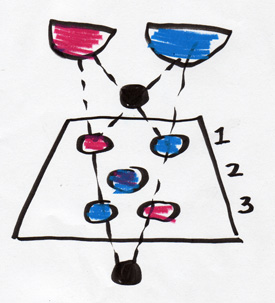
The theory is simple. When viewing the image with red/blue glasses, the red lens shows the blue dot as black and the red dot as white and the blue lens shows the blue red as black and the blue dot as white. The brain is fooled into believing that the black dot seen by each eye is the same dot, which leads the brain to calculate the dots position as shown in these examples.
1 the dot appears to float above the paper
2 they overlap and appear on the surface
3 shift the other way dots appear below the surface

Can you tell me a little about TRPS Festival of Rock Posters that you were part of?

The Rock Poster Society is a volunteer army of poster art enthusiasts who put on poster shows in San Francisco that include rock art legends from the 60’s and new artists, too. Their regular shows are in the summer at Fort Mason and in the fall at the Hall of Flowers, but they are also involved in events like The 40th Anniversary of the Summer of Love last year. A great bunch of folks who really care about the art, the artists, and the fans.

Image is Roky Erickson Halloween show at the Great American Music Hall, by poster artist John Howard.

Tuesday, January 1, 2008

Kenneth Baker's top 10 for '07


From SFGate:

1. "A Rose Has No Teeth: Bruce Nauman in the 1960s": The Berkeley Art Museum survey traced the Bay Area creative roots of one of the late 20th century's most influential American artists.

2. "Brice Marden: A Retrospective of Paintings and Drawings": A perfect marriage of art and venue - the San Francisco Museum of Modern Art - this show let visitors walk within the sensibility of a major contemporary abstract painter.

3. "In the American West: Photographs by Richard Avedon": Avedon's 1986 album of portraits from chance encounters with ordinary folks in the West attained discomfiting intensity, presented in just the way the late photographer intended by Stanford's Cantor Center for Visual Arts.

4. "Hiroshi Sugimoto": The M.H. de Young Memorial Museum wisely gave the Japanese photographer free rein to design his retrospective, which showed both what a great visual artist he is and how complex the hidden conceptual dimensions of his medium are.

5. "Martin Ramirez": The San Jose Museum of Art collaborated with the nearby Mexican Heritage Plaza La Galeria to study an illegal immigrant "outsider" artist who produced his unforgettable drawings while confined in California mental hospitals.

6. "Listening Post": Yerba Buena Center for the Arts brought to San Francisco for four months one of the San Jose Museum of Art's smartest acquisitions: an elaborate device built by Ben Rubin and Mark Hansen that spellbindingly harvests live Internet chat-room content, turning it into a social symphony of text and sound.

7. "Joseph Cornell: Navigating the Imagination": (Through Jan. 6.) Two key practices of 20th century art - collage and assemblage - culminated in the work of this reclusive New Yorker who would have delighted to see the space and care the San Francisco Museum of Modern Art has lavished on his oeuvre.

8. "Diebenkorn in New Mexico": (Through Jan. 6.) Although smaller than the version staged by the Harwood Museum in Taos, which organized the show, the San Jose Museum of Art's survey of Richard Diebenkorn's early work still has something to surprise even those who know this Bay Area titan's art well.

9. "Jeff Wall": (Through Jan. 27.) The work of Jeff Wall, a pioneer of staged photography, tends be large and scarce, so it is often seen piecemeal. His San Francisco Museum of Modern Art retrospective shows why he remains a controversial figure.

10. "The Sculpture of Louise Nevelson: Constructing a Legend": (Through Jan. 13.) Nevelson staked everything on her own artistic confidence and won, at a time when women still faced extraordinary struggles for art-world recognition. The M.H. de Young Memorial Museum survey of her work displays its full power.

For the rest of the story, including Baker's High, Low, Most Improved, and Most Valuable Player awards, go here.

Image at top is "Listening Post" (#6) by Fenchurch! on Flickr

Monday, December 31, 2007

SFMOMA buys another Ed Ruscha

Ed Ruscha, "Parts Per Trillion,” 1987, acrylic on canvas, 50 by 120 inches. Collection SFMOMA, purchased through the Phyllis C. Wattis Fund for Major Accessions.

From "Antiques and the Arts":

SFMoMA Acquires Essential Painting By Ed Ruscha
Dec 28th, 2007

The San Francisco Museum of Modern Art (SFMOMA) has acquired the painting "Parts Per Trillion," 1987, by American artist Ed Ruscha.

Purchased through the Phyllis C. Wattis Fund for Major Accessions, the painting joins more than 25 important Ruscha paintings, works on paper, and photographs already in SFMOMA's collection. Together these works tell the story of the rise of Ruscha's career from the 1960s to the present.

SFMOMA also recently acquired an important suite of photographs from Ruscha's cross-historical study of the landscape of Los Angeles ("Then and Now," 1973/2006), as well as the rarest and most valuable of Ruscha's artist's books for the SFMOMA Library. These recent acquisitions have allowed SFMOMA to be one of very few museums in the world with an entire collection of Ruscha's historically significant books.

In the early 1980s Ruscha began exploring a new visual vocabulary with silhouette paintings that do not carry an overt intermingling of text and image, yet evoke a textual narrative. At this time the artist created his first ship paintings, a series of 11 works created between 1983 and 1988 that feature silhouetted ships in varying sizes and formats; for Ruscha, the ship is a symbol for adventure and exploration.

"Parts Per Trillion," the one work from this series that Ruscha opted to keep in his own collection, is one of the two largest and the most visually compelling. Across the surface of this painting, the artist breaks up the visual cohesiveness of the basic black and white picture plane with stark white rectangles reminiscent of censor bars that are laid across text.

Saturday, December 29, 2007

Marie Antoinette and Le Petite Trianon


The show at the Legion on Marie Antoinette’s decorative arts, paintings and sculpture that adorned the Petite Trianon is quite sumptuous. Based on the Grand Trianon, a retreat area the King had enjoyed as a child, Petit Trianon was completed on the Versailles grounds in 1768. Initially built as a gift from Louis XV to his mistress Madame de Pompadour, the main building of this “natural getaway” features architecture in the new neo-Classical style and exceptional interior woodwork.

When Louis XVI took the throne in 1775, he gave Petit Trianon as a gift to Marie Antoinette. Despite the fact that no cost was spared to make the building over to suit the Queen's taste and allow her to make it her own, it never really lost the taint of being associated with the most dominant royal mistress in French history. (PBS website).

18th Century artwork has never held much interest for me but it was fascinating to view the original works – works that have been copied so often and so poorly. They have an exquisite delicacy that reproductions cannot capture. Images of roses and cornflowers adorn everything – including some of the fancy porcelain that was used in the dairy at Trianon – show her exquisite taste but also, her complete distance from the reality of the majority of the French at the time. The carved and gilded furniture and the beautifully recreated rooms give a taste of what life must have been like for the elite, where, as Talleyrand said, “Whoever did not live in the years neighboring 1789 does not know what the pleasure of living means.”
[Fr., Qui n'a pas vecu dans les annees voisines de 1789 ne sait pas ce que c'est le palisir de vivre.]

http://www.famsf.org/legion/
(Images from the Legion’s website; information on Marie Antoinette from the PBS and Legions’ website).

Kitsch and Pinocchio


A lot of galleries are closed between now and the New Year so the pickings are slim but there are a couple of interesting (if uneven) shows. Berggruen is showing new work by Jim Dine based on the legend of Pinocchio. According to the press release, Dine perceives that "this idea of a talking stick becoming a boy, it's like a metaphor for art, and it's the ultimate alchemical transformation." His Geppetto is a self-portrait, alluding to the artist as creator, who in giving life has a connection with the Divine. Frankly, I think that’s way over the top for a show that has some visual interest but hardly gave me any frisson of excitement. The paintings have a nice (maybe that’s not quite the right word) slapdash painterly finish, a la Francis Bacon. The Pinocchio sculptures are made of wood, charred wood, stained wood and cast aluminum. Made mostly by his assistants, they have the same sort of finish as the wall paintings but don’t work particularly well as three-dimensional objects. I suppose that if you like Walt Disney, you'll love this show but for me, it was an unsuccessful juxtaposition of POP, paint and hype to promote his book. I kept seeing Mickey Mouse superimposed on Pinocchio’s long nose and felt that Dine has crossed the line from Pop into kitsch.


Berggruen: Jim Dine “Pinocchio as I knew him.”
Up until January 5th: http://www.berggruen.com/
(Images from the Berggruen website)

Thursday, December 27, 2007

Clyfford Still Changing


KQED has published a piece by Timothy Buckwalter about the condition of the Clyfford Still paintings at SFMOMA. Apparently he mixed his his own paints and some of his paintings are fading. Buckwalter talked to SFMOMA conservator Paula De Cristofaro who said, "Change in an artwork that is inherent to an artist's technique is not a condition we would consider ‘restoring.' We accept it as part of the nature of the work."

Read the whole story here.

(Image is from ClyffordStill.net)

Monday, December 24, 2007

Now it begins: the "Best of 2007" lists

"Woman with Scarf at Inspiration Point, Roger Minick, 1980

Robert Taylor at the Contra Costa Times lists his top ten Bay Area Art Exhibits for 2007. I give you the bare list below (go HERE for his commentary.)

The Top 10

1. "Yosemite: Art of an American Icon," Oakland Museum of California

2. "Joseph Cornell: Navigating the Imagination," San Francisco Museum of Modern Art

3. "Picasso and American Art," S.F. Museum of Modern Art

4. "Masters of Bamboo," Asian Art Museum, San Francisco

5. "Goya: The Disasters of War," UC Berkeley Art Museum

6. "Footloose in Arcadia," Hearst Art Gallery, St. Mary's College

7. "The Sculpture of Louise Nevelson: Constructing a Legend," de Young Museum, S.F.

8. "The Art of a Community," Arts Benicia Gallery

9. "The Edge," Oakland Museum of California

10. "2 of a Kind," NIAD Gallery, Richmond

How about you? What was your top ten Bay Area Art shows of 2007?

Friday, December 21, 2007

Scott Greene and Al Farrow at Catherine Clark


Scott Greene's enormous paintings of body parts are dutifully rendered and shined to a full gloss. There are plenty of nods to Phillip Guston's famous boots but the cartoonish, flat look of Guston has been replaced with a triumphant attempt at achieving renaissance style rendering and varnish. Judging from the sprawled legs and arms, it appears Scott created headless monster sculptures out of doll parts, removing the articulated arms and legs of superheros, knights and horses. I think he then creates very large paintings from these sculptures. The end result is a decadent image of war, chaos, and brutality.

Al Farrow architects cathedrals, mosques and other religious buildings using parts from guns and lots of bullets. The buildings are all large model sized and cold. The detailed metalwork is impressive and ominous. Many of the pieces had the bones of a finger encased in a glass enclosure. This impressive body of work must be seen in person. You can feel the weight of the metal when you stand in the room with these things. People are so transfixed by the pieces, it makes you feel anxious waiting your turn to see.

Scott Greene and Al Farrow will be showing at
Catherine Clark Gallery
From November 29th 2007 - January 12th 2008

See older work of Scott's at scottmgreene.com
More of Al Farrow's work can be seen at alfarrow.com/

View more photos on the Bay Area Art Quake Flickr Photo Group.

Bare Branches for Winter

This show is closing tomorrow: Gyongy Laky at Braunstein Quay Gallery
The Steinberg Farmer Report on the show:
So many red dots! This work is in a word stunning. Gyöngy Laky's work employs materials from nature, with the occasional inclusion of recycled elements. Her sculptural constructions, referred to as textile architecture, hang on the wall or are free-standing. Laky's themes cross varieties of subjects and social issues, often taking the form of words, letters, or symbols. Wondering from whence Laky's interest in tree branches sprang, she admits " I was taken by the winter pruning of orchards. I had a strong visual response to the trimmed branches. I was born in 1944 in Hungary during the war. We had nothing. I found the pruned branches beautiful and useful, and the idea that they were considered waste to be burned, abhorrent." My personal fav: "Multiplied Thinking" is a gorgeous basket of Manzanita branches neatly sawed into small pieces, burnished to a majestic burgundy that shimmers in the light. All this beauty is firmly held in place by sheetrock screws.

Thursday, December 20, 2007

More on "Off the Point"

KQED's Kristin Farr posted another review of the Hayes Valley Market show, "Off the Point," a group show of work by 35 Hunter's Point artists. (Nancy wrote about it here on Dec. 7th.)
From Farr's review:

The Hayes Valley Market is a gigantic, temporary gallery. It'll soon be reduced to a pile of rubble but, for now, it's an enormous art space that's difficult to contend with. As an individual artist, you'd be overwhelmed by the space, unless you happen to have several elephant-sized sculptures or an installation the size of a football field in the works. This is why most of the shows in the Market have been group shows like this month's Off the Point, the first annual Holiday Show featuring artists with studios in the Hunter's Point Shipyard.

The show's featured works are those of poet, Lawrence Ferlinghetti, and mixed media artist, JoeSam. Ferlinghetti's fiery Elegy for the Iraqi People is on display, along with a photo print of the artist with a mannequin wearing nothing but shoes sitting on his lap. JoeSam has wall sculptures in two areas of the gallery made of things like wood, metal, handcuffs, a boxing glove, and a wheel that actually turns (don't ask me how I figured out that last part).

Rest of the story here.

Wednesday, December 19, 2007

SF Transbay in Top Five


Richard Lacayo at Time Magazine pronounced the Cesar Pelli proposal for San Francisco's Transbay Center to be the "Most Promising Development":

Most promising development? I was glad when Cesar Pelli's proposal won the competition for the new Transbay Transit Center in San Francisco. What's most interesting about Pelli's scheme is not so much the tower — which is a variation on a fairly elegant template he's already provided for towers in Hong Kong and Jersey City — but the 5.4 acre park that the design provides on the six block-long roof of the transit center, which is a hub for bus and rail lines. If all goes as planned it'll be a green roof that's also a true public amenity.

Full story here. Image of artist's rendering from the Time website.

Tuesday, December 18, 2007

Making a Body of Work

Unfortunately, this is a bit of old news, but I still wanted to write briefly about an installation last month at Side Show Studios (in Sacramento) by Susan Li O’Connor. Looking at the works and talking with Susan gave me some valuable insight into how she – or any artist – might choose to go in a certain direction or make a body of work.

detail - “Minus One But No One’s Counting”
“Minus One But No One’s Counting” (detail) mixed media work by Susan Li O'Connor, shown at Side Show Studios in Sacramento, CA; Nov. 2007

Susan is interested in exploring the idea of the individual versus society as a whole. How is the way people behave as individuals different from how they behave as a society? Why are some people “chosen” to stand out from society as a whole? What obstacles are there to our connecting with other individuals?

Several of the pieces in this show were mixed media collages that include elements from telephone books and fashion photographs. The idea came partially from the observation that telephone books list the names and numbers of thousands of separate individuals and then put them all together, making up a collective unit. The resulting artworks are studies in alienation and community, and the ways people can connect (or fail to).

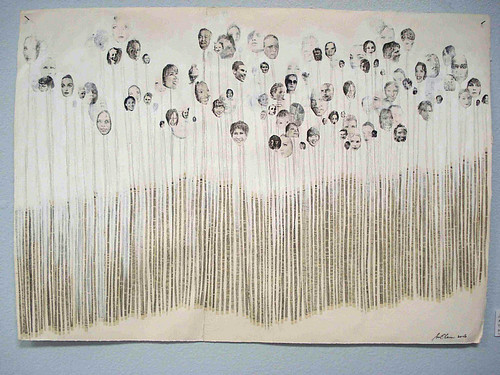
“The Directory”

In one of these pieces, “The Directory,” (above) individual heads appear to float like balloons, anchored with strips from the telephone directory, which form a mass at the bottom of the piece.

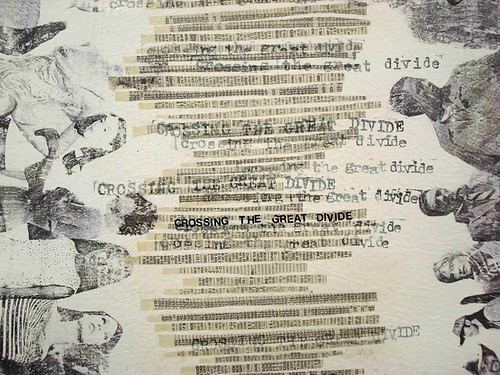
“Crossing the Great Divide” (below) seems to be a comment on the ways men and women connect – or don’t. Looking at the piece, it feels amazing that people ever successfully navigate the space between them.

“Crossing the Great Divide”

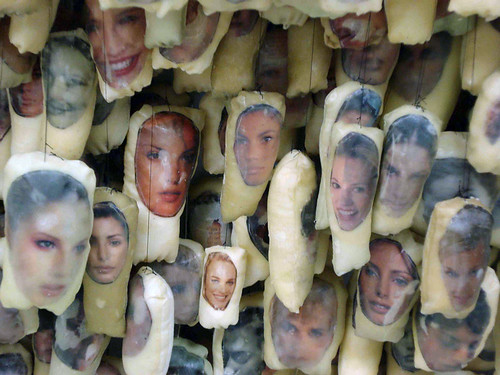
One of the more unusual pieces in the show was “Minus One But No One’s Counting.” (Detail at top, more images here.) It’s a complex piece made up of dozens of pillow-like elements onto which photos of faces from magazines have been applied, then covered with wax. Each “pillow” is suspended from a separate string. Each is attached to the wall with a T-pin, then they are all hung together to form a collective, oddly fleshy-looking mound of humanity at the bottom.

Susan says about this piece, “My thought process for [this piece] stems from my interest in the subject of individual vs. the masses. The piece dates back to 2002, and several other pieces from that time also include images from magazines, particularly fashion magazines. At the time, I was interested in the idea of an average person being unrecognizable vs. a celebrity person, and how much we think we know that person simply based upon images we'd seen in the mass media.”

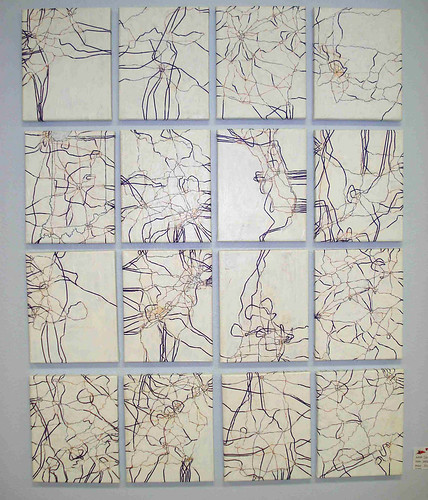
"MapQuest Series"

Also represented in this show was the “Mapquest series,” (above) a set of small mixed-media works on canvas based on the lines of interstate highways leading into and out of cities in each state. She follows the converging lines around cities, then as they begin to lessen and spread out, she emphasizes the lines reaching out to the edge of each small canvas. The result looks like a grid of abstract encaustic pieces – but each piece has an oddly familiar look to it, being based on the road maps we’ve all studied.

The largest piece in the show was a floating wavelike sculpture made of tealight holders and plastic twist-ties. You can see in the photo that it floats above the gallery’s seating area like a silver cloud-creature, responding to touch and any currents of air coming into the room as the door opens.

Taken all together, Susan Li O’Connor’s pieces show how an artist can begin with a question or an idea and then interpret it in a multitude of ways to build a body of related work.

More photos at the BAArtquake Flickr pool.

Monday, December 17, 2007

So many books, so little time

The Hand Bookbinders of California is having their 35th Annual Exhibit on the 5th Floor at the SF Public Library. The exhibit will be up until December 31st and it’s well worth taking a detour from the downtown galleries and museums to look at it. Each book cover is a small work of art and the craft that went into the making is simply astonishing. Calf Leather, birds’ eye maple boards, gold lettering, inlay, suede; the list of materials reads like an alchemist’s shopping list. But instead of the Philosopher’s Stone, contemporary bookbinders are in search of the perfect marriage of materials and technique to make books that transcend our understanding of “book” into an object that is both beautiful and unique.


Alissa Fleet: les Deux Magots: Altered book in dos-a-dos Structure of Miller's Tropic of Cancer, found endsheets and marbled paper. This one is so small that it fits in the palm of your hand.
More images at: http://cheznamastenancy.blogspot.com/

Saturday, December 15, 2007

Where ARE the women? Not at SF Moma


Frieda Kahlo and Georgia O'Keefe (only two images of work by women artists up on the website under "Permanent Collection"


There has been a flurry of articles (yet again) on the lack of women artists in major museums.
Jerry Saltz at ArtNet posted one and I've seen others. Being a curious sort of person, I downloaded the alphabetical list of artists from the SF Moma permanent collection and formatted the web pages in Word. There are seventy-three pages of artists listed in the permanent collection. Of those seventy-three pages, only six pages are of women artists -- approximately 1/12 of the entire collection. The museum is currently showing works by fifteen women artists. So, out of the whole floor devoted to the "permanent" collection, we get to see paintings by fifteen women.

There are whole sections of art movements that have no women represented (Fauvism, Cubism, Surrealism). There are no women artists prior to the 1920’s and the one women artist displayed (Helen Minter) is one that I am not familiar with. The museum is not showing any works by Sonia Delaunay, Mary Cassat, Berte Morisot or even Suzanne Valadon. The museum does own one piece by Merit Oppenheim, the fur lined cup, which is a Dadaist icon and one of the most famous pieces in the history of 20th century art, but they have chosen not to display it.

Many of the women artists are dead; although the captions by their works do not describe when the works were purchased, it’s a safe assumption that the works were not purchased during their lifetime. In contrast, most of the male artists in the contemporary section are still alive: Jim Dine, Rauschenberg, Jasper Johns, Polke, Richter, Anselm Kiefer, Bill VIola.

The Rose, by Jay De Feo which is arguably the finest Bay Area painting of the last 50 years is not in the museum. The whole saga of The Rose and its entombment at the SFAI for over 40 years before being shipped to the Whitney is a salutary lesson on how women artists are viewed. 1 In the past, the museum has gone to great lengths to preserve fragile works by men artists, including some strange installations pieces involving honey, pennies and sheep that I remember viewing at the old SF MOMA and another one involving old tires. However, preserving and hanging The Rose seems to have been beyond their resources. Similar fragile works by Eva Hesse are on display but Hesse has reached iconographic status in the art world due to her beauty, her talent and her early death (probably due to toxic exposure of the materials used in her work). There is nothing like the early death of an artist to guarantee popularity.2


Only one image deals with a woman looking at a man – Kahlo’s painting of her self and her husband (who is infantilized in the painting and certainly not presented as an object of desire). "The body," which became a locus of so much academic theorizing is not represented in any part of the collection on display. In fact, the contemporary collection focus on non-representational women painters avoids the entire topic of the female gaze. While I would not necessarily say that the works displayed are “safe,” they certainly are non-confrontational in terms of women’s images of men.

The women painters represented in the permanent collection paint in the traditional (and more highly valued) medium of oil. There are no quilts, ceramics, needlework, or embroidery represented. Few of the paintings represent specific female areas of experience. The exceptions are the work by Kahlo of her and her husband and Brown of her son, Noel.

The work on the wall does not challenge any mainstream conceptions of the viewer. For instance, there are no works by Judy Chicago whose exhibit here in 1979 of “The Dinner Party” stimulated a wide variety of related exhibitions, performances and lectures at the museum and in the Bay Area generally. Unfortunately, the backlash that followed was so strong that it took 25 years before there was once again (at least on the West Coast) a major exhibition at a museum focusing on feminist art. 3

Women artists of color and especially those who deal with issues of color, race and gender are not represented at all. Betty Saar, Inez Sorer, Mildred Howard, and Viola Frey are not in the collection; many of them are from the Bay Area. The museum is in no danger of slipping into multiculturalism – at least as far as women artists go.

If art is a luxury that artists pay for, as the sculptor David Smith is supposed to have said, being an artist is an even great luxury for women. The world outside the museum does not present a level playing field for women but the work on the walls magnifies that inequality.

The more recent acquisitions do reflect a greater degree of equality. I saw works by Julie Nehru, an up-and-coming painter of Ethiopian descent, works by Tuba Chador, Chloe Pine, Shahs Islander and Rebecca Bollinger. However, there are no works by current Bay Area women artists including Katherine Sherwood and Squeek Carnwith, to name two. A current exhibit of "new and emerging artists" earlier this year showcased three men; one portrays women in a quasi-pornographic fashion (Zak Smith) and the other two artists also showed work that used sexuality as a theme but was not particularly interesting (IMHO).

According to the Guerrilla Girls newsletter (summer, 2005) the economic policies of the Bush Administration have come home to roost in the art auction market. A new generation of Bush Billionaires is the latest poker players in the world of contemporary art. They’re throwing millions of dollars at the work of a handful of living artists to see which ones will appreciate the most over time. Problem is, the super rich throw their money at artists who look like themselves: other white males. A recent feature article in The New York Times tracked two British artists of the same generation, with similar exhibition records, and similar critical success. An artwork by the guy brought not two or three but ten times the price at auction of a comparable work by the woman. Neither the SF MOMA website nor their descriptions of the paintings in the collection tell us who bought the work for the museum or when it was bought but the paucity of women artists leads me to the inescapable conclusion that while the politics of museum donors may be liberal, their views on women in the arts is not. Another statistic from the Guerrilla Girls Newsletter is for a different, but related art form:

“72% of NEA grants for Choreography in 2000 were awarded to men. Thirteen men received an average grant of $10,000. apiece. Three women received an average of $5000. apiece. Most of the companies appearing at prestigious NY venues_American Dance Festival, Brooklyn Academy Next Wave Festival, Joyce Theatre, etc.—were headed by men. Any dancers out there need some Guerrilla Girls posters? (Summer 2001)."

The evidence is overwhelming that women are discriminated against across the board so we shouldn’t be surprised that this extends to the SF MOMA, indeed, any museum. In fact, this is supported again by research done by the Guerrilla Girls:

“The Guerrilla Girls have always maintained that public museums have a special repsonsibility to be inclusive in their presentation of art and to not support discrimination, even if that discrimination has been perpetrated by one of their biggest donors. Four Decades of Art from the Broad Collections, now on exhibit at the Los Angeles County Museum of Art, contains work by one artist of color and 4 women out of 25 artists. That's 4% and 14%, respectively. SHAME, SHAME, SHAME! (Summer 2001).”

And another note on collectors:

“Did you know that wealthy art collectors sit on committees that vote on what works of art museums should buy? Artists get no say, members of the public get no say, but individuals who donate lots of money do. A NYT article about Larry Rinder, a Whitney Museum curator, followed him to dinner with a novice collector who had just donated $25,000 to join such a committee. For that amount, the collector gets to tell the Whitney what to collect. “4

I know that the Whitney, like most museums, is desperate for money in a country where there is virtually no government support for the arts, but let's face it: this kind of behavior would be considered unethical, if not illegal, in other professions. And worse, it insures that most of the work being acquired by museums (and preserved for the future) is work that the marketplace has validated, i.e., the work of while males. SF MOMA is very discreet about who their donors are and what specific works are donated by whom, but their website lists ways to give – through Foundations, corporate sponsorship or private donations. Given what we see on the walls, is there any doubt that SF MOMA follows in the footsteps of the Whitey or indeed, any museum in this country? The evidence is there: seventy-three pages of artists but only six pages of women artists. Fifteen women artists are on display in the permanent collection – a collection that stretches for half a block or more.

Whatever gains women have made in the last decade are under constant attack by our current administration. The progressive forces outside the art world are fighting to maintain what they have gained, in some very significant ways losing (stopping the continuing war in Iraq being the latest example). In art, as in every other field, there is a glass ceiling. While we may dream that the ivory tower of the museum is a refuge from the racial, gender and economic issues that impact our society, alas, it is not so. So, when it comes to the institutions of the art world, liberal SF is right up there with the rest of the country.

References
1. Green, Jane and Levy, Leah. Jay DeFeo and The Rose. University of California Press. 2000
2. Wagner, Anne Middleton. Three Artists (Three Women). Modernism and the Art of Hesse, Krasner, and O’Keefe. University of California Press. 1998.
3. Sackler, Elizabeth (ed) , Lippard, Lucy, Lucie-Smith, Edward and Wylder, Viki D. Thompson. Judy Chicago. Watson-Guptill, 2002. pp. 11-12.
4. Guerrilla Girls Website
Bibliography
Broude, Norma and Garrard, Mary D. The Power of Feminist Art: The American Movement of the 1970’s, History and Impact. Harry N. Abrams. 1994
Green, Jane and Levy, Leah. Jay DeFeo and The Rose. University of California Press. 2000.
Sackler, Elizabeth (ed) , Lippard, Lucy, Lucie-Smith, Edward and Wylder, Viki D. Thompson. Judy Chicago. Watson-Guptill, 2002.
Wagner, Anne Middleton. Three Artists (Three Women). Modernism and the Art of Hesse, Krasner, and O’Keefe. University of California Press. 1998.


Friday, December 14, 2007

Richard Misrach

Art wants to be interesting and meaningful. Beauty just wants to be beautiful. Their relationship, as a result, is often difficult. It doesn't seem to bother Richard Misrach, though, who regularly makes high art from the ridiculously beautiful.

How does he do that?


Richard Misrach, 1.1.99 5:20 pm, 1999

I think it might have something to do with distance. Not just the obvious physical distance between camera and subject, but emotional distance. Misrach photographs with a sense of perspective, a reserve, that allows him to present the beautiful without wearing it on his sleeve.


Richard Misrach, Submerged Gazebo, Salton Sea, 1984

And what about the light? Have you ever seen a Misrach in which the light was not itself beautiful? I wonder if the crystalline quality of his light - like water on hot metal - doesn't somehow help temper all that beauty and anneal it into art.


Richard Misrach, Untitled # 696-05, 2005

Or it may simply be that Misrach has uncanny taste, preternatural knowledge of where art ends and kitsch begins.

Whatever it is, it seems to work. And Fraenkel Gallery has an interesting exhibit of early Misrach night pictures until December 22. Don't miss it.

Art in Second Life

Exploring Art in Second Life

A few weeks ago, I was watching the monthly KQED video podcast, "Gallery Crawl", which usually covers art galleries in the SF Bay Area. This time they visited a couple of galleries in Second Life. Which is a virtual place. It's real enough, though . . .

I'd heard of Second Life, but had never visited before. I thought it was just a fantasy version of a singles bar. Even so, the art galleries looked interesting and I wanted to explore them myself. So I signed on and went into Second Life.

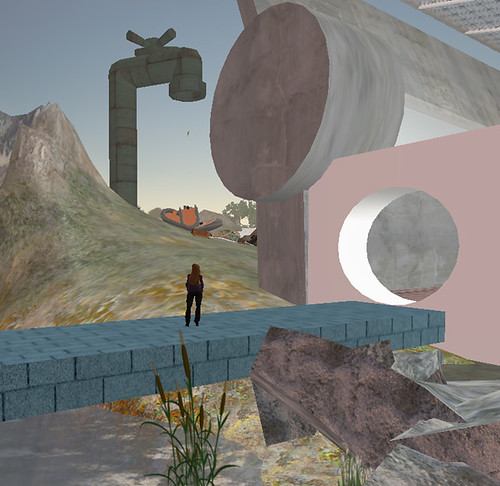
There is most definitely a wealth of art in Second Life, but before I get to that, let me say a few things about Second Life, as a place, as an experience. From my casual observations, it seems to me that the primary activities of the citizens of Second Life (in order of importance) are shopping, hanging out with friends, sex play, making art, and finding information. Vast amounts of land are filled with shopping malls, boutiques, and retail outlets (just like real life?) There are plenty of public gathering places like parks, beaches, museums, libraries, as well bars, clubs, theaters and the like. If you're into X-rated entertainment - it's easy to find, if you're not - it's easy to avoid. A variety of corporate and non-profit organizations have set up libraries, museums, universities, and interactive learning stations. Second Life reminds me of the early days of the web, but in 3-D, and it's much more interactive.
Exploring Art in Second Life

And for now at least, Second Life is heavily influenced by artists. It's a visually rich environment. If you're interested in architecture, fashion, landscaping, kinetic sculpture, color, pattern, design - you'll get hours of pleasure just wandering around the place, looking at everything. Imagine a world where artists got in at the beginning and had a say in how the place was built - this is it.

So it's no surprise that, not only is there plenty of public art, but there are tons of art galleries and quite a few art museums. Just like in the real world, some galleries are little more than souvenir shops for the tourists, while other galleries sell likable, forgettable paintings and photos (usually copies of real world works) and a few galleries show exciting, innovative work. The art museums are more conservative, but when you're talking about the Sistine Chapel (seriously) who cares?

Exploring Art in Second Life

KQED highlighted the galleries on Odyssey island, and justifiably so - it's an interesting space, with a couple of big galleries, some outdoor sculptures, an auditorium, and a strong emphasis on performance art. One gallery held photos of famous historical performance art pieces, next to photos of Second Life reenactments of scenes like Chris Burden's 1971 shooting.

One of the biggest galleries I've seen in Second Life is the Ginsberg Art Center, which is 6 floors of contemporary painting, photography and sculpture. It took me four visits to see the whole thing. Most of the paintings and photography look like they were brought over from real life. Here's a painting by Tommy Parrott (on right, below) called "3 birds and 2 beetles"- no other info available. Wall tags, and identifying info of any kind are somewhat lax in Second Life galleries. Sometimes, even in solo shows, I couldn't figure out who the artist was.
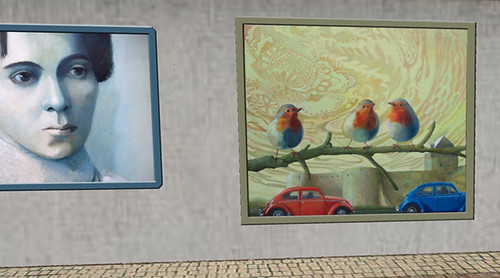
Exploring Art in Second Life

Some artists set up their own galleries, which operate like 3D portfolios. These places often did a better job of identifying the artist and providing web links to more info and contact details. For instance, on the island of Artropolis, artist Esch Snoats (aka Todd Tevlin) had a couple of signs up in his display area, "Esch Snoats in offline, touch here to leave a message for later." and "Want the real thing? Visit Esch's website to buy real life prints of his artwork! Click for website." Next door at the Gespot Gallery, was a space full of drums and colorful, symbolic narrative paintings (or collages?) for sale by Grimfiddle Dogpatch. Downstairs, next to a crowing rooster, I found his artist's statement, web link and real life name, Mark C. Meyers. Incidentally, Artoplolis has a free boat tour around the island. I took it at night, with a full moon, lots of stars in the sky, water sounds all around - and it was quiet, restful, and gorgeous. Pick up the boat at the dock by the photo studio of Shoshanna Epsilon. On the other side of the island were inventive portraits by Wake Idler - 3-D and hologram blendings of multiple images. The artist had another piece next to her dockside gallery, a sculpture of an oil drum, called "The Price of Oil." An info card next to the piece said that:
This piece serves to hammer home the true price of oil. The concept came to me while driving (what else?) and listening to Billy Bragg's song, "The Price of Oil." To get this piece, someone must die. Yes, die. This way we won't forget the thousands of Americans and the tens of thousands of Iraqis who have already died in the Second Gulf War. I don't want this going to alts, so your Second Life account must be real. To be real, your Second Life account must fufill the following characteristics:

1.) You must have been a member of Second Life for more than six months.
2.) You must either have payment info on record or rent land in a private island that doesn't require payment info on record.
3.) You must designate your heir to receive this work.
And of course ... you must die.

After you are gone from Second Life and have been gone from Second Life for 30 days, your designated heir will receive the piece. There will be no other charge for the item.

And then there are the out-of-gallery art experiences. One evening on Blackrock island, I ran into a guy, named Zenos Zond. He told me he was an artist, and when I asked him where I could see his work, he looked around and said, "Let's move over there, where there's more room." We walked a little ways to an open meadow and he began to conjure sculptures and paintings. One by one, an artwork would appear before us, I could walk around it, inspect it closely, ask him questions, and then it would disappear, to be replaced by another piece. Wow - talk about a spectacular portfolio presentation . . .

Exploring Art in Second Life

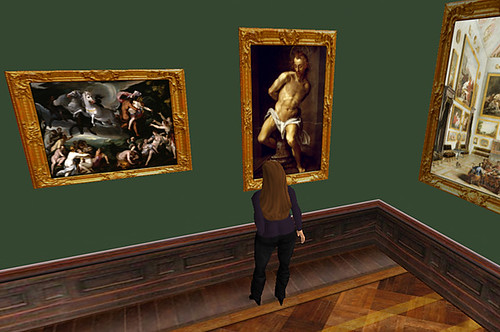
There are two museums in Second Life that I keep visiting again and again. The Dresden Museum is a recreation of the Old Masters Galleries in the real life city of Dresden and all 750 masterpieces in the permanent collection are on display. I still haven't seen everything in this building, and almost everything there is stunning. Yes, it's true that you can't get close enough to see the brush strokes and the accuracy of the colors depends on your monitor (among other things) but there's still a lot to be said for walking into a room full of great paintings that have been placed together by some kind of intelligent design . . . pausing in front of one, then stepping back to take in the pieces next to it, then stepping forward to check out a detail in one of them. It's an experience that you don't get in a book or in an online inventory where you click-through to the next slide. As a bonus, the Second Life Dresden museum gives away free t-shirts when you enter and the audio-guides are free, too.

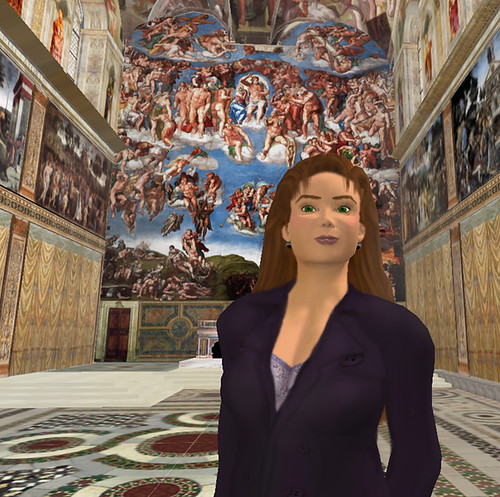
Vassar College has established a campus in Second Life and on that campus, they reconstructed the Sistine Chapel. The really cool thing about this version of the Sistine Chapel is that you can fly up near the ceiling and hover there while you take your time looking at the frescos. Over in the Castle Vassar art gallery, they have life-sized reproductions of the Leonardo DaVinci's Last supper and Jan van Eyck's Ghent Altarpiece. The altarpiece is constructed so that you can open and close the side panels to see the work on both sides, and get an idea of the work as an single construction. I guess it sounds silly, but I got big kick out of manipulating the panels and getting up really close to the panels.

There are a few things that Second Life is missing:
-Smog, traffic, parking problems. There are almost no roads, and cars are novelty toys, because you can get around by walking, flying or teleporting. (And climbing the pyramid at Chichen Itza doesn't make you short of breath.)
- Weather, except as a controlled event, designed for your education and enjoyment.
- Sewage systems, landfills, power plants, except as art installations.
- Taste, smell, touch. Your experience of Second Life is mediated by your computer, just as your experience of the Real World is mediated by your body. The brain is the most important element in both places.
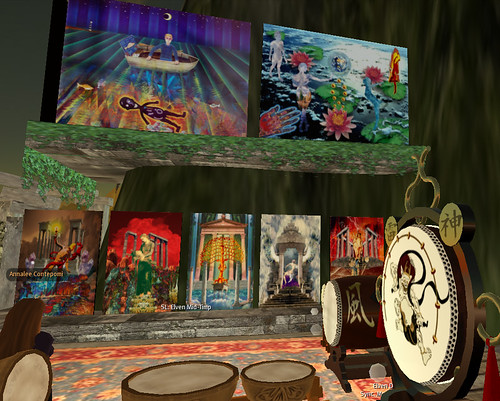
Exploring Art in Second Life

If you're thinking of checking out Second Life for the first time, you'll need a high-speed internet connection and a computer with a pretty fast graphics processor (ie: able to watch streaming video.) Go to SecondLife.com and sign up for a new account (it's free to visit, it costs money to become a resident.) When you enter Second Life that first time be prepared to spend about an hour making your avatar and learning how to use it - how to walk, talk, and so forth. Also be ready to pick a name for yourself. First you will have to choose your last name from list of names presented to you and then you can invent your first name (and all the usual ones are taken.) If you get there, look me up - my Second Life name is Annalee Contepomi. I've been thinking of leading a gallery crawl in Second Life, and if there's enough interest, I might just do it.

(The images are snapshots from my most recent visit to Second Life. More photos and captions identifying the artists on my Second Life Flickr page.)

Wednesday, December 12, 2007

Art for Peace at YBCA

from the San Jose Mercury News:

Expressions of peace
By Sara Wykes
for the Mercury News
published: December 11, 2007

Peace is one of those ideas with as many definitions as there are people in the world. The Dalai Lama - the exiled Tibetan spiritual leader whose official title includes such powerful honorifics as "Ocean of Wisdom" - has symbolized the hope of peace for millions. And in this one man, who wears glasses and utilitarian shoes, lies a world of possibilities.

"The Missing Peace: Artists Consider the Dalai Lama," an exhibit of work by 88 artists from 25 countries, offers a symphony of images voiced by a full orchestra of aesthetic instruments riffing on the powerful life force of this religious leader.

This is not an exhibit to be rushed through like a cafeteria line. Within the high-ceilinged spaces of the first-floor galleries at the Yerba Buena Center for the Arts, the paintings, photographs, sculpture and multimedia installations furnish long moments for meditation on the surprising ways the artists responded to the exhibit's organizing themes.

"Why do thousands go to hear him?" said Darlene Markovich, president of the Committee of 100 for Tibet and executive director of the show. "What is the message? How can art help to amplify that message?

Several artists in the "Missing Peace" exhibit are from the Bay Area - one of the show's most popular works was created by David and Hi-Jin Hodge of Half Moon Bay. The couple asked more than 100 people to talk about change. The process would stop, the couple agreed, when their subjects began to duplicate one another. But that never happened. And when technical problems led the Hodges to use iPods with video screens to display the many mini-films, this practical choice provided an appropriate visual wallop for our gadget-culture weary eyes.

The show is structured in sections that begin with work focused on the Dalai Lama himself. Here are photographs by Richard Avedon, Chuck Close and Sylvie Fleury. Bill Viola's video documents a blessing from the Dalai Lama so all can share in it.

A group of images focuses on Tibet and its people. One large canvas - it measures 6 1/2 feet by 10 feet - is titled "Brief History of Tibet" and its brilliant colors and intertwined images tell a story in striking fashion.

Another part of the exhibit springs from the artists' response to the basic beliefs of Buddhism, and visitors are guided through the works with a series of "lessons" from the Dalai Lama. "If you want others to be happy, practice compassion. If you want to be happy, practice compassion," or "Our prime purpose in this life is to help others. And if you can't help them, at least don't hurt them."

The exhibition has expanded exponentially beyond its original parameters. Its Web site (http://gallery.tmpp.org) includes an educational curriculum, a virtual tour and a wall of visitor responses. In development is an electronic gallery of work done by anyone who wants to participate by finding visual ways to express peace. Each answer will become part of a mosaic that can be accessed in a variety of electronic ways.

The works were originally intended to be auctioned off or to be sold as a group for permanent installation in a museum, but that future seems to be evolving, too. Just as the original idea for the exhibit changed in unexpected ways, it's impossible to predict just how the exhibit will end - or if it ever will, Markovich said. "You must let go of what you think you want to happen and something much more wonderful could happen."

Through March 16th at Yerba Buena Center for the Arts, 701 Mission St. at Third Street, San Francisco.

rest of the story here

images from YBCA web site: Marina Abramovic, Binh Danh, Squeak Carnwath