

Tuesday, May 18, 2010


Saturday, May 15, 2010
SFAI MFA Show at Fort Mason
Normally, I'm fairly tolerant of student work. I realize that students don't have that much experience and their work shows it. I realize that this is the time for experimentation. But this show is so bloody bad that I am non-plussed to find anything positive to say about it.


Friday, May 7, 2010
New pieces up at the Examiner.com on the various MFA Shows

From Monica Lundy's show at Mills College (up until the end of the month)
New pieces up at the Examiner on the various MFA shows.
Wednesday, May 5, 2010
TechShop
Tech and Industrial Tools for Artists

For technical and industrial artists and other creative types whose spectacular ideas never make it past the napkin they were designed on, TechShop seems like a really good idea.
TechShop has been in Menlo Park for a while and has just opened in SF, according to an article today in the San Francisco Chronicle.
Photo by Jessica Pons / The Chronicle
posted by Phil Gravitt
Monday, May 3, 2010
Where are the women at SF MOMA?
New posts up at Chez Namaste Nancy on the continuing lack of representation for women artists at SF MOMA, giant 21 foot robot baby at the Shanghai Expo and an essay on Mierle Laderman Ukeles, one of the generation of feminist artists and performers who is still making provocative work.

http://cheznamastenancy.blogspot.com/

http://cheznamastenancy.blogspot.com/
Friday, April 30, 2010
MAYNARD DIXON SHOW IN UKIAH
 Morning on the San Joaquin Plains, 1921, oil on canvas board
I finally made it over to the Grace Hudson Museum for their show, "Space, Silence, Spirit: Maynard Dixon's West." It is up through June 20th.
The Hudson website notes that it is a coup for a small town museum to display work by an artist of Dixon's prominence. This is true, but it should be noted that the exhibit, one man's collection, is very heavy on drawings and light on paintings, and that most of the drawings are what I'd consider sketches. Having said this, I hasten to add that it is a very well conceived and coherently presented show, arranged chronologically and with all phases of his creative life well represented.
The painting I spent the most time with is a very small oil, perhaps 5 or 6 inches high x 10 inches wide, titled "Trail Herd" and dating to early in his long career, 1915. Unfortunately I can't find an image of it online. It depicts a group of cattle and in the foreground two mounted cowboys. The dynamic movement of the two horses and riders is so very wonderfully captured and the composition dances across the small canvas.
The other single thing I found most interesting was a copy of a letter to the editor Dixon sent to the San Francisco Chronicle in 1939. He had been married to Dorothea Lange (by 1939, divorced) and during the time she was taking the photos for which she is famous, he was producing drawings and paintings on similar themes. The letter is a passionate defense of the humanity and rights of California's economic migrants.
This is a show worth seeing - but for folks reading this from over 2 hours away, frankly it may not be worth a trip up unless you have other things you want to see or do here (and being it's wildflower season, the weather is great, there are lots of great day trips around here and its a very scenic ride either to the coast or the Napa Valley, you could make a great weekend out of it!).
Wednesday, April 28, 2010
The Art of Photography
Today's KQED Radio "Perspectives"
Interesting observations on the art of photography, on KQED radio "Perspectives."
Listen to the recording at http://www.kqed.org/radio/programs/perspectives/
Wed, Apr 28, 2010 -- 7:35 AM
Tools
The most probing questions Peggy Hansen gets about her photography are all about the camera she uses. But the key to good art has little to do with the means of producing it.
posted by Phil Gravitt
Listen to the recording at http://www.kqed.org/radio/programs/perspectives/
Wed, Apr 28, 2010 -- 7:35 AM
Tools
The most probing questions Peggy Hansen gets about her photography are all about the camera she uses. But the key to good art has little to do with the means of producing it.
posted by Phil Gravitt
Monday, April 26, 2010
(ReBlogged from "Working Artist's Journal")
Another spectacular weekend spent visiting artist open studios . . . this time it was in the Mission district which, according to Mission Artists United, "has more artists than any other neighborhood in San Francisco." I hit the big buildings, spent two days at it, still didn't get to see everyone, but here are my top four favorites:
Sonya Philip
fiber arts
www.sonyaphilip.com
1890 Bryant Street, Studio 210
She calls herself a fiber artist, but I think she's more than that. She did have a lot of woven, knotted, sewn, and needled work. Some of it reminded me of Masako Takahashi's work, although Ms. Philip wasn't familiar with her. A mixed media sculpture caught my eye - it was a white dress form filled with little red & white fist-sized creatures which Ms. Philip called "the spleens." She explains here:
Diane Komater
wire sculpture
www.wireist.com
Her wire drawings are the best I've ever seen in this medium. Excellent, intelligent grasp of line with a good dose of humor. She also shows work at Velvet Da Vinci on Polk Street in San Francisco:

Kirstine Reiner
painting
Workspace Ltd., Studio 10a
2150 Folsom Street
kirstinereiner.com
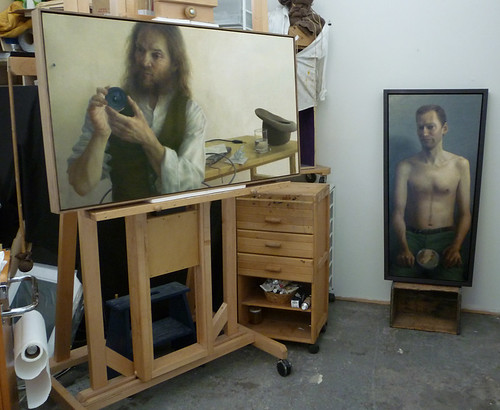
I'm really at a loss for words when it comes to Reiner's work. It's perfect. Mind-blowing, really. Her rendering of flesh is so alive, it's hard to resist touching it. And she puts just as much care into her backgrounds, with emotional, modulated mixtures of colors and tints:
Natasha Dikareva
sculpture
Workspace Ltd., Studio 12
2150 Folsom Street
dikarevart.com
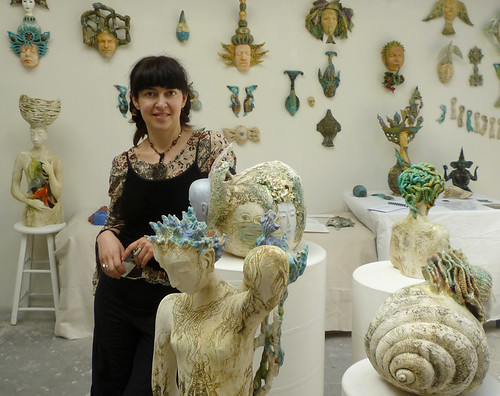
These sculptures drew me in more than anything else this weekend. I want one. They have enough symbolic and narrative content to keep me thinking for a long, long time and the form & colors are exquisite. Many of the wall sculptures on exhibit this weekend were commissioned portraits that centered around a cast of the subject's face. Surrounding the face was an integrated imaginarium specific to that person's story. Many of her other pieces were covered with ink-like scribing, which she called tattoos, but which really resembled ancient cartography. Natasha Dikareva's work makes spirit visible:
More quick shots of artists in their studios on my Flickr page.
Another spectacular weekend spent visiting artist open studios . . . this time it was in the Mission district which, according to Mission Artists United, "has more artists than any other neighborhood in San Francisco." I hit the big buildings, spent two days at it, still didn't get to see everyone, but here are my top four favorites:
Sonya Philip
fiber arts
www.sonyaphilip.com
1890 Bryant Street, Studio 210
She calls herself a fiber artist, but I think she's more than that. She did have a lot of woven, knotted, sewn, and needled work. Some of it reminded me of Masako Takahashi's work, although Ms. Philip wasn't familiar with her. A mixed media sculpture caught my eye - it was a white dress form filled with little red & white fist-sized creatures which Ms. Philip called "the spleens." She explains here:
Diane Komater
wire sculpture
www.wireist.com
Her wire drawings are the best I've ever seen in this medium. Excellent, intelligent grasp of line with a good dose of humor. She also shows work at Velvet Da Vinci on Polk Street in San Francisco:
Kirstine Reiner
painting
Workspace Ltd., Studio 10a
2150 Folsom Street
kirstinereiner.com
I'm really at a loss for words when it comes to Reiner's work. It's perfect. Mind-blowing, really. Her rendering of flesh is so alive, it's hard to resist touching it. And she puts just as much care into her backgrounds, with emotional, modulated mixtures of colors and tints:
Natasha Dikareva
sculpture
Workspace Ltd., Studio 12
2150 Folsom Street
dikarevart.com
These sculptures drew me in more than anything else this weekend. I want one. They have enough symbolic and narrative content to keep me thinking for a long, long time and the form & colors are exquisite. Many of the wall sculptures on exhibit this weekend were commissioned portraits that centered around a cast of the subject's face. Surrounding the face was an integrated imaginarium specific to that person's story. Many of her other pieces were covered with ink-like scribing, which she called tattoos, but which really resembled ancient cartography. Natasha Dikareva's work makes spirit visible:
More quick shots of artists in their studios on my Flickr page.
Friday, April 23, 2010
Reinventing Ritual: Contemporary Art and Design for Jewish Life at the CJM

Jonathan Adler. Utopian Menorah. 2006 (Theme: Building)
For most of us, the morning ritual consists of falling out of bed, stumbling to the bathroom, putting on the water for coffee and reading the paper - or the Internet. Some of us check our e-mail first thing. Some have to walk the dog. But the current exhibit at the Contemporary Jewish Museum takes the idea of routine, thoughtless ritual into a more spiritual dimension and links objects made by contemporary artists and designers with the ancient rituals of Judaism. It is designed to invite visitors to consider their own rituals and create dialogue through a series of questions asked through the exhibition like: What are the rituals that you perform as you wake up in the morning? Are rituals different from a habit or routine? What do you remember about rituals you participated in as a child? Have you continued or modified those rituals for your family? Do you have a sacred space in your home? How did you make it sacred?
Judaism is one of the oldest, if not the oldest surviving monotheistic religion. Jewish rituals, customs and scholarly traditions have allowed it to survive centuries of persecution so the ritual items in the exhibit take on an importance beyond their design - they are a spiritual link with the past. The objects presented in the show reflect contemporary concerns and artistic viewpoints.
The show is arranged in four thematic nodes: Thinking, Covering, Absorbing, and Building. These themes focus on ritual as physical action related to specific acts such as eating, drinking, counting, smelling, lighting candles, and praying, essentially grounding them in things shared by all people -- food, clothes, the environment.

Studio Armadillo. Hevruta Minuta. 32 knitted skullcaps. 2007 (Covering)
Ritual is central to Jewish lived experience and practice. Rituals are performed to celebrate or mark life’s passages, to bless the food that that they eat, and to sanctify the space in which they pray. Jewish texts and laws require rituals, although specific customs and practices vary in different parts of the world and have evolved and transformed over the centuries. Contemporary Jews seeking renewed relevance in their relationship to Judaism have expanded and invented new ritual practices. Rituals can be celebratory and raucous or somber and meditative, solitary activities or group experiences. The impact of a ritual on those engaged in it is not easily articulated, but it transforms and changes the participants in the process.

Martin Wilner. Sephirot III, 2007 (Thinking)
The exhibit features innovative works in diverse media including installation art, video, drawing, metalwork, jewelry, ceramics, comics, sculpture, textiles, industrial design and architecture created between 1999 and 2009. Since the 1990's, Judaism has been revolutionized by feminism, environmentalism and much more and the current exhibit reflects that reality. “The Museum has really been at the forefront of thinking about ritual objects and their contemporary significance,” says Connie Wolf, Executive Director of the CJM. “Reinventing Ritual builds on what we’ve created – looking across the spectrum at traditional objects and rites and bringing in both new and familiar artists to think in fresh ways about the role of ritual in our everyday lives.”

Many of the objects can be viewed through the prism of contemporary social movements – feminism for example being one of the greatest sources of new ritual practices. With Fringed Garment (2005), American fiber artist Rachel Kanter pushes the boundaries of traditional sex roles by combining a kitchen apron and a prayer shawl (until recently worn only by Jewish men) in a more practical form designed for a woman. Kanter writes, “If I wanted to wear a tallit, it should be made for me and speak of my experiences as a spiritual Jew, a woman and a mother.”

Rachel Kanter. Fringed Garment. 2005 (Covering)
A sculptural installation by past CJM Invitational artist Helène Aylon, All Rise (2007), addresses the patriarchal tradition that allows three males to pass judgment in the Jewish Court but forbids women to judge. Aylon’s installation is an egalitarian vision of the future: a courtroom that administers feminist halakha (Jewish law). “I think of my work as a ‘rescue’ of the Earth and G–d and Women—all stuck in patriarchal designations,” she writes.

Alan Wexler. Gardening Sukkah.(Building)
The exhibition also includes a resource area that provides information about traditional and contemporary Jewish ritual. Several works in the exhibition also have an accompanying video-label that provides further insight into the process, ritual, and concept behind these works. These video-labels are portions of a commissioned video featuring commentary by rabbis, artists and the exhibition’s curator. The excerpts provide insight into the show’s themes and an explanation of the highly symbolic rituals of Judaism and more.
All images courtesy of the Contemporary Jewish Museum. Check their website for hours and a list of accompanying programs: http://www.thecjm.org/
or call 415.655.7800. The Contemporary Jewish Museum is located at 736 Mission Street (between 3rd & 4th streets), San Francisco.
Tuesday, April 20, 2010
SOMA Open Studios at South Beach
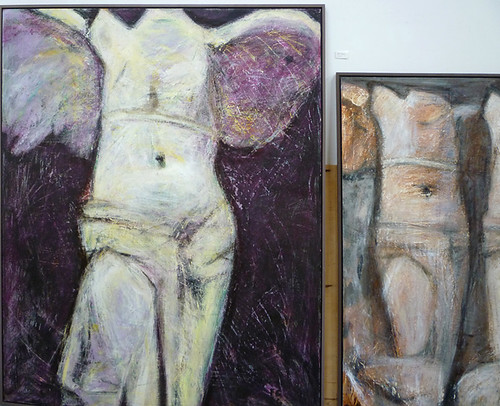
I stopped by South Beach Artist Studios on Sunday, the last day of SOMA Open Studios in SF. I'll write more about Sandra Yagi in the next post, but two of my other favorites were Susan Rippberger and Florence Gray. (That's Florence's work above - a couple of huge paintings in the hall outside her studio.)
Susan Rippberger's studio was a hodge-podge of disparate projects and she was sitting at a table in the middle of it all with food wrappers scattered on the floor by her feet. Turns out, she was weaving a prototype "shawl" out of the plastic wrappers. Half the wrappers were from Mexico, half the wrappers were from the US. She explains it here:
Florence Gray is a painter and I was immediately drawn to her use of color and her expressive, brushy application of the paint. Her newest work is a large set of mostly small pieces, all with single iconic images and single words. She's been using an vintage set of simple kid's flash cards as inspiration. Regardless of subject, her paint handling is really beautiful. Here she is in her own words:
Also: Nancy Ewart wrote about some of the SOMA open studios at the Examiner.
Saturday, April 17, 2010
Helen Frankenthaler at Berggruen

Bias Blue, 1965, @ Helen Frankenthaler
To be young, talented, and ambitious in the NY of the 1950's was not such a gift if you were also a woman. But if you were all of the above, and smart/and or lucky enough to fall in with the most influential art critic of the times (Clement Greenberg), marry another one of the giants of American Painting (Robert Motherwell) and not fall prey to the shadows that consumed many of the women artists of the time, you too could still be a "name" in the art world. Helen Frankenthaler is still a "name" in the contemporary art world. The current exhibit at is a rare look at a thirty year time span, one which is even more rare because none of the local museums have any of her work (or at least, not on display). She has also been fiercely protective of her work, often not allowing images to be reproduced, either in magazines or on the web. So to to see them here in San Francisco, in the flesh, as it were, is doubly unique.

Granada, 1953. @ Helen Frankenthaler
At the time, her staining or soaking technique of color into unprimed canvas was different enough to bring critical attention but it's the quality that continues to command respect - the lyrical watercolor aesthetic that harkens back to John Marin and Arthur Dove. Her breakthrough painting, Mountains and Sea (1953) came after a year spent studying and assimilating Pollock's work. This piece made her reputation and established her signature style.

Orange Underline, 1963. @ Helen Frankenthaler.
Her fluid, intuitive visual language - poured paint on unprimed canvas - does not photograph well. In photographs, you miss the shock of paint against the off-cream of the canvas, the halo effect of the colors, the blurred edges. I think that her work remains popular because it makes no demands on the viewer beyond appreciating the dreamy, creamy colors.

Helen Frankenthaler Provincetown 1, 1965

Helen Frankenthaler. Winter Energy
I enjoyed her lyrical pieces in the exhibit but I wasn't sure that that she had been anywhere other than where she first started, back in 1953. Some of the pieces are more shapeless than lyrical with muddy and indistinct colors. Even her master, Jackson Polllock came to a stuck place in his drip-and-pour process. Ms. Frankenthanler has been at it a long time and it's natural that not all the paintings are up to the highest standards. If she were a lesser-known artist, she might be less indulged and that's not a bad thing. The show could have done with a more rigorous selection process. That would have made the better pieces stand out more.

Helen Frankenthaler. Movable Blue, 1973
Nevertheless, to have a solo exhibit of an artist of this stature here in the Bay Area is a grand treat.There aren't many living artists of the second-generation of abstract expressionists still around and fewer still are women. Joan Mitchell, Grace Hartigan, Lee Krasner are all gone so the fact that Frankenthaler is still going strong is something of a miracle.
http://www.berggruen.com/
All images courtesy of the John Berggruen Gallery; copyright Helen Frankenthaler
Wednesday, April 14, 2010
Worlds in Miniature

The Museum of Performance & Design is making preparations for a new exhibition featuring the world of toy theatres.
Toy Theatres: Worlds in Miniature opens in July and will showcase 21 rare toy theatre models from around the world, some dating back to the 18th century.
Toy theatre certainly isn't dead. In recent years contemporary artists including Sandow Birk and William Kentridge have used toy theaters to create stunning new work.
Sandow Birk produced and filmed his interpretation of Dante's Inferno entirely on the stage of a toy theatre, and Kentridge used a toy theatre to create a production of Mozart's Magic Flute that employed Kentridge's unique projections.
You can see more images of toy theatres at MPD here. I've had the opportunity to work with some of these models and they truly are a fascinating coming together of the visual and performing arts.
Photo of "William Tell" toy theatre courtesy of MPD.
Friday, April 9, 2010
Looking for Art in One of the Wrong Places
 Haven’t gotten out much to see art in the last 4 months, with the exception of the early February opening of Love, Art and Chocolate at 323 Gallery, and more recently a quick sprint through SFMOMA 75th Anniversary exhibit.
On an early morning walk the other day, I came across a row of boxy 1950s-style houses that were all painted about the same time during the fresh-paint-and-then-flip housing boom a few years ago. Even though the paint wasn't that old, several houses had massive peeling.
One house caught my eye, and I stopped to marvel at how the paint peeled in interesting and creative forms. I wondered if it was a different painter, if he or she knew that by ignoring all the rules of paint preparation, and then applying the paint a certain way, it would yield a few short years later a 3D mural of peeling paint in the shape of butterflies, the continents of Africa and Australia, the islands of Hawaii, Indonesia, and Rhode, a large manta ray and a tall ship. It was something to behold in the early morning light.
 Speaking of murals, San Francisco muraling team Jennifer Ewing and Leo Germano recently completed several large art deco paintings that are installed in the historic Varsity Theater in downtown Davis. The theater web site doesn’t mention the murals; I guess you need to buy a ticket to see them.
  Another reason to go to Davis is to see the Proclivities show of SF encaustic artist Adele Shaw at the Pence Gallery. The opening reception is tonight Friday April 9, 7-9PM. The show runs through May 9.
posted by Phil Gravitt
Saturday, April 3, 2010
Chinese Master Ink Painters at the Cantor Arts Center

 Just a few quick notes about a show I saw today: "Tracing the Past, Drawing the Future - Master Ink Painters in 20th-Century China" at the Cantor Arts Center, through July 4, 2010
I was really excited to see this show. Not only was it a room full (100 pieces) of ink & watercolor paintings, but it built on the things I learned in February at the "Shanghai, Art of the City" show at the Asian Art Museum in San Francisco.
This exhibit at the Cantor was work by four artists, known in China as the "Four Treasures" of 20th Century painting: Wu Changshuo (1844–1927), Qi Baishi (1864–1957), Huang Binhong (1865–1955), and Pan Tianshou (1897–1971).
One of the first images the visitor sees on entering the exhibit is a very large portrait of Wu Changshuo, executed by two of his students. the head is painted in photorealistically, the rest of painting is the loose, brushy style more common to traditional Chinese ink paintings. Until I saw a similar piece at the SF museum recently, I'd never seen this kind of work before. They had several examples here sat the Cantor. Always done in collaborations, with one artist working on the face, another artist finishing the rest. Wu Changshuo's work was very colorful and some showed the influence of the European impressionists. (His painting of hanging gourds below.)

Qi Baishi's animal scrolls were animated, sensitive masterpieces - the perfect line, single strokes, awesome! (That's his shrimp at upper right.)
 Huang Binhong did plain air painting in the countryside, and some of his "sketchbooks" (tiny scrolls) were on display in cases. Amazing when you consider they had to grind the inks. His larger scrolls were mostly blacks & greys with lots of layered overpainting and dry brush. (Image of his work at top left.)
Many of Pan Tianshou's scrolls were massive in size. They were designed for public spaces and often hung in government buildings. He also used his fingers instead of brushes much of the time! (Image at right is his.)
In the hall outside the painting exhibit are photographic of the artists, their students, and some of the areas where they lived and worked.
There are a few YouTube videos about the exhibit, but the Cantor web site has almost no images.
Friday, April 2, 2010
Friday Gallery Walk
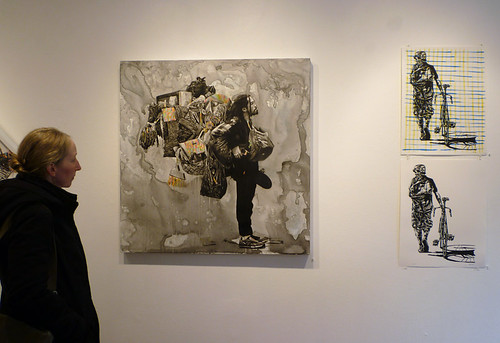
Just a quick run-down of a few galleries we saw this evening:
F*cal Face Dot Gallery
Marco Zamora & Derek Aalbeck - Extremely small gallery (one room, about the size of a master bedroom) but bold art. Incredibly rendered graphite drawings by Derek Albeck and interesting ink & watercolor paintings on wood by Marco Zamora.
Octavia's Haze
Expressionist paintings by James Michalopoulos - Had trouble finding this gallery (the gallery web site says it's located at 370 Hayes - it's actually a block away from there) and when we did finally locate it, it was closed. Even though we were there an hour before the stated closing time. Too bad, I really wanted to see James Michalopoulos' paintings.
So we checked out another gallery instead - Polanco Gallery at 393 Hayes. They had a terrific group show of Mexican artists - the best show of the evening, really. Unfortunately, they don't allow photos in the gallery, which is really too bad since the images on their web site don't do justice to the work. The work was arranged exceptionally well and paintings by Rafael Rodriquez and Carlos Jaurena were top quality. There was also a great little piece by Abel Almenara that is not even on the web site.
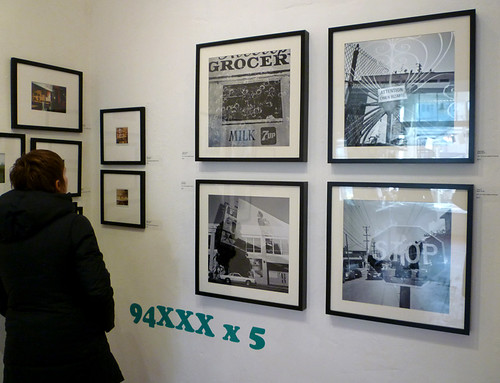
Rare Device is one of those small gallery & craft places that seem to be proliferating these days. Theoretically, sales of the small craft items support the fine art exhibition space, but I've heard from some of the folks in these spaces that actually the economic downturn has hurt small craft sales more than fine art. "94xxxx5" is a photo show in a tiny back room at Rare Device - the work focuses on SF neighborhoods and fits well with the rest of the items in the space.
Along the way, we passed some outdoor art on Octavia:

Wednesday, March 31, 2010
Allison Adams At the SF MoMA's Artists Gallery at Ft. Mason
"I seek the outdoors and that feeling of connection as much as possible, but I am still within this urban environment most of the time, which can sometimes feel isolating. I reflect and muse upon all that I experience and see here and seek out the Nature hidden under asphalt, pavement, and planted green lawn. " Allison Adams


Allison Adams, Pathway (now on exhibit at the SF MOMA Artists Gallery)

At the current show in The Loft space at SF MOMA's Ft Mason gallery, Curator Renee de Cossio has paired Adams' woven textile forms with Stern's more open and airy pieces. Using an old-fashioned loom four harness loom, Adams uses recycled plastic as well as wire, monofilament, audio and video tape to create asymmetrical woven pieces and three-dimensional sculptural pieces. The woven pieces are shinny and dense, glittering with bits of recycled material, integrated into the irregular grids. The Nebula pieces are more open, and very evocative of the star clusters from which they get their name. Many of the woven textile pieces are enclosed within dark frames which does not, in my opinion, allow their need for visual expansive space. The lighter framed pieces are more successful because the frame disappears against the wall, allowing the viewer to be pulled in far enough to examine the superb craft of the artist as well as the inventive use of recycled materials.

Allison Adams, Swirl Nebula III
Unfortunately, Adams' three-dimensional pieces and Stern's airy abstractions (some of which are on unframed paper0 don't always work well together -- or, to be more accurate, the Loft's gallery space is too small to allow each artist's work to claim its visual territory. I was reminded of SF MoMA's exhibit in which they combined pieces by Ansel Adams and Georgia O'Keefe. In many instances, Adams' dark, glossy photographs sucked energy from O'Keefe's more delicate and colorful abstractions. A 2009 show at the Clark Museum in Williamstown, Massachusetts, which paired O'Keefe and Dove was more successful. Both those artists shared a painterly vision and a similar technique and palate. Yet I understand why the curator packed the small Loft gallery with these pieces. They are unique and deserve to be shown. But, given the gallery situation in San Francisco, artists like Adams and Stern have to fight for recognition in a town with too little space for serious artists.
http://www.allysunkadams.com
SFMOMA Artists Gallery at Fort Mason
Building A, Fort Mason Center
San Francisco, CA 94123 USA
415.441.4777
Hours : Tuesday - Saturday, 11:30 a.m. - 5:30
http://www.sfmoma.org/pages
All images courtesy of SF MOMA Artists Gallery and the artist
http://www.allysunkadams.com
SFMOMA Artists Gallery at Fort Mason
Building A, Fort Mason Center
San Francisco, CA 94123 USA
415.441.4777
Hours : Tuesday - Saturday, 11:30 a.m. - 5:30
http://www.sfmoma.org/pages
All images courtesy of SF MOMA Artists Gallery and the artist
Monday, March 29, 2010
Pia Stern at SF MOMA Artists Gallery at Fort Mason (through April 23)
Stern didn't start out to be a painter; in college she studied social sciences, language, city planning, anthropology - the grab bag of a student unsure of her direction and lacking discipline and focus. That's an observation, not a criticism. I think most of us were in the same place in the less financially stressed college atmosphere of the 1960's and 1970's. But she spent her junior year in Aix-en-Provance, signed up for a painting class which changed her life:

"I felt at home with the people teaching that class...They were all devoted to Cezanne and lived in the shadow of Monte Saint-Victoire. I felt at home with how they looked at things, philosophically speaking, as well as their way of perceiving things visually."
" I remember the first stoke; cobalt blue, a diagonal stroke on a rectangular three-by-four canvas. I burst into tears when I made it. It was a Zen experience."
When she returned to California, she began to study painting in earnest. She was fortunate in her teachers for the art world here was still infused with the unique artists that came out of the post-war generation - Diebenkorn, Park, Thiebaud. They distrusted too much verbalization and taught in a direct, personal manner. One of her most influential teacher, Elmer Bischoff addressed the work on "what was going on, or not, in inner terms." (1)


(1) Charles Shere. Impulse, Depth and Poetry: The Art of Pia Stern. Imagio, Vol 21, February 1999, pp 31-41.
(2) Sister Wendy Beckett. Contemporary Women Artists. 1988
SFMOMA Artists Gallery at Fort Mason
Building A, Fort Mason Center
San Francisco, CA 94123 USA
415.441.4777
artistsgallery@sfmoma.org
Hours : Tuesday - Saturday, 11:30 a.m. - 5:30 p.m.
http://www.sfmoma.org/pages/artists_gallery_exhibitions
All images courtesy of the artist. Photographer Ian Cummings.
Pia Stern. Nocturne
"I felt at home with the people teaching that class...They were all devoted to Cezanne and lived in the shadow of Monte Saint-Victoire. I felt at home with how they looked at things, philosophically speaking, as well as their way of perceiving things visually."
" I remember the first stoke; cobalt blue, a diagonal stroke on a rectangular three-by-four canvas. I burst into tears when I made it. It was a Zen experience."
When she returned to California, she began to study painting in earnest. She was fortunate in her teachers for the art world here was still infused with the unique artists that came out of the post-war generation - Diebenkorn, Park, Thiebaud. They distrusted too much verbalization and taught in a direct, personal manner. One of her most influential teacher, Elmer Bischoff addressed the work on "what was going on, or not, in inner terms." (1)
Pia Stern. This Time The Promise
Out of this she developed a lyrical style, based on intuitive gestures and spontaneous marks, a cryptic language that almost seemed understandable if the viewer looked long enough. Her current work at the Artists Gallery at Ft. Mason is still lyrical but is edging closer to abstraction. The pieces are larger than the ones last shown here in the lobby of 555 Market Street but they still pull the viewer in. Stern describes her current oils on canvas as a cross between optimism at Obama's election but concern over the dismal decade that we had just survived and where we, as a country and the world, might be going. The canvas is large, rectangular, layered with a palimpsest of oil and oil pastels. She retains the poetic feeling of her earlier work but the gestural shapes and quasi-writing float in the luminous field, asking questions that only the viewer can answer.
Stern's concerns with what she describes as "...existential nature of her work...the tension between light and dark" comes to the fore in the series "Earth Abides." These charcoal pieces were done just before the US entered the war in Iraq and prefigure the devastating conflict to come. Nevertheless, her work retains what Sister Wendy Beckett wrote about in her 1988 publication, Contemporary Women Artists:
"When art is personal and private, we can feel an irritating sense of exclusion. The artist has therefore to win our trust, and lure us into his "private dreams" in a way that we can understand. Pia Stern ..has an unusual power of transforming her "dreams" into our own. They remain hers; she does not share them..But we are not asked to riddle out Stern's private meanings." (2)
What I find fascinating is that Stern, while continuing to develop as a painter, has avoided the pull to make work that is completely insular and self-referential. Her work speaks to me beyond her biography - her parents escaped Nazi Germany - or even (possibly) her intent. Like all good work, it allows the viewer to make their own assumptions and associations.
(2) Sister Wendy Beckett. Contemporary Women Artists. 1988
SFMOMA Artists Gallery at Fort Mason
Building A, Fort Mason Center
San Francisco, CA 94123 USA
415.441.4777
artistsgallery@sfmoma.org
Hours : Tuesday - Saturday, 11:30 a.m. - 5:30 p.m.
http://www.sfmoma.org/pages/artists_gallery_exhibitions
All images courtesy of the artist. Photographer Ian Cummings.
Thursday, March 25, 2010
Pia Stern at the SF MoMA Artists Gallery at Ft. Mason

Pia Stern, "Wicked Romp" (2009). photo, Ian Cummings (courtesy of the artist).
From the press release..
"Stern's paintings suggest a logic of the heart, which she uses to guide her art-making process. Her painted and drawn figures and forms set within abstract fields combine to create rich, tactile, and vibrant expressions that allude to the individual's psyche and one's place in the natural world."
I am going to write a decent review later but for now, I just want to mull over the luminous beauty of her paintings. In her book on Peace, Sister Windy Beckett wrote: "Stern shows us two ways of being: the physical, answerable only to accident, to wind and tides; and the spiritual, answerable to inward truth. One is free-flowing; the other is fixed, grounded in more than its own small compass - in God. "
Thursday, March 18, 2010
Same as It Ever Was
. . . in the immortal words of 80s icons the Talking Heads.
Went to the Getty Villa a few weeks ago. You probably know this already, but it's all antiquities now--the paintings were trucked over to the Getty Center. I am a philistine, I know, but one floor of antiquities is pretty much my limit, then they all start to look the same, so much so that my friend had to call my attention to the paintings of drunks on the wine vessels. The drunks were doing what drunks do everywhere (click on these to see the vessels): singing; singing while urinating (a servant holds a pitcher for his master's eliminations); dancing; flirting and frolicking; making unwelcome advances; having a sexual encounter; staggering home with the help of one's friends; and, of course, the classic: vomiting.
Went to the Getty Villa a few weeks ago. You probably know this already, but it's all antiquities now--the paintings were trucked over to the Getty Center. I am a philistine, I know, but one floor of antiquities is pretty much my limit, then they all start to look the same, so much so that my friend had to call my attention to the paintings of drunks on the wine vessels. The drunks were doing what drunks do everywhere (click on these to see the vessels): singing; singing while urinating (a servant holds a pitcher for his master's eliminations); dancing; flirting and frolicking; making unwelcome advances; having a sexual encounter; staggering home with the help of one's friends; and, of course, the classic: vomiting.
Monday, March 8, 2010
International Women's Day and San Francisco's own International Museum of Women

International Women's Day is the story of ordinary women as makers of history; it is rooted in the centuries-old struggle of women to participate in society on an equal footing with men. In ancient Greece, Lysistrata initiated a sexual strike against men in order to end war; during the French Revolution, Parisian women calling for "liberty, equality, fraternity" marched on Versailles to demand women's suffrage. The struggle continues today because the issues that impact women are our issues - poverty, racism, injustice, violence. As the saying goes, women hold up half of the sky.
San Francisco has it's own museum dedicated to women. The International Museum of Women, (I.M.O.W.), is a social change museum that celebrates and values the lives of women around the world. The museum's programming is offered locally in the San Francisco Bay Area as well as globally. The museum began as the Women's Heritage Museum in 1985 and in 1997 became the more encompassing International Museum of Women.
The need for a larger museum was realized in 1997 when a group of Bay Area teachers sought a place to take their students. One of these teachers, Elizabeth L. Colton, who had been on the board of the Women's Heritage Museum, spurred the drive to create a larger museum, in part through private funding.
Since its rebirth under the new name in 1997, I.M.O.W. has organized more than seven major exhibitions, hosted a number of public fora, developed educational curriculum for schools and created a number of speaker series programs. Current on-line exhibits include "Economica: Women and the Global Economy" and Women on the Map."
http://www.imow.org/home/index
http://en.wikipedia.org/wiki/International_Museum_of_Women
Saturday, March 6, 2010
Shanghai - Art of the City at the Asian - Soiled Doves, New Women and Celluloid Goddesses
What do the following have in common – foot binding, prostitution, the silk industry, concubines? They all have to deal with the reality of women in Shanghai and they are all omitted from the current exhibit at the Asian. Shanghai, The Art of the City, presents such a cleaned up and ready for its close-up image that you would never guess that it was a byword for decadence, corruption, violence, and in the 1920's and 1930's, the VD capital of the world.

Shining Eyes and White Wrists. (Above) (1887-1893) Wu Youru. Ink on Paper. Collection of the Shanghai History Museum. Women are playing billiards in one of the new public gardens in Shanghai. Since upper class and "respectable " women were largely secluded during this time, it's a reasonable assumption that these women were prostitutes (from the catalog of the show, p. 95)
In the first part of the exhibit, we are treated to a display of charming images about women. One brush-and-ink drawing is described as women playing table tennis, another one is identified as a courtesan while another women is using a sewing machine, but among the lot, there is only a casual mention of bound feet.

 Bound feet were a fact of life in China. In a conversation during the press preview, Barbara Koh, the Shanghai Celebration assistant, told me that food binding wasn’t banned until 1949. So, all those tiny feet peeping out underneath trousers were actually bound, one of the numerous ways humans have invented to torture themselves in the name of fashion. Girls, some as young as four years old, had their feet strapped and broken. They suffered years of pain and a life-long restricted mobility, all for the sake of fashion, custom and what was thought of as sexy and erotic.
Image on the left: Bound feet (Wikipedia, Creative Commons License)
It wouldn’t have taken much to include this information in the exhibit – maybe a photo, a pair of the tiny embroidered slippers and we would have had a telling visual of the deformed feet that Chinese women tottered on for centuries.
What about the reality in the section titled "New Women?" In Stella Dong’s book on Shanghai, she recounts the experience of Alicia Little, a 19th century Englishman who attended an upper class banquet. As upper class women were secluded, the only women who attended were concubines and prostitutes attached to the various brothels in the district. Beautiful, young and beautifully dressed, the women were carried into the room in palanquins and "limped" back into them after the dinner was over. These women were the lucky ones, pretty, with some accomplishments who lived in fairly luxurious surroundings until they got too old to ply their trade or got ill. But the reality for most women in Shanghai was different. By the time Shanghai became a treaty port, it was the brothel capital of the world. One in every 130 women in Shanghai were prostitutes and the city had the highest rate of VD in the world. (Dong, 35 - 45).
The exhibit would have gained immeasurably if there had been an open acknowledgment of the status of women during the 150 years covered by the show. Women were regarded as inferior and expendable. An ancient maxim decreed “Eight saintly daughters are not equal to a boy with a limp.” It's something that the Chinese Communist government fought against but their "one family, one child" policy resulted in more male births with girls being either aborted or abandoned (and China is not alone in this attitude). This policy resulted in a disparate ratio of 114 males for every 100 females among babies from birth through children four years of age. Normally, 105 males are naturally born for every 100 females.
 It Often Begins with a Smile, Jin Meisheng, 1930's - New Woman or just the same old profession, dressed up in new clothing? (from the catalog, pl 148).
 There is a whole section of the exhibit on the new women of the 1920’s and 1930’s. The posters are gorgeous, the new fashionable dress elegant but how many women would afford this life style?. There is a delightful poster of two women dancing together. They are called tea girls but the text tiptoes around what their actual profession was.
Now, I realize that the museum is doing a survey and that a lot of children come to view the exhibit. It wouldn’t do to have too much frankness in the signage but why not somewhere in the catalog? In fact, given the talented museum staff, why not something in the wall text?
Some new women – like the Soong Sisters, daughters of a millionaire family really were new women -- although they were still defined by whom they married. The second daughter, Ching-ling married Sun Yat-Sin, the founder of the Chinese Republic. The youngest daughter, May-Ling married Chiang Kai-shek., the eventual dictator of China and Taiwan and the eldest daughter, Ai-ling, married the richest man in China at the time. There were the daughters of the nouveau riche bought the gorgeous Art Deco furniture and carpets displayed in the exhibit but the majority of women in China, in Shanghai (or elsewhere), worked for pennies, were treated like dirt and lived hard and difficult lives.
Even the goddesses of the Chinese Cinema suffered from public expectations of their behavior and their role. Ruan Lingyg, one of the most famous, committed suicide because of this. I wrote about this in a previous post:
http://cheznamastenancy.blogspot.com/2010/01/upcoming-at-asian-shanghai-opening-feb.html
Where the Asian DOES get it right is in their film series. Starting off with the film "Triad," they will be showing a wide variety of films not normally seen in the U.S. There are films from ethe earliest days of Chinese cinema, films with a social focus and ones that portray the reality of the city, from the prostitute in "Triad" to "The Goddess," the best known surviving film staring Ruan Lingyu to documentaries on the Jewish refugees in Shanghai.
If women make up 50% of the population, why are we, why is the museum in 2010 promoting such an inaccurate and sanitized picture of their lives? The Shanghai exhibit at the Asian is a survey show. Parts of the exhibit suffer from taking such a wide angle view of a city with such rich and difficult past. Yet, it would not have taken much to include a few items such as an opium pipe, a pair of bound slippers, a portrait of of a real prostitute, even a photograph of the Chinese part of the city to have make the show more accurate, without sacrificing its broad appeal. Monday is International Women's Day and we are still fighting to have our authentic experience and history told.
http://en.wikipedia.org/wiki/Soong_sisters
http://geography.about.com/od/populationgeography/a/onechild.htm
http://en.wikipedia.org/wiki/Cinema_of_China
http://www.asianart.org/
Stella Dong. Shanghai, The rise and fall of a decadent city.

Shining Eyes and White Wrists. (Above) (1887-1893) Wu Youru. Ink on Paper. Collection of the Shanghai History Museum. Women are playing billiards in one of the new public gardens in Shanghai. Since upper class and "respectable " women were largely secluded during this time, it's a reasonable assumption that these women were prostitutes (from the catalog of the show, p. 95)
In the first part of the exhibit, we are treated to a display of charming images about women. One brush-and-ink drawing is described as women playing table tennis, another one is identified as a courtesan while another women is using a sewing machine, but among the lot, there is only a casual mention of bound feet.


Image on the left: Bound feet (Wikipedia, Creative Commons License)
It wouldn’t have taken much to include this information in the exhibit – maybe a photo, a pair of the tiny embroidered slippers and we would have had a telling visual of the deformed feet that Chinese women tottered on for centuries.
What about the reality in the section titled "New Women?" In Stella Dong’s book on Shanghai, she recounts the experience of Alicia Little, a 19th century Englishman who attended an upper class banquet. As upper class women were secluded, the only women who attended were concubines and prostitutes attached to the various brothels in the district. Beautiful, young and beautifully dressed, the women were carried into the room in palanquins and "limped" back into them after the dinner was over. These women were the lucky ones, pretty, with some accomplishments who lived in fairly luxurious surroundings until they got too old to ply their trade or got ill. But the reality for most women in Shanghai was different. By the time Shanghai became a treaty port, it was the brothel capital of the world. One in every 130 women in Shanghai were prostitutes and the city had the highest rate of VD in the world. (Dong, 35 - 45).


Now, I realize that the museum is doing a survey and that a lot of children come to view the exhibit. It wouldn’t do to have too much frankness in the signage but why not somewhere in the catalog? In fact, given the talented museum staff, why not something in the wall text?
Some new women – like the Soong Sisters, daughters of a millionaire family really were new women -- although they were still defined by whom they married. The second daughter, Ching-ling married Sun Yat-Sin, the founder of the Chinese Republic. The youngest daughter, May-Ling married Chiang Kai-shek., the eventual dictator of China and Taiwan and the eldest daughter, Ai-ling, married the richest man in China at the time. There were the daughters of the nouveau riche bought the gorgeous Art Deco furniture and carpets displayed in the exhibit but the majority of women in China, in Shanghai (or elsewhere), worked for pennies, were treated like dirt and lived hard and difficult lives.
http://cheznamastenancy.blogspot.com/2010/01/upcoming-at-asian-shanghai-opening-feb.html
Where the Asian DOES get it right is in their film series. Starting off with the film "Triad," they will be showing a wide variety of films not normally seen in the U.S. There are films from ethe earliest days of Chinese cinema, films with a social focus and ones that portray the reality of the city, from the prostitute in "Triad" to "The Goddess," the best known surviving film staring Ruan Lingyu to documentaries on the Jewish refugees in Shanghai.
If women make up 50% of the population, why are we, why is the museum in 2010 promoting such an inaccurate and sanitized picture of their lives? The Shanghai exhibit at the Asian is a survey show. Parts of the exhibit suffer from taking such a wide angle view of a city with such rich and difficult past. Yet, it would not have taken much to include a few items such as an opium pipe, a pair of bound slippers, a portrait of of a real prostitute, even a photograph of the Chinese part of the city to have make the show more accurate, without sacrificing its broad appeal. Monday is International Women's Day and we are still fighting to have our authentic experience and history told.
http://en.wikipedia.org/wiki/Soong_sisters
http://geography.about.com/od/populationgeography/a/onechild.htm
http://en.wikipedia.org/wiki/Cinema_of_China
http://www.asianart.org/
Stella Dong. Shanghai, The rise and fall of a decadent city.
Tuesday, March 2, 2010
Joe Cunningham, Quilter and Artist-in-Residence at the De Young

Bend in the River. Joe Cunningham. Now property of the De Young.
I've always liked quilts and even helped make a few when I visited my grandmother. My participation was limited to cutting out blocks of fabric as my stitches were nowhere near her standards. I enjoyed playing around with the fabric and listening to the ladies from her quilting group as they stitched away, needles flashing and tongues clacking as they destroyed the reputation of somebody else in the tiny Oregon lumber town where she lived. Of course, at the next meeting, it would be somebody else's turn to be the topic of gossip but the cakes and pies were always good. I especially remember the coconut pie which I will always associate with the Wedding Ring quilt pattern. It's funny how the memory works!
This months' artist-in-residence at the De Young probably doesn't continue the gossip portion of the quilting bee (we certainly won't be served coconut pie, alas) but his quilting skills are right up there with the best in the tradition. He invites visitors of all ages to experiment with their own quilt making ideas, as well as learn quilting techniques such as hand-quilting stitch and quilting on a frame.
Joe Cunningham began making quilts professionally in 1979, after a ten-year career as a musician in Michigan. His early mentors were steeped in the history and traditions of quilts, leading Cunningham to a life of study in quilt history and a love of traditional technique. Over the years his work has evolved into a unique personal style both original and shaped by the tradition. Throughout Cunningham’s career, he has written eight books on quiltmaking, including an essay on the current exhibit on Amish Quilts. He has made appearances on the HGTV series Simply Quilts with Alex Anderson, as well as The Quilt Show with Ricky Tims and Alex Anderson. Cunningham performs a musical quilt show titled Joe the Quilter for guilds and theaters nationwide.
Cunningham explains, “I enjoy interacting with the public and explaining to them the history of quilts and the process of quiltmaking. It is rewarding to have people join me at the frame to learn how to quilt. I am an ambassador from the quilt world.”
Cunningham explains, “I enjoy interacting with the public and explaining to them the history of quilts and the process of quiltmaking. It is rewarding to have people join me at the frame to learn how to quilt. I am an ambassador from the quilt world.”
De Young Museum in Golden Gate Park, 50 Hagiwara Tea Garden Drive, San Francisco, CA 94118
Hours: Tuesday–Thursday, Saturday and Sunday: 9:30 am–5:15 pmFriday: 9:30 am–8:45 pm. Closed on Monday
http://www.famsf.org/
Joe Cunningham's web site: www.joethequilter.com.
More on cloth and textiles at the always well-written and insightful Venetian Red:
http://venetianred.net/
Joe Cunningham's web site: www.joethequilter.com.
More on cloth and textiles at the always well-written and insightful Venetian Red:
http://venetianred.net/
Subscribe to:
Posts (Atom)

 Posts
Posts


