Founded in the 1960’s, during one of the more tumultuous decades in American history, The Intersection for the Arts continues to showcase works that question the existing zeitgeist. One aspect of the current political discourse is to demonize Iran and the Iranians, just as the Vietnamese were demonized and denigrated during the war in Vietnam. The project was organized by two artists: SF-based Taraneh Hemami, and Tehran-based Ghazaleh Hedayat, who, along with the other contributing artists, want to demystify their life, challenge current stereotypes and promote cultural understanding (a huge agenda for such a small show!). It is a sad commentary on contemporary politics that these Iranian artists want to emphasize their similarity to “us” rather than to Iran’s rich cultural heritage; the work suffers from a generic modernism and a bit too much "tell" and not enough "show." Some of the photographs could be made in any urban wasteland; there doesn't seem to be anything specifically Iranian about them. Nevertheless, the artists hope that we view the work as rooted in Iran’s struggle for political freedom and a better life.
But, note that Iran is home to one of the world's oldest continuous major civilizations, with historical and urban settlements dating back to 4000 BC. It is the homeland of Zoroastrianism, considered to be one of the oldest religions in the world. The founder of the Bahá'í Faith, one of the newest of the world’s religions, came from Persia (Iran). Persian poetry has a tradition that reaches back to pre-Islamic Persia and an artistic culture that is equally ancient. The various Persian kings fought Rome for over six centuries, showing that East/West conflicts over that portion of the globe are long-standing and destructive for both parties.
Iran was once again reunified as an independent state in 1501 by the Safavid dynasty that established Shia Islam as the official religion of their empire, marking one of the most important turning points in the history of Islam. Shia Islam holds that Muhammad's family, the Ahl al-Bayt ("the People of the House"), and certain individuals among his descendants, who are known as Imams, have special spiritual and political rule over the community. Shia Muslims further believe that Ali, Muhammad's cousin and son-in-law, was the first of these Imams and was the rightful successor to Muhammad. Ali's murder in 661 CE, created the rupture between the two main bodies of Islamic belief, which continues to this day. Iran had been a monarchy ruled by a shah, or emperor, almost without interruption from 1501 until the 1979 Iranian revolution, when Iran officially became an Islamic Republic on 1 April 1979. There was a destructive war between Iran and Iraq which is little known in the west but which claimed half a million causalities. Nothing changed through this brutal conflict except for the families of the dead. Iran is still controlled by a ruthless theocracy and the current demonstrations may have shaken them, but change is a long way off.
Currently, Tehran is the 16th largest city in the world, with the same sort of urban issues common to any other city with huge extremes of rich and poor and ruled by a repressive dictatorship with illusions of world domination. The eight artists represented here want to show their everyday experience within the larger social and cultural contest of the city. One part of that experience – messages from Radio Tehran – is being broadcast as part of the show. The messages are written in Persian script on the walls, the flowing script at variance with the chilling messages, right out of any right-wing government, anywhere in the world, exalting those who die for religion and promoting their religious and political agenda. “Tonight the calls of Allah o Akbar for the Supreme leader Khomeini will fill the skies of the city.” “We are going to show our strong fist to the world.” (Installation by Nina Alizadeh, translated by Alizadeh).
Abbas Kowsari's three long, large format photos of the city move from generic urban smog of any city anywhere to more chilling images of Iranian political power – the center photograph is of black-clad, anonymous police rappelling down the sides of the police station as part of a public display. The last image, of people passing by each other, ignoring each other could be any city, anywhere except for the women, draped head to foot in black, another sign of the repressive misogyny of the current regime.
The traveling maps of Ghazaleh Hedayat, made before the current demonstrations, now have a “second reading as the routs of the public gatherings that became violent throughout the city.” (Taraneh Hemani). The lines were drawn on grid paper with different colored inks when she was in transit through out the city. Red stands for highways, the blue for main roads and the green for back roads and alleys; each zig, zag and jerked line another place where the car or bus hit a pot hole, bumped along in traffic (or not as the case may be) or jolted the artist on her journeys.The work would have been stronger if the tiny scribbles in Arabic script had been translated or if it was clear, without the explanation, what was being communicated. The same goes for the laser cut out of a felt map of Tehran. Placed in the middle of the room, it's unclear what point, if any, it makes.
Mehran Mohajer used a pinhole hole camera to take his photos of empty urban spaces. Inspired by Atget, his work is far bleaker, apocalyptic rather than elegiac, an allusion to the social situation they are living in. Mohammad Ghazali’s gelatin silver prints carry a nightmare message of entrapment and fear, "no way out."
Not every artist who participated in the original project was able to show their work. Kevin B. Chen, Program Director for Visual Arts told me that one of the women artists involved in the project had to drop out. She had been taking photos of herself throughout the city, some of which were against the back ground of the current demonstrations. As she was easily identifiable from the photos, it was more prudent for her to withdraw rather than run the risk of being arrested. One of the installation pieces honors 72 people killed in the recent demonstrations.
John Lennon sang so long ago to "give peace a chance." We haven't done so yet but understanding is always better than misunderstanding, honoring cultures better than demonizing and hope, always, better than dispair. Regime change is always fraught with uncertainty and danger. Revolutions often eat their young and artists who take a stance against a police state are always vulnerable.
The artists' state that they hope for a better future. I hope so too.
Insha'Allah
Thanks to Kevin Chu for the images and his time.
Events associated with the project:
Sat, Nov 21. 2 PM: Readings by the Association of Iranian American Writers
Sat, Jan 16, 2010, 7 PM: Artists talk.
446 Valencia (Between 15/16) – be warned that the area is under construction but you can still access the gallery.
San Francisco, CA 94103
Phone 415-626-2787
The show is up until January 23, 2010
Friday, November 13, 2009
Wednesday, November 11, 2009
Women Artists with
a Burning Desire to Weld
FLG has built installations for events around the world, including Burning Man, the Fire Arts Festival at the Crucible in Oakland, Festival of Lights in Sausalito, Robodock in Amsterdam, and the Big Day Out in Australia.
The sculptures utilize computer-controlled flame and sequenced LEDS to create colorful moving patterns of light. Some of the effects are interactive, created and controlled by observers. Flaming Lotus Girls also offers training in welding for other artists looking to expand their knowledge in the helmeted arts.
See also:
http://twitter.com/flaminglotus
http://www.facebook.com/flaminglotus
by Phil Gravitt
Tuesday, November 10, 2009
Dangerous Streets
San Francisco street artist Chor Boogie was working on a project on Market Street between Sixth and Seventh street (in image at right) when he confronted four people who were trying to steal his spray paint. They stabbed him and took off on a Muni bus, but he hopes surveillance cameras will help police track them down. Boogie's mural is part of San Francisco's Art in Storefronts project launched last month. The arts commission selected 20 artists to come up with art installations aimed at revitalizing Market Street and other neighborhoods.
"Chor Boogie along with all the other artists who were invited to the Art In Storefronts program were only paid $500 to help defray some of their expenses associated with these installations, so they're really providing a gift to the city," says Luis Cancel from the San Francisco Arts Commission. Naturally the arts commission hopes this was an isolated incident but recommends that artists painting murals for the city work in teams. (via ABC News)
http://abclocal.go.com/kgo/story?section=news/local/san_francisco&id=7109565
http://www.chorboogie.com/
"Chor Boogie along with all the other artists who were invited to the Art In Storefronts program were only paid $500 to help defray some of their expenses associated with these installations, so they're really providing a gift to the city," says Luis Cancel from the San Francisco Arts Commission. Naturally the arts commission hopes this was an isolated incident but recommends that artists painting murals for the city work in teams. (via ABC News)
http://abclocal.go.com/kgo/story?section=news/local/san_francisco&id=7109565
http://www.chorboogie.com/
Sunday, November 8, 2009
Upcoming for the week of November 12th - tea, quilts and Martin Lubner
What a lot of fascinating things to do - read more at:
http://www.examiner.com/x-13996-SF-Museum-Examiner~y2009m11d8-Upcoming-for-the-week-of-November-12th--tea-quilts-and-Martin-Lubner
Saturday, November 7, 2009
Tuesday, November 3, 2009
Upcoming First Thursdays - with a Wednesday thrown in extra!
Is it November already? 2009 has, well, not exactly flown by but certainly moved more quickly than I anticipated. Thanks to Anna and Sandy Yaga, who Anna wrote about (see below), I was able to get to Hunter's Point and saw a lot of great art. The day was warm and beautiful, the vibes mellow and welcoming and the rib sandwich (which I snagged a bit from Sandy) was utterly delicious. I saw several artists that I want to write about but first, some interesting upcoming shows which are opening this week, on in the case of Lost Art Salon, opening next Thursday.
Artists from Tehran at Intersection for the Arts:
Featuring the work of eight artists living in Tehran, Iran – Nima Alizadeh, Saba Alizadeh, Mohammad Ghazali, Ghazaleh Hedayat, Abbas Kowsari, Mehran Mohajer, Neda Razavipour, and Homayoun Sirizi – alongside new work by San Francisco- based artist Taraneh Hemami, this exhibition compiles a collective narrative of everyday Tehran, the largest city in the Middle East and the 16th most populated city in the world with close to 8 million residents. Representing the current unpredictability of each day in Tehran and also the hope that comes from imagining a better future, the artists chronicle narratives of place and time, demystifying life in a country that has been misunderstood and maligned for decades.
http://www.theintersection.org/
Walter Robinson at Catherine Clark (Opening November 4th
http://www.cclarkgallery.com
Lost Art Salon: Opening Thursday, November 12 - another in their continuing rediscovery of lost and forgotten artists:
Woodcuts on paper by Hope Brooks Meryman made during her art career in New York City in the 1960s will be on display and for sale. Meryman was a master at capturing the feeling of a moment, the atmosphere of a particular place or the character of an individual. She cut little moments into large-scale woodblocks, giving them a timeless and iconic presence. Her life in New York City, her vacations to New England and her travels to the Mediterranean informed much of the imagery in her work.
http://www.lostartsalon.com/
Artists from Tehran at Intersection for the Arts:
Abbas Kowsari; Police
Featuring the work of eight artists living in Tehran, Iran – Nima Alizadeh, Saba Alizadeh, Mohammad Ghazali, Ghazaleh Hedayat, Abbas Kowsari, Mehran Mohajer, Neda Razavipour, and Homayoun Sirizi – alongside new work by San Francisco- based artist Taraneh Hemami, this exhibition compiles a collective narrative of everyday Tehran, the largest city in the Middle East and the 16th most populated city in the world with close to 8 million residents. Representing the current unpredictability of each day in Tehran and also the hope that comes from imagining a better future, the artists chronicle narratives of place and time, demystifying life in a country that has been misunderstood and maligned for decades.
http://www.theintersection.org/
Walter Robinson at Catherine Clark (Opening November 4th
http://www.cclarkgallery.com
Lost Art Salon: Opening Thursday, November 12 - another in their continuing rediscovery of lost and forgotten artists:
Woodcuts on paper by Hope Brooks Meryman made during her art career in New York City in the 1960s will be on display and for sale. Meryman was a master at capturing the feeling of a moment, the atmosphere of a particular place or the character of an individual. She cut little moments into large-scale woodblocks, giving them a timeless and iconic presence. Her life in New York City, her vacations to New England and her travels to the Mediterranean informed much of the imagery in her work.
http://www.lostartsalon.com/
Saturday, October 31, 2009
At the De Young: Mummy Dearest (opening on Halloween)
L: Anthropoid coffin of Irethorrou. R: Visualization of Irethorrou showing two amulets on his forehead by Sarah Hegmann of eHuman, Inc. using Osirix software. (FAMSF)
Mummies are another artifact from an ancient culture that has come to represent the complete opposite of their original purpose. From Herodotus to Hollywood, mummies have fascinated us. Medieval doctors used mummy wrappings in their medicine (along with other, even more obscure and ineffective ingredients). When Napoleon invaded Egypt in the 18th century, he brought with him a host of scientists who were determined to unlock the secrets of Ancient Egypt, including how mummies were manufactured. Nineteenth century travelers didn't feel that their journey was complete unless they could bring back a mummy (or two or three) for the family castle. In the 1920’s the curse of Tutankhamen became a media sensation. Art from Egypt has influenced artists from Ancient Greece onward.
The dry air and desert sand of Egypt probably preserved the first mummies, but as Egyptian civilization became more sophisticated, so did their methods of preserving the dead. Here, as in so many areas, the Greeks Herodotus and Diodorus, understood the process centuries before the Europeans did. There are three different methods, from the cheapest to the most expensive. In the low-cost version (the Wal-Mart of Mummification, if you will), the intestines were cleaned and the body was placed in natron, a natural salt drying agent. In the second type, the corpse was injected with oil of cedar before it was placed in the bath, although modern authorities question the word “cedar” indicating that there is some doubt as to how this “oil” was employed.
The third type, the most elaborate and the most expensive as used during the New Kingdom – the time of the heretic king Akhenaton and the boy king Tutankhamen. All of the internal organs, except for the heart and kidneys, were removed. The brain was drawn out through the nostrils and the viscera were removed and all these organs were put in canopic jars, The empty body cavity was cleaned and anointed and natron was applied as in the other two methods. Eventually, the body was cleaned, and wrapped in fine linen, torn into strips and wound around limbs and body. For kings, queens and the upper class, jewelry was placed into the body cavity and the whole edifice was then placed within the mummy case(s), painted, gilded and launched into eternity.
What is it about Egypt that fascinates us so? Is it because we see ourselves in them? This was a society so in love with life that they wanted to continue its pleasures after death. Their art still has the power to fascinate and charm us? Or is it the tantalizing mysteries of mummies, which, now due to the power of modern technology, can teach us more about them and enable us to somehow, touch a part of our collective heritage?
At the De Young, the exhibition Very Postmortem: Mummies and Medicine (Opening on Halloween!) explores the modern scientific examination of mummies. Among the artifacts on view will be a very-well-preserved, 2,500-year-old ancient Egyptian mummy, known as Irethorrou. CT scans done by scientists at Stanford Medical School shed light on Irethorrou's physical attributes and the cause of his death. The scans provide depth and scientific background to the exhibition and contribute to a three-dimensional "fly-through" of the mummy as well as a forensic reconstruction of his head. The exhibition also includes a variety of ancient artifacts that date from 1450 B.C. to A.D. 150.
http://www.famsf.org/legion/exhibitions/exhibition.asp?exhibitionkey=1052
http://www.flickr.com/photos/famsf/sets/72157622151159656/
More reading: Barbara Mertz: Temples, Tombs and Hieroglyphs. A popular history of Ancient Egypt.
Mummies are another artifact from an ancient culture that has come to represent the complete opposite of their original purpose. From Herodotus to Hollywood, mummies have fascinated us. Medieval doctors used mummy wrappings in their medicine (along with other, even more obscure and ineffective ingredients). When Napoleon invaded Egypt in the 18th century, he brought with him a host of scientists who were determined to unlock the secrets of Ancient Egypt, including how mummies were manufactured. Nineteenth century travelers didn't feel that their journey was complete unless they could bring back a mummy (or two or three) for the family castle. In the 1920’s the curse of Tutankhamen became a media sensation. Art from Egypt has influenced artists from Ancient Greece onward.
The dry air and desert sand of Egypt probably preserved the first mummies, but as Egyptian civilization became more sophisticated, so did their methods of preserving the dead. Here, as in so many areas, the Greeks Herodotus and Diodorus, understood the process centuries before the Europeans did. There are three different methods, from the cheapest to the most expensive. In the low-cost version (the Wal-Mart of Mummification, if you will), the intestines were cleaned and the body was placed in natron, a natural salt drying agent. In the second type, the corpse was injected with oil of cedar before it was placed in the bath, although modern authorities question the word “cedar” indicating that there is some doubt as to how this “oil” was employed.
The third type, the most elaborate and the most expensive as used during the New Kingdom – the time of the heretic king Akhenaton and the boy king Tutankhamen. All of the internal organs, except for the heart and kidneys, were removed. The brain was drawn out through the nostrils and the viscera were removed and all these organs were put in canopic jars, The empty body cavity was cleaned and anointed and natron was applied as in the other two methods. Eventually, the body was cleaned, and wrapped in fine linen, torn into strips and wound around limbs and body. For kings, queens and the upper class, jewelry was placed into the body cavity and the whole edifice was then placed within the mummy case(s), painted, gilded and launched into eternity.
What is it about Egypt that fascinates us so? Is it because we see ourselves in them? This was a society so in love with life that they wanted to continue its pleasures after death. Their art still has the power to fascinate and charm us? Or is it the tantalizing mysteries of mummies, which, now due to the power of modern technology, can teach us more about them and enable us to somehow, touch a part of our collective heritage?
At the De Young, the exhibition Very Postmortem: Mummies and Medicine (Opening on Halloween!) explores the modern scientific examination of mummies. Among the artifacts on view will be a very-well-preserved, 2,500-year-old ancient Egyptian mummy, known as Irethorrou. CT scans done by scientists at Stanford Medical School shed light on Irethorrou's physical attributes and the cause of his death. The scans provide depth and scientific background to the exhibition and contribute to a three-dimensional "fly-through" of the mummy as well as a forensic reconstruction of his head. The exhibition also includes a variety of ancient artifacts that date from 1450 B.C. to A.D. 150.
http://www.famsf.org/legion/exhibitions/exhibition.asp?exhibitionkey=1052
http://www.flickr.com/photos/famsf/sets/72157622151159656/
More reading: Barbara Mertz: Temples, Tombs and Hieroglyphs. A popular history of Ancient Egypt.
Thursday, October 29, 2009
Burma and Thailand
More background information from the blog: Right Reading, written by Tom Christensen:
http://www.rightreading.com/blog/2009/04/28/thailand-burma-map/
Asian Art Museum-Burma and Siam (or Thailand)
The current exhibit up at the Asian is different in many ways from the preceding exhibit - different countries (naturally) different histories -- especially during the crucial 19th century period of colonial expansion -- and a completely different artistic aesthetic. We have all heard the old proverb, "All that glitters is not gold." But in the Emerald cities exhibit (named as a subtle tribute to the Emerald Buddha Temple in Bangkok), all that glitters is gold, layered with gems, sequins, mirrors and scalloped into images of flamboyant exuberance. The following is a bit of historical background, taken from the museum's website and iTunes podcasts which makes the show even more interesting. Unlike Japan, which modernized rapidly, built a powerful navy and army and was conducting its own wars of expansion against China and Russia, both Burma and Siam had to fight off European colonial designs on their territory.
Most people know about Siam from the movie "The King and I. " While Anna Leonowens was an imaginative writer, her portrayal of King Mongkut was colored by her Victorian prejudices. She and the king most assuredly did not fall in love and the people of Siam still resent the way he was portrayed in her book, the play and the ensuing Hollywood movies.
"King Mongkut or Rama IV (1804-1868) was a Buddhist monk for many years before succeeding to the throne in 1851. As a monk, Mongkut studied widely, even learning English. He traveled around the country, becoming acquainted with ordinary people in a way most princes never could have. Eventually, he undertook a reform of Thai Buddhist doctrine and practice. As king, he modernized many aspects of his kingdom’s life while successfully fending off threats from the British and other European colonialists."
The Burmese were not so lucky. Burma is another country that seems to only make the news when there's yet another economic or human rights violation connected with the current regime. What makes this even more tragic is how hard the Burmese fought to gain their independence from the British, who annexed the country in the 19th century and turned it into a province of the Raj.
"In 1824-1826, however, the Burmese lost the first of three wars to the British, and had to give up their recent conquests. The kingdom and its leaders were stunned. After being defeated a second time in 1852, and being forced to cede the vital port city of Rangoon and the entire southern section of their realm, they rallied and set out on a program of modernization, introducing Western knowledge and technology."
"As part of the effort to turn over a new leaf, King Mindon (1853-1878) founded a new capital, formally extolled as “City of Gems” and “Land of Victory,” but known to outsiders as Mandalay. The building of a new capital was a bonanza for artists and artisans, and a number of the art objects displayed here must have been made for Mandalay."
"All of the efforts of King Mindon and his court fell short. The next king floundered, and in 1885 the Burmese lost a final war with the British. The king was exiled, and Burma reduced to a colony—just one part of British India. While Buddhist ritual objects were of course still needed, the demand for adornments for courtiers and palaces disappeared overnight. Patronage was disrupted, but artists found new customers among rich merchants and foreigners."
Kipling could write of the British soldier, looking wistfully toward Mandalay:
By the old Moulmein Pagoda, lookin' eastward to the sea,
There's a Burma girl a-settin', and I know she thinks o' me;
For the wind is in the palm-trees, and the temple-bells they say:
"Come you back, you British soldier; come you back to Mandalay!"
Come you back to Mandalay,
Where the old Flotilla lay:
Can't you 'ear their paddles chunkin' from Rangoon to Mandalay?
On the road to Mandalay,
Where the flyin'-fishes play,
An' the dawn comes up like thunder outer China 'crost the Bay!
But the Burmese nationalists most certainly did not want the British there. British rule imposed a ruling class and an economic policy which further oppressed the common people. In fact, they were so hated that some in the Burmese nationalistic movement wanted to ally with the Japanese in WW II, assuming that if the Japanese won that war they would gain their independence. In any case, Burma did gain its independence after WW II but the ensuing decades have been difficult ones, both politically and economically.
Some links: http://en.wikipedia.org/wiki/History_of_Burma#British_rule
Orwell's novel of Burma in the 1930's: http://www.george-orwell.org/Burmese_Days/index.html
Emerald Cities at the Asian: The arts of Siam and Burma-through January 2010
http://www.asianart.org
Most people know about Siam from the movie "The King and I. " While Anna Leonowens was an imaginative writer, her portrayal of King Mongkut was colored by her Victorian prejudices. She and the king most assuredly did not fall in love and the people of Siam still resent the way he was portrayed in her book, the play and the ensuing Hollywood movies.
"King Mongkut or Rama IV (1804-1868) was a Buddhist monk for many years before succeeding to the throne in 1851. As a monk, Mongkut studied widely, even learning English. He traveled around the country, becoming acquainted with ordinary people in a way most princes never could have. Eventually, he undertook a reform of Thai Buddhist doctrine and practice. As king, he modernized many aspects of his kingdom’s life while successfully fending off threats from the British and other European colonialists."
The Burmese were not so lucky. Burma is another country that seems to only make the news when there's yet another economic or human rights violation connected with the current regime. What makes this even more tragic is how hard the Burmese fought to gain their independence from the British, who annexed the country in the 19th century and turned it into a province of the Raj.
"In 1824-1826, however, the Burmese lost the first of three wars to the British, and had to give up their recent conquests. The kingdom and its leaders were stunned. After being defeated a second time in 1852, and being forced to cede the vital port city of Rangoon and the entire southern section of their realm, they rallied and set out on a program of modernization, introducing Western knowledge and technology."
"As part of the effort to turn over a new leaf, King Mindon (1853-1878) founded a new capital, formally extolled as “City of Gems” and “Land of Victory,” but known to outsiders as Mandalay. The building of a new capital was a bonanza for artists and artisans, and a number of the art objects displayed here must have been made for Mandalay."
"All of the efforts of King Mindon and his court fell short. The next king floundered, and in 1885 the Burmese lost a final war with the British. The king was exiled, and Burma reduced to a colony—just one part of British India. While Buddhist ritual objects were of course still needed, the demand for adornments for courtiers and palaces disappeared overnight. Patronage was disrupted, but artists found new customers among rich merchants and foreigners."
Kipling could write of the British soldier, looking wistfully toward Mandalay:
By the old Moulmein Pagoda, lookin' eastward to the sea,
There's a Burma girl a-settin', and I know she thinks o' me;
For the wind is in the palm-trees, and the temple-bells they say:
"Come you back, you British soldier; come you back to Mandalay!"
Come you back to Mandalay,
Where the old Flotilla lay:
Can't you 'ear their paddles chunkin' from Rangoon to Mandalay?
On the road to Mandalay,
Where the flyin'-fishes play,
An' the dawn comes up like thunder outer China 'crost the Bay!
But the Burmese nationalists most certainly did not want the British there. British rule imposed a ruling class and an economic policy which further oppressed the common people. In fact, they were so hated that some in the Burmese nationalistic movement wanted to ally with the Japanese in WW II, assuming that if the Japanese won that war they would gain their independence. In any case, Burma did gain its independence after WW II but the ensuing decades have been difficult ones, both politically and economically.
Some links: http://en.wikipedia.org/wiki/History_of_Burma#British_rule
Orwell's novel of Burma in the 1930's: http://www.george-orwell.org/Burmese_Days/index.html
Emerald Cities at the Asian: The arts of Siam and Burma-through January 2010
http://www.asianart.org
Saturday, October 24, 2009
SF Open Studios Report: Steve Shapona

I hadn't been up the hill to Steve Shapona's studio in a few years (first interviewed him in 2005.) It was exciting to see his new work. He's been experimenting with glazing and looser techniques, and focusing more on faces. Interestingly, his older nudes are cooler, almost conceptual color studies, but most of his more recent portraits are hot, juicy, and directly confront the viewer.

He's also been making his own frames, and he's come up with a beautiful design (in the upper the left of image above and image at right.) It's clean, simple, and really lets his paintings shine.We talked a little bit about other artists we knew and how things are going for artists in this economy. Steve agreed that this was a highly creative time for us. We're experimenting more and working just as hard as we did in the "boom" times, only this time we're working more on our art and less on marketing.
His studio is open again tomorrow, 11am - 6pm - 831 Avalon Ave. at Moscow St.
Friday, October 23, 2009
Asian Art Museum: Emerald Cities -Arts of Thailand and Burma
In the 19th-century Siam and Burma—two neighboring kingdoms in Southeast Asia—were renowned for their golden-roofed temples, lush gardens, and handsomely adorned palaces. Emerald Cities is the first major exhibition in the West to explore the rich but little known arts of Siam and Burma from this period. Many of the 140 stunning artworks—including gilded ritual vessels, mother-of-pearl inlaid furniture, colorful paintings, manuscripts, exquisite textiles, delicate ceramics, and more—were recently acquired by the museum from the Doris Duke Charitable Foundation and are on display for the first time.
The Asian has provided a wealth of information on their website, They even have put free lectures on iTunes that you can download for your iPod. The museum's mission, as stated by director Jay Xu, to enlighten, educate and entertain is something they take seriously. I will be reviewing the show in greater depth as soon as I recover from Open Studios (Reception tonight - ekkkk). But I can tell you, dear reader, that it's another beautifully organized, elegantly presented exhibit with a catalogue that's a "must buy." The museum's blog has some wonderful videos about the labor-intensive process of conservation which took five years (7500 hours) to restore and repair the neglect of decades of weather, fragile materials and war. Burma, alas, was the victim of another one of Britain's 19th century imperialist "little wars" which is the subject of one of the insightful essays in the catalogue.
The Asian Art Museum Blog is another resource with current entries on Burmese puppets, a tribute to Doris Duke, links to films on the current government of Myamar (Burma) and videos on conservation. http://www.asianart.org/blog/
Tom Christensen, the publications designer for the Asian has an insightful post on designing a book dealing with the arts of this region. It's interesting that he chose Perpetua for the typeface which was designed by Eric Gill, the subject of a current post here.
"A challenge in this book was to come up with a design that is compatible with the decorative, sensual, spiritual, and ornate character of the art, without resorting to a proliferation of dingbats and flourishes—without creating too busy a page, full of gratuitous distractions"
http://www.rightreading.com/blog/2009/06/24/designing-a-book-on-southeast-asian-art/http://www.asianart.org/blog/index.php/2009/06/27/emerald-cities-the-catalogue/
Asian Art Museum: October 23 - Jan 10th, 2010
The Asian has provided a wealth of information on their website, They even have put free lectures on iTunes that you can download for your iPod. The museum's mission, as stated by director Jay Xu, to enlighten, educate and entertain is something they take seriously. I will be reviewing the show in greater depth as soon as I recover from Open Studios (Reception tonight - ekkkk). But I can tell you, dear reader, that it's another beautifully organized, elegantly presented exhibit with a catalogue that's a "must buy." The museum's blog has some wonderful videos about the labor-intensive process of conservation which took five years (7500 hours) to restore and repair the neglect of decades of weather, fragile materials and war. Burma, alas, was the victim of another one of Britain's 19th century imperialist "little wars" which is the subject of one of the insightful essays in the catalogue.
The Asian Art Museum Blog is another resource with current entries on Burmese puppets, a tribute to Doris Duke, links to films on the current government of Myamar (Burma) and videos on conservation. http://www.asianart.org/blog/
Tom Christensen, the publications designer for the Asian has an insightful post on designing a book dealing with the arts of this region. It's interesting that he chose Perpetua for the typeface which was designed by Eric Gill, the subject of a current post here.
"A challenge in this book was to come up with a design that is compatible with the decorative, sensual, spiritual, and ornate character of the art, without resorting to a proliferation of dingbats and flourishes—without creating too busy a page, full of gratuitous distractions"
http://www.rightreading.com/blog/2009/06/24/designing-a-book-on-southeast-asian-art/http://www.asianart.org/blog/index.php/2009/06/27/emerald-cities-the-catalogue/
Asian Art Museum: October 23 - Jan 10th, 2010
Wednesday, October 21, 2009
Sandra Yagi Open Studios Preview

I recently made a studio visit to Sandra Yagi, in her South Beach studio. Sounds almost tropical, doesn't it? It's an old CalTrans building nestled up against the Bay Bridge on-ramp. The last time I visited this building it was to see Tina Vietmeier.
Sandy just moved to this studio from her old place on Belcher Street. (I interviewed her there five years ago.) The same rolling cart and easels were here in "South Beach" (Rincon Hill), but this studio seemed a lot brighter, with huge windows along one wall. Sandy said it could get a little too bright, and she just got some curtains to cut down the mid-morning glare.If you're not familiar with her work, Sandra paints with classic old-world methods, using familiar symbols and iconography to convey timeless and contemporary concerns. Lots of skeletons, animals, imagined landscapes, and darkly funny situations.

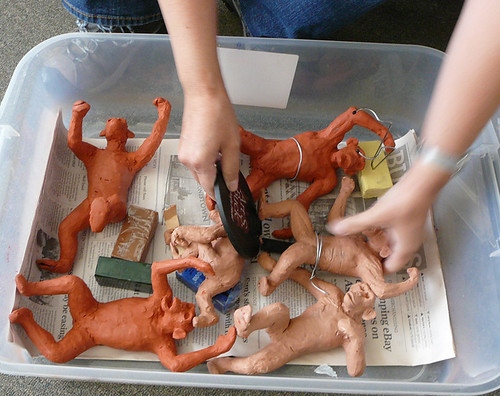
Sandra works out her ideas in sketchbooks before going to paint. She often uses 3D models to work out position, viewpoint, and lighting. Besides the occasional live model, Sandy has several skeletons (human and other) and she makes clay models when necessary. She showed us a box full of clay chimps that she was using to choreograph a fight scene.
These classic methods seem commonplace and hardly worth mentioning to most painters, but I think many art visitors/ viewers are completely unaware of the long road to the canvas. Another good reason to visit Open Studios (and ask questions) this month.Sandra Yagi's building is holding an Open Studio event this weekend, starting Friday evening, October 23, 6-9 pm.
Saturday and Sunday, October 24-25, 11 a.m. to 6 pm. South Beach Artists Studios at 340 Bryant Street, near 2nd Street
Sandra Yagi is on the 3rd floor, suite 320, Studio 10.
Another interview with Sandra Yagi: NeverStopSeeing.com
Her blog: Beyond the Comfort Zone
Click on any image for more (and larger) photos of Sandra Yagi in her studio!
Labels:
artists,
Open Studios 2009,
painting,
Sandra Yagi
Tuesday, October 20, 2009
Eric Gill at USF

Drawn from USF’s Albert Sperisen Collection, the over 100 works in “Eric Gill Iconographer” primarily represent wood engravings completed between 1910 to 1940. These were commonly completed on boxwood using carving tools and were printed in limited editions using letterpress technology. Original engraving blocks and publications are also on display.
Eric Gill was one of the most colorful and eccentric figures in early 20th century art. Sculptor, typographer, and writer, it was his superb line and strong graphic sense that have made his work so sought after.
"Letters are things, not pictures of things."
"Lettering is a precise art and strictly subject to tradition. The New Art notion that you can make letters whatever shapes you like, is as foolish as the notion, if anyone has such a notion, that you can make houses any shapes you like. You can't, unless you live all by yourself on a desert island".
"Yet, as years go by, Eric Gill becomes more, not less, unsettling. His out of control sexuality, his flouting of societal norms regarding incest taboos make huge demands on those who admire his art. From today's perspective his work looks even better: his sculpture truly radical; his woodcuts and engravings instantly engaging, with an often astonishing ebullience of line; his lettering clear, confident and hugely influential on the development of modern type design. The world has now caught up with many of Gill's wider views: his fury at the "art nonsense" perpetrated by the fashionable London dealers; his hatred of bad workmanship and luxury and waste. His powerful religious sculptures have a wonderful contemporary resonance."
But the more we understand of the prevalence of child abuse, the more reprehensible Gill's personal morality becomes. Just what do we do with Eric Gill? Should we, CAN WE, just appreciate at his superb work without ethical or moral judgments? Separating the work of an artist from his or her life can sometimes be a conundrum; it's all the more difficult with Eric Gill.
November 5-December 20, 2009
Donohue Rare Book Room, 3rd Floor Gleeson Library
October 11-December 20, 2009
Thacher Gallery at USF
http://www.usfca.edu/library/thacher/
Monday, October 19, 2009
Stay Human!
. . . in the immortal words of Michael Franti.
Art and wine do seem a natural pairing. Both are invitations to have some kind of genuinely human experience. Unfortunately, the experience is not always pleasant.
This past weekend, I went to yet another one of these ubiquitous art and wine festivals. Why do I do it, I don’t know, chalk it up to some kind of morbid curiosity, the kind that compels you to inhale deeply when there is some awful smell in the air.
This particular festival was awash in bronze sculptures of alien-like beings hugging, brightly-colored bits of glass, some lovely underwater photography, and these paintings—well! As I told my daughters, anyone can splash a big red heart on a canvas and scrawl “forgive” next to it, where is the mastery, where is the imagination, the creativity, in that? That’s art therapy, which definitely has its rightful place in the world. Just not there.
What else art and wine have in common, besides sharing a number of festivals, is that both may and can be and often are used as status leverage, in which the experience itself is far less important than the recounting of the experience, a recounting that preferably takes place in front of a large (captive) audience and invariably includes the slinging of a lot of nonsense jargon, and in fact, it does seem that a lot of people do not ever really have an experience with art and wine. They like to say they do, and they swirl their glasses and spout off about bouquet (often inaccurately, because “bouquet” should be reserved for wines that have attained maturity, while “aroma” is the term for bright young things), or they stand in front of a painting at a museum and get that look of profound absorption that puts one in mind of a German shepherd that’s momentarily mistaken a plastic bag fluttering down the street for a rabbit, but to these, things like art and wine are merely accessories that symbolize money or taste or social standing, which inevitably means that things like art and wine are then viewed with resentful suspicion by the other side, those who pride themselves on being down-to-earth, who like to point at works like the chocolate Jesus and rail about the emperor having no clothes, and it is no coincidence that these are the same people who will say that the only difference between a glass of two-buck chuck and a glass of Pétrus is the price.
Why was I thinking about this. Well, I’ll tell you. I fell in love with Rollo May after reading a quote from The Courage to Create in which he talked about something along the lines of what if imagination and creativity were not viewed as simply “frosting” in the human experience, but as essential components. So then I read Love and Will and The Courage to Create, which got me to thinking about genuine experience, and about different kinds of courage May describes, the courage to look oneself in the mirror, the courage to allow life to happen in all its scary guises (because it do have a way of sneaking up on you with a loud Boo! that can be quite unnerving), the courage to have relationships and experiences, and to let oneself not only have an effect on others but be affected and transformed by others as well. I don’t think we are in the habit of looking at tiny things, such as the willingness to be open to one’s actual experience (actual experience, not the experience we think we should have) with art, with wine, with nature, with a friend, as evidence of courage. Maybe we all think that bravery means rescuing a kitten from a burning building. Even bungee jumping may seem more courageous than opening one’s heart to one’s friend.
But that is only kind of courage, physical courage. There are lots of other kinds. Intellectual courage. Moral courage (by which I certainly don’t mean holding up pro-life posters of fetuses in front of the Walgreen’s on Wigwam and Green Valley Parkway). While it don’t take much in the way of courage to enjoy a glass of 2005 Magnificat, I will argue that it does take courage to be willing to have genuine experiences, whether it be with wine or art or nature or in fellowship with other humans. Why? Maybe partly because having a genuine experience takes us into that world of emotion and our subconscious and dreams and memories. And fears.
It brings us closer to self-knowledge, and that is indeed the age-old question, according to May, the question faced by Oedipus, the question of how much self-awareness can a human bear? A genuine experience—of friendship, of love, of transcendence, of joy, of grief—breaks through whatever walls we’ve constructed to protect our little castle of the self, and who knows what might happen then. What might escape from the dungeons. What realizations we might come to. We might even have to, in the immortal words of Rilke, change our life.
Art and wine do seem a natural pairing. Both are invitations to have some kind of genuinely human experience. Unfortunately, the experience is not always pleasant.
This past weekend, I went to yet another one of these ubiquitous art and wine festivals. Why do I do it, I don’t know, chalk it up to some kind of morbid curiosity, the kind that compels you to inhale deeply when there is some awful smell in the air.
This particular festival was awash in bronze sculptures of alien-like beings hugging, brightly-colored bits of glass, some lovely underwater photography, and these paintings—well! As I told my daughters, anyone can splash a big red heart on a canvas and scrawl “forgive” next to it, where is the mastery, where is the imagination, the creativity, in that? That’s art therapy, which definitely has its rightful place in the world. Just not there.
What else art and wine have in common, besides sharing a number of festivals, is that both may and can be and often are used as status leverage, in which the experience itself is far less important than the recounting of the experience, a recounting that preferably takes place in front of a large (captive) audience and invariably includes the slinging of a lot of nonsense jargon, and in fact, it does seem that a lot of people do not ever really have an experience with art and wine. They like to say they do, and they swirl their glasses and spout off about bouquet (often inaccurately, because “bouquet” should be reserved for wines that have attained maturity, while “aroma” is the term for bright young things), or they stand in front of a painting at a museum and get that look of profound absorption that puts one in mind of a German shepherd that’s momentarily mistaken a plastic bag fluttering down the street for a rabbit, but to these, things like art and wine are merely accessories that symbolize money or taste or social standing, which inevitably means that things like art and wine are then viewed with resentful suspicion by the other side, those who pride themselves on being down-to-earth, who like to point at works like the chocolate Jesus and rail about the emperor having no clothes, and it is no coincidence that these are the same people who will say that the only difference between a glass of two-buck chuck and a glass of Pétrus is the price.
Why was I thinking about this. Well, I’ll tell you. I fell in love with Rollo May after reading a quote from The Courage to Create in which he talked about something along the lines of what if imagination and creativity were not viewed as simply “frosting” in the human experience, but as essential components. So then I read Love and Will and The Courage to Create, which got me to thinking about genuine experience, and about different kinds of courage May describes, the courage to look oneself in the mirror, the courage to allow life to happen in all its scary guises (because it do have a way of sneaking up on you with a loud Boo! that can be quite unnerving), the courage to have relationships and experiences, and to let oneself not only have an effect on others but be affected and transformed by others as well. I don’t think we are in the habit of looking at tiny things, such as the willingness to be open to one’s actual experience (actual experience, not the experience we think we should have) with art, with wine, with nature, with a friend, as evidence of courage. Maybe we all think that bravery means rescuing a kitten from a burning building. Even bungee jumping may seem more courageous than opening one’s heart to one’s friend.
But that is only kind of courage, physical courage. There are lots of other kinds. Intellectual courage. Moral courage (by which I certainly don’t mean holding up pro-life posters of fetuses in front of the Walgreen’s on Wigwam and Green Valley Parkway). While it don’t take much in the way of courage to enjoy a glass of 2005 Magnificat, I will argue that it does take courage to be willing to have genuine experiences, whether it be with wine or art or nature or in fellowship with other humans. Why? Maybe partly because having a genuine experience takes us into that world of emotion and our subconscious and dreams and memories. And fears.
It brings us closer to self-knowledge, and that is indeed the age-old question, according to May, the question faced by Oedipus, the question of how much self-awareness can a human bear? A genuine experience—of friendship, of love, of transcendence, of joy, of grief—breaks through whatever walls we’ve constructed to protect our little castle of the self, and who knows what might happen then. What might escape from the dungeons. What realizations we might come to. We might even have to, in the immortal words of Rilke, change our life.
Friday, October 16, 2009
Live and in Color : Caroline Allen
In our dining room is a painting by California painter Caroline Allen. It is a large landscape, of green hills and lush foliage and blue sky with white clouds. But the greens aren't just greens--they're bright and brilliant, and the browns are rich, and the whites are tinged with lavender, and there is this lovely sense of the painter as one who sees the world in this particular way, a way of seeing that encompasses light and energy and movement and color with a vivacious and feminine sensibility. This painting makes my life better every day.
I first knew Caroline Allen as a writer of fiction (wonderful fiction, with vivid characters described with wit and thoughtfulness) at the College of Creative Studies at UC Santa Barbara, where she continues to teach. What I didn't know at the time was that Ms. Allen had been an art major at Art Center in Pasadena before enrolling in Creative Studies as a lit major. She continued writing and studying literature (and then teaching) and painting, but the painting became almost a compulsion when her mother died, though her writing was temporarily interrupted. Ms. Allen had wanted to write about her mother even before her death, but then when her mother died, she lost the ability to think in words for a time--but she was able to paint. And painting was such a pleasure, and it wasn't really about mourning, it was a joy, and some of the joy seemed to be the understanding that she really was a painter, that painting wasn't just something she did, it was part of who she was.
And so she painted pictures of her mother, who was and still is mysterious to her, painting from old photographs, and then Ms. Allen would alter the images in some way. There was one, a black and white photo that had been taken in daylight, of her mother standing in front of a large bush, holding her as a baby, that Ms. Allen painted as a kind of ghost image or dream, of this mysterious woman wearing a scarf around her hair, and holding a baby in front of a dark bush under a purple sky.
Ms. Allen and her husband (photographer Bob DeBris) were then living in an artists' community in Santa Barbara, where it seemed natural to paint. For 7 years, she painted every free day. After taking a class with Michael Drury, it felt natural to do landscape painting; it felt natural to go outside and paint what she saw. Not only natural, but--again--a pleasure. Which takes us back to the paintings--in the immortal words of Aristotle, "Pleasure in the job puts perfection in the work." (Or, as Rollo May says, "Joy, rather than happiness, is the goal of life, for joy is the emotion which accompanies our fulfilling our natures as human beings.")
Here is "Late Summer at Cañada Larga":

When Ms. Allen was painting these landscapes, she would paint with her friend, Todd Anderson, and she felt that landscape painting was this kind of macho venture, to pack up her painting kit and dress in old, paint-splattered clothes and brave the heat and the wind and the cold, standing up for hours out on country roads. And yet, though there were these seemingly masculine elements to the process, the paintings have a distinct feminine quality.
Caroline Allen's landscapes and urbanscapes are immediately recognizable as pure California in spirit and scene--the gold hills in central California, the bungalows and palm trees of a beach town. There's a naturalness to them, without the strict adherence to a certain view that sometimes flattens some of the life out of realistic painting. In Ms. Allen's paintings, you never think you are looking at a photograph, nor do you wonder where the artist is. The view is clearly and beautifully shaped through the lens of another's mind and imagination, and then crafted to add feeling and movement.
But even though the artist always has an unmistakable presence, that presence shifts its shape and intensity with the focus and subject of the work. Part of what interests me about Ms. Allen's work is that over the years, I've seen her landscapes, traditional still lifes, arranged still lifes, portraits of chihuahuas, portraits of people, more landscapes, and urbanscapes, and so I've seen this personality emerge more in some work and less in other work, or maybe it is more accurate to say that different pieces allow (and emphasize) different facets. The portraits of people are lovely, and have so much feeling, so much emotion, and yet still have all that beautiful color. The newer landscapes are evidence of exploring technique, of working on being "tight but loose"--allowing more looseness in the painting, letting paint drip, not drawing ahead of time, in order to be more aware of the medium, with strokes that are more gestural for a greater sense of movement and for the sensual presence of paint.
I asked Ms. Allen a question I usually do ask artists (because the answer is always interesting to me), about whether she sees the world differently from other people, and she said that she's not aware of it, but maybe her painting mind does. She does think that she finds beauty in things that others don't, and she does like gloomy subjects--even though her attempts at painting or writing about gloomy topics never come off as she intended, her subjects always do manage to find their way to the light.
Here is one of my favorites of the arranged still lifes, "Who Were These People?":

If you find yourself in that part of the world--if you've been to Ventura County, you know it is worth the trip, and if you haven't, you might put it on your list, and there are lots of wineries on the way, so you can create your own art and wine festival without subjecting yourself to ceramic frogs or clown paintings--you can see Ms. Allen's work in Ojai Celebrates Art II at the Ojai Valley Museum's annual juried art exhibit October 17-November 22, 2009.
To make an appointment to see Caroline Allen's paintings, please contact the artist at mscallen@west.net.
I first knew Caroline Allen as a writer of fiction (wonderful fiction, with vivid characters described with wit and thoughtfulness) at the College of Creative Studies at UC Santa Barbara, where she continues to teach. What I didn't know at the time was that Ms. Allen had been an art major at Art Center in Pasadena before enrolling in Creative Studies as a lit major. She continued writing and studying literature (and then teaching) and painting, but the painting became almost a compulsion when her mother died, though her writing was temporarily interrupted. Ms. Allen had wanted to write about her mother even before her death, but then when her mother died, she lost the ability to think in words for a time--but she was able to paint. And painting was such a pleasure, and it wasn't really about mourning, it was a joy, and some of the joy seemed to be the understanding that she really was a painter, that painting wasn't just something she did, it was part of who she was.
And so she painted pictures of her mother, who was and still is mysterious to her, painting from old photographs, and then Ms. Allen would alter the images in some way. There was one, a black and white photo that had been taken in daylight, of her mother standing in front of a large bush, holding her as a baby, that Ms. Allen painted as a kind of ghost image or dream, of this mysterious woman wearing a scarf around her hair, and holding a baby in front of a dark bush under a purple sky.
Ms. Allen and her husband (photographer Bob DeBris) were then living in an artists' community in Santa Barbara, where it seemed natural to paint. For 7 years, she painted every free day. After taking a class with Michael Drury, it felt natural to do landscape painting; it felt natural to go outside and paint what she saw. Not only natural, but--again--a pleasure. Which takes us back to the paintings--in the immortal words of Aristotle, "Pleasure in the job puts perfection in the work." (Or, as Rollo May says, "Joy, rather than happiness, is the goal of life, for joy is the emotion which accompanies our fulfilling our natures as human beings.")
Here is "Late Summer at Cañada Larga":

When Ms. Allen was painting these landscapes, she would paint with her friend, Todd Anderson, and she felt that landscape painting was this kind of macho venture, to pack up her painting kit and dress in old, paint-splattered clothes and brave the heat and the wind and the cold, standing up for hours out on country roads. And yet, though there were these seemingly masculine elements to the process, the paintings have a distinct feminine quality.
Caroline Allen's landscapes and urbanscapes are immediately recognizable as pure California in spirit and scene--the gold hills in central California, the bungalows and palm trees of a beach town. There's a naturalness to them, without the strict adherence to a certain view that sometimes flattens some of the life out of realistic painting. In Ms. Allen's paintings, you never think you are looking at a photograph, nor do you wonder where the artist is. The view is clearly and beautifully shaped through the lens of another's mind and imagination, and then crafted to add feeling and movement.
But even though the artist always has an unmistakable presence, that presence shifts its shape and intensity with the focus and subject of the work. Part of what interests me about Ms. Allen's work is that over the years, I've seen her landscapes, traditional still lifes, arranged still lifes, portraits of chihuahuas, portraits of people, more landscapes, and urbanscapes, and so I've seen this personality emerge more in some work and less in other work, or maybe it is more accurate to say that different pieces allow (and emphasize) different facets. The portraits of people are lovely, and have so much feeling, so much emotion, and yet still have all that beautiful color. The newer landscapes are evidence of exploring technique, of working on being "tight but loose"--allowing more looseness in the painting, letting paint drip, not drawing ahead of time, in order to be more aware of the medium, with strokes that are more gestural for a greater sense of movement and for the sensual presence of paint.
I asked Ms. Allen a question I usually do ask artists (because the answer is always interesting to me), about whether she sees the world differently from other people, and she said that she's not aware of it, but maybe her painting mind does. She does think that she finds beauty in things that others don't, and she does like gloomy subjects--even though her attempts at painting or writing about gloomy topics never come off as she intended, her subjects always do manage to find their way to the light.
Here is one of my favorites of the arranged still lifes, "Who Were These People?":

If you find yourself in that part of the world--if you've been to Ventura County, you know it is worth the trip, and if you haven't, you might put it on your list, and there are lots of wineries on the way, so you can create your own art and wine festival without subjecting yourself to ceramic frogs or clown paintings--you can see Ms. Allen's work in Ojai Celebrates Art II at the Ojai Valley Museum's annual juried art exhibit October 17-November 22, 2009.
To make an appointment to see Caroline Allen's paintings, please contact the artist at mscallen@west.net.
Thursday, October 15, 2009
SF Open Studios 2009: Project Artaud Wrap-up
I'm running out of time for posting this week, so I'm going to make these really quick. Luckily, they're all from Project Artaud, which held Open Studios last week . . .
Carrie Nardello paints funny, piquant, dazzling images of (mostly) animals doing outrageous things. My favorite is one of her recurring characters, Bubba the dog. I noticed a carefully crafted series of dress paintings and asked her if it was a new direction. she said, no, it was an additional, more personal series that she was developing over time. She talked about her inner conflict between her expressive, emotional work and her more detailed, "illustrative" work - it's hard for her to choose which way to go . . . I said "why choose?" - I thought she should just keep doing them both.
Carrie Nardello
Project Artaud
499 Alabama, #215, San Francisco
Dale Erickson is really settling into a new surge of creativity. A recent trip to Italy seems to have given him a boost. He is producing an incredible number of awesome environmental portraits, some friends & family, some strangers.
E. Dale Erickson
Project Artaud
499 Alabama, #309, San Francisco
Bernie Rauch in his studio. Yes, he was playing guitar, talking to us, AND watching a football game on TV.
One of his paintings is behind him - they are so incredibly complex, multi-layered, and multi-dimensional that it's been (so far at least) impossible to photograph accurately. You really have to see them in person. But Give a try HERE.
Bern Rauch
Project Artaud, #302
499 Alabama Street, SF
Javier Manrique, talking to Anna Conti in his studio at Project Artaud. Javier is fluent in many aspects of art making, including painting, encaustics, fresco, printmaking, sculpture and installations. He also has a fabulous collection of old cameras (on the shelves behind him.) You should see his bronze castings of camera and other photo equipment!
Javier Manrique
Project Artaud
499 Alabama Street, #216, San Francisco
Carrie Nardello paints funny, piquant, dazzling images of (mostly) animals doing outrageous things. My favorite is one of her recurring characters, Bubba the dog. I noticed a carefully crafted series of dress paintings and asked her if it was a new direction. she said, no, it was an additional, more personal series that she was developing over time. She talked about her inner conflict between her expressive, emotional work and her more detailed, "illustrative" work - it's hard for her to choose which way to go . . . I said "why choose?" - I thought she should just keep doing them both.
Carrie Nardello
Project Artaud
499 Alabama, #215, San Francisco
Dale Erickson is really settling into a new surge of creativity. A recent trip to Italy seems to have given him a boost. He is producing an incredible number of awesome environmental portraits, some friends & family, some strangers.
E. Dale Erickson
Project Artaud
499 Alabama, #309, San Francisco
Bernie Rauch in his studio. Yes, he was playing guitar, talking to us, AND watching a football game on TV.
One of his paintings is behind him - they are so incredibly complex, multi-layered, and multi-dimensional that it's been (so far at least) impossible to photograph accurately. You really have to see them in person. But Give a try HERE.
Bern Rauch
Project Artaud, #302
499 Alabama Street, SF
Javier Manrique, talking to Anna Conti in his studio at Project Artaud. Javier is fluent in many aspects of art making, including painting, encaustics, fresco, printmaking, sculpture and installations. He also has a fabulous collection of old cameras (on the shelves behind him.) You should see his bronze castings of camera and other photo equipment!
Javier Manrique
Project Artaud
499 Alabama Street, #216, San Francisco
Wednesday, October 14, 2009
SF Open Studios Report: Jennifer Ewing
photo © Marianna Whang, 2009 All rights ReservedJennifer Ewing has been working on her "Spirit Boats" series for a few years now, but she keeps finding new ways to explore the topic. Ewing started the Spirit Boats series of paintings in January 2005, after her father passed away. Creating the paintings made her feel closer to her father, and helped her grieve over losing him. She has said, "The paintings give the viewer pause for reflection and an invitation to a journey filled with radiant light. These boats are ready to take passengers. I believe we all need our very own spirit boat to move us into the light."
This year, one wall of her studio was lined with her luminous boat paintings, and on the opposite side of the studio boat sculptures floated in the air, suspended from the ceiling with translucent lines. The boats were made with many materials, including curly white feathers which added to the illusion of flight. She gets the feathers from a friend who raises the special breed of duck. The feathers are shed/gathered naturally with no harm to the ducks.photo at right © Marianna Whang, 2009 All rights Reserved
Jennifer Ewing
Developing Environments
540 Alabama Street, at Mariposa
http://www.ewinggermano.com/
Tuesday, October 13, 2009
SF Open Studios Report: John Sullivan at Logos Graphics
John Sullivan of Logos Graphics, with the printed, embossed, die-cut, but unfolded Vandercook letterpress model. (photo © Marianna Whang, 2009 All rights Reserved)
Anna Conti and John Sullivan of Logos Graphics, with the folded Vandercook letterpress model. (photo © Marianna Whang, 2009 All rights Reserved)John Sullivan has worked with San Francisco artists and non-profits for 35 years, helping them with etching, litho, offset, letterpress and silkscreen printing, as well as book-binding. During this open studios event, he was happy to give tours of the place and answer any questions about equipment or process.
He was especially proud (and rightly so) of the printed, folded paper models of a Vandercook letterpress. These little models were 3-color offset printed, then scored and embossed on a letterpress, then die-cut, before folding. more about it HERE.
He sent some sheets through his Heidelburg Windmill Letterpress while we peppered him with questions and before we left he handed us flyers for an upcoming silk-screen class.
John Sullivan
Logos Graphics
499 Alabama, #126, San Francisco
http://www.logosgraphics.net/
SF Open Studios Report: Victor Cartagena
Project Artaud member artist Victor Cartagena is well known in Bay Area art circles and beyond. He has been living and working in the Bay Area since the 1980s. His large paintings and drawings are mostly focused on the figure (an everyman) with a classic palette of black, white and reds. The content of his work references geopolitical issues but it's really about the human condition.

Many of his canvases are enormous and, while his studio is a fairly big one, it looked more like a gallery than a working space. I asked him where he worked and he said "right here." He spreads the largest canvases out on the floor and uses bridges to work on them.
His current project is theater sets and installations and he also conducts workshops.
(photo at right © Marianna Whang, 2009 All rights Reserved)
Victor Cartagena
Project Artaud,
499 Alabama #101, San Francisco
Monday, October 12, 2009
SF Open Studios Report: Shawn Ray Harris
My favorite new find this year: Shawn Ray Harris. I saw him in his studio at Developing Environments (540 Alabama Street #220, San Francisco). He describes his work as "photography and such." But that's a faint description of his powerful, fascinating, unique work.
His work is photo-based but frankly it didn't occur to me until much later that photography was the common denominator in all his pieces. He uses witty manifestations of archetypal imagery in huge constructions that he calls "sculptography." They're made up of large format hand-toned BW prints mounted on wooden panels with multiple cutouts and embedded objects, including neon, vending machines, retail racks, and other fascinating ephemera."Seed Seller" is a life-sized image of a sports stadium food vendor wearing a hat labeled "Preexistence." The vendor is peddling seed packets which are displayed in a metal rack mounted to the panel with leather straps. The seed packets each have an image and description of a particular kind of human incarnation. The prices for these incarnations vary widely.
(Image at right from the artist's web site, ©Shawn Ray Harris 2008, all rights reserved)
3D photography is his current passion and there's plenty of it there, but he goes farther with it than anyone I've seen. He's selling unframed limited edition prints of 3D photo-based line drawings, packaged with the 3D glasses. Many of the images are classic San Francisco scenes, but some are dreamlike images. He calls them "anaglyphs." (Image at left © Marianna Whang, 2009 All rights Reserved)He's a big guy, but very shy, and relatively new in town. He says he's looking for spaces to do some woodworking and welding.
Shawn Ray Harris
Developing Environments
540 Alabama Street #220, San Francisco
Sunday, October 11, 2009
Open Studios Report: Kirstine Reiner

from guest blogger, T. Newson
I stopped by the new studio of my friend Kirstine (KerSTEEna) Reiner, during the ArtSpan sponsored San Francisco Open Studios. Her studio is now in Workspace Ltd., a revamped industrial space located at 2150 Folsom Street in the Mission District of San Francisco. The light is good and the space much more condusive to painting than her recent studio spaces in Dogpatch, where an unidentifiable miasma of environmental toxins made her feel sick all the time, or her first studio space in the Workspace building itself, which was also the access route for another artist into his studio.
Reiner has also recently found a new apartment in a nearby neighborhood (one of my absolute favorites), with a sunnier microclimate than her previous one.The photos here don't do justice to Reiner's paintings. (Click on photo to see larger image.) She is one of the best I have ever seen for technique (including what I've seen in the Louvre), and within the deceptively simple images there resides both a vibrant tension and an expansive, often sublime tranquility.

See more of her work at:
http://reiner-art.blogspot.com
(photos by T. Newson)
Labels:
"Kirstine Reiner",
artists,
Open Studios 2009,
painting
Wednesday, October 7, 2009
Open studios, 2009 - Farewell to Belcher St. Studios
When I picked up the Art Span catalogue, I went looking for the listings for Belcher Street, one of my favorite places to visit, only to find that the building has been sold and the artists booted out. Here's a loud boo to the "new owners" who evicted a thriving art colony and a hope that they find new spaces and appreciative customers. It's a sad sign of the times that so many art spaces in this neighborhood have closed in the last year - Hayes' Valley Reeves Gallery and Bucheon to name two. They are still doing business on line but it's not the same as having a physical space. I know that all across the country, artists and art spaces and places have been hit hard. We seem to be the first to feel the pain and the last to receive even a penny when the economy recovers. I chant my mantra, Ars Longa, Vita Brevis, and hope for better times. In the meantime, get out there and support your local artists. These artists are all in new spaces and the Art Span website has listings for dozens more artists who are showing this first weekend in October: www.artspan.org
Adams 100: adams100.com
Julie Alland: flickr.com/photos/julieallard
Peikwen Cheng: peikwen.com
Paul Ferney: paulferney.com
Tracy Taylor Grubbs: http://www.tracygrubbs.com/Tracy_Taylor_Grubbs/Home.html
Michael Mullin: MichaelMullin.com
Hadley Northrop: hadeynorthrop.blogspot.com
Paul O'Valle: paulovalle.com
William Salit: williamsalit.com
Rebecca Szeto: rebeccaszeto.com
Chris Wiedman: madefreshdaily.com
Tracy Grubbs: Landscape
Carlo Abruzzese: abruzzese.netAdams 100: adams100.com
Julie Alland: flickr.com/photos/julieallard
Peikwen Cheng: peikwen.com
Paul Ferney: paulferney.com
Tracy Taylor Grubbs: http://www.tracygrubbs.com/Tracy_Taylor_Grubbs/Home.html
Michael Mullin: MichaelMullin.com
Hadley Northrop: hadeynorthrop.blogspot.com
Paul O'Valle: paulovalle.com
William Salit: williamsalit.com
Rebecca Szeto: rebeccaszeto.com
Chris Wiedman: madefreshdaily.com
Monday, October 5, 2009
Saturday, October 3, 2009
Remembering the Collectors
Collectors Share a Special Bond with Artists
At this time of the year, when San Francisco artists prepare for Open Studios, it is good to remember the bond they share with collectors.
When you purchase a piece of art, clothing, jewelry, or recording from an artist, you are taking a piece of that experience home to live with you. Every time you wear, or listen, or walk by the art, memories of the time and place and shared spirits return.
When you buy a recording from an artist at a club you remember who you were with, what you wore, how much you danced, and how happy you were, each time you play the music. You relive the night over and again and again. That is why people who do not buy music at a store buy CDs from a band at a club. It is not about the music or the band. It is the night that they want to capture.
Artists set the stage with flowers, food, wine and music, and invite the public to participate as guests. These informal gatherings encourage social interaction, unlike the hushed formal atmosphere in most galleries and museums. Art events are special places, where people go to meet and mingle, to engage in conversations and share ideas.
People who need to look for a primarily red painting that goes perfectly with the red and green striped couch that sits in a beige room on a deep burgundy carpet, carry out those tasks elsewhere.
Informal encounters and memories of the good times are reflected in art that hangs on the wall, around the neck, or plays on the stereo. Living with their art keeps collectors in touch with the creative spirits.
M Eliza
At this time of the year, when San Francisco artists prepare for Open Studios, it is good to remember the bond they share with collectors.
When you purchase a piece of art, clothing, jewelry, or recording from an artist, you are taking a piece of that experience home to live with you. Every time you wear, or listen, or walk by the art, memories of the time and place and shared spirits return.
When you buy a recording from an artist at a club you remember who you were with, what you wore, how much you danced, and how happy you were, each time you play the music. You relive the night over and again and again. That is why people who do not buy music at a store buy CDs from a band at a club. It is not about the music or the band. It is the night that they want to capture.
Artists set the stage with flowers, food, wine and music, and invite the public to participate as guests. These informal gatherings encourage social interaction, unlike the hushed formal atmosphere in most galleries and museums. Art events are special places, where people go to meet and mingle, to engage in conversations and share ideas.
People who need to look for a primarily red painting that goes perfectly with the red and green striped couch that sits in a beige room on a deep burgundy carpet, carry out those tasks elsewhere.
Informal encounters and memories of the good times are reflected in art that hangs on the wall, around the neck, or plays on the stereo. Living with their art keeps collectors in touch with the creative spirits.
M Eliza
Thursday, October 1, 2009
Julie tangos into the SF Chronicle
My friend Julie, who writes the delightful blog “TangoBaby” has an interview in the SF Chronicle! It's is about her photography and bloggling project, “I live here: SF." She's delightful as well as talented and I hope that this bit of PR will bring her more well-deserved acclaim (and business).
"It really is all about (the subject)," Michelle says. "They write their story, they edit their photo set, they pick their location. ... That's all a part of their story."
http://tangobaby2.blogspot.com/
Read more: http://www.sfgate.com/cgi-bin/article.cgi?f=/c/a/2009/10/01/DDCP19OTUO.DTL#ixzz0ShmjT0N2
Image from her websiteRead more: http://www.sfgate.com/cgi-bin/article.cgi?f=/c/a/2009/10/01/DDCP19OTUO.DTL#ixzz0ShmjT0N2
Subscribe to:
Posts (Atom)